

PLETHORA-autophagy fine tunes ROS to enable de novo root regeneration
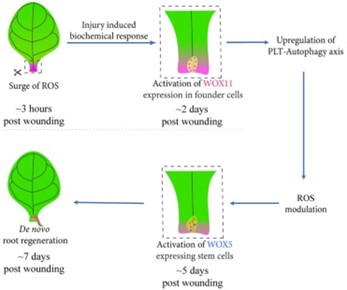 Autophagy (or “self-eating”) is a conserved quality-check pathway that degrades and recycles damaged components of the cell to restore cellular homeostasis. In plants, autophagy has been studied during wound responses, but it is less clear how it particpates in de novo organ regeneration. In a recent study, Ganguly et al. studied the role of autophagy in root regeneration from excised leaves. They found that ATG8 (a core autophagy protein) is upregulated during this process of root regeneration and that it is transcriptionally upregulated by the PLETHORA7 (PLT7) transcription factor. To establish a link between autophagy and reactive oxygen species (ROS), the earliest hallmark of cellular stress, the authors detected ROS levels using the fluorescent probe 2′,7′-dichlorofluorescein diacetate (H2DCFDA) in wild type and mutants of PLT and ATG8. Strikingly, the findings demonstrated that the PLT-ATG8 axis mediates spatiotemporal suppression of ROS, thereby restoring redox balance at the site of the wound. Proper ROS positioning is crucial for promoting expression of stem-cell regulators such as WOX5, which is essential for founder cell specification during root regeneration. Overall, the authors established a central mechanism of the PLETHORA (PLT)–autophagy (ATG8)–ROS axis that activates de novo root regeneration in excised leaves. (Summary by Priyanka Babuta) PNAS 10.1073/pnas. 2513954123

