
Sensing the neighbors: Phytochrome A fine-tunes plant adaptation to light
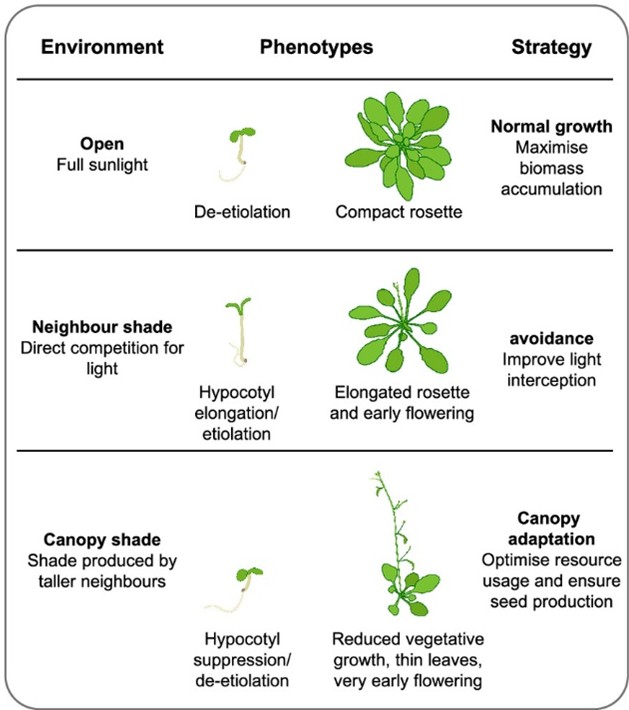
Plants constantly compete for light, and the threat of shading by neighbors has been a powerful driving force for the adaptive plasticity during evolution. Changes in both light quantity and quality, most notably a reduced ratio of red to far-red wavelengths (low R:FR), serve as early warning signals of shading and are perceived by the phytochrome family of photoreceptors. While Phytochrome B (phyB) classically promotes the shade avoidance syndrome (SAS), stimulating upward and outward growth, such responses can become maladaptive under deep or persistent shade. In contrast, Phytochrome A (phyA) counteracts SAS, favoring tolerance and survival. To explore the role of phyA under milder, more realistic canopy conditions, Prizeman-Green and colleagues developed a phyA-nLUC reporter line. This system revealed diel oscillations in phyA abundance, with accumulation at night and rapid degradation upon light exposure. Using hypocotyl elongation as a functional readout across varying R:FR ratios, the authors uncovered a strong correlation between phyA expression and growth responses, establishing phyA as a sensitive detector of canopy shade. Beyond morphology, phyA mutants exhibited reduced shade-induced early flowering, whereas phyB mutants flowered constitutively early, and both mutants accumulated less dry biomass. Together, these findings highlight phytochromes as central integrators of growth, development, and resource allocation, offering new perspectives on how plants fine-tune survival strategies in increasingly crowded and dynamic light environments. (Summary by Ching Chan@ntnuchanlab @ntnuchanlab.bsky.social) PNAS 10.1073/pnas.2512201123