


How a kernel of corn may yield answers into some cancers (by Kevin Folta)
Blog, Research, Research Blog0 Comments
/
This article was originally published on The Conversation. Read the original article.
By Kevin M. Folta, University of Florida
Driving down a country highway in the Midwest can seem an endless ribbon flanked by green walls of corn, neatly planted in stately rows. But who would guess…
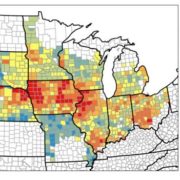
The contribution of solar brightening to the US maize yield trend ($)
Plant Science Research Weekly, ResearchOver the past several decades, the amount of maize produced in the US Midwestern “Corn Belt” has been rising steadily. In order to accurately predict future grain yields, the factors that contribute to these recent yield increases must be identified. Tollenaar et al. found that more than a quarter…
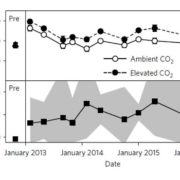
Elevated CO2 does not increase eucalypt forest productivity on low-phosphorus soil ($)
Plant Science Research Weekly, ResearchThe “Law of the Minimum” put forth by Justus von Liebig states that the most limiting nutrient governs plant growth. Although there is evidence in some conditions that increasing atmospheric CO2 levels can enhance plant growth, this only holds true under conditions in which CO2 is limiting growth.…
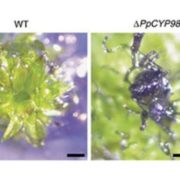
A phenol-enriched cuticle is ancestral to lignin evolution in land plants
Plant Science Research Weekly, ResearchMoss are non-vascular plants and do not produce the phenolic polymer lignin, but they do have some enzymes associated with the lignin pathway, raising the question of the evolutionary origins of lignin. In angiosperms, the cytochrome P450 enzyme encoded by CYP98 catalyzes the first irreversible step…
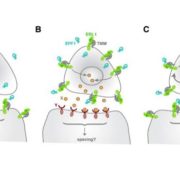
Autocrine regulation of stomatal differentiation potential by EPF1 and ERECTA-LIKE1 ligand-receptor signaling
Plant Science Research Weekly, ResearchThe patterning of stomata in epidermal tissues involves both positive and negative cues, as revealed by the phenotypes of mutants including too many mouths and speechless, but the precise interactions between identified gene products are still not fully resolved. Qi et al. explore the interactions between…
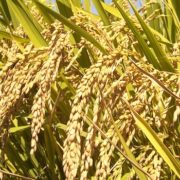
The rice paradox: Multiple origins but single domestication in Asian rice
Plant Science Research Weekly, ResearchRice is the world’s most important food crop and its domestication was a key event in human history. Centuries of propagation across large geographical areas have resulted in five domesticated subpopulations: aus, indica, temperate japonica, tropical japonica, and aromatic rice. Choi et al. analyzed…
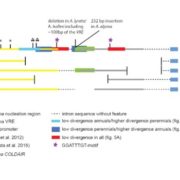
Divergence of annuality and perenniality in Brassicaceae and contribution of FLC variation ($)
Plant Science Research Weekly, ResearchFLOWERING LOCUS C (FLC) is a flowering repressor that is highly conserved in the Brassicaceae family. This family contains species that show an annual life history (plants that flower and senesce, giving one generation per year), as well as perennials (plants that flower several times in their life cycle…

Regulation of gravitropic set point angle
Plant Science Research Weekly, ResearchOne parameter that defines a plant’s architecture is the angle at which its branches and lateral roots lie with respect to gravity, known as the gravitropic set point angle (GSA). Like all aspects of plant architecture, GSA is a highly plastic trait that is sensitive to light and nutrient availability.…
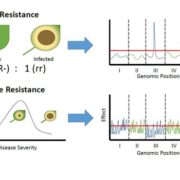
Review: Quantitative resistance: More than just perception of a pathogen
Plant Science Research Weekly, ResearchSome forms of pathogen resistance function like an on/off switch: if a plant has an appropriate receptor it recognizes a pathogen and shows resistance. Corwin and Kliebenstein review the other kind of resistance, quantitative resistance, in which many genes make small contributions to the plant’s resistance.…