

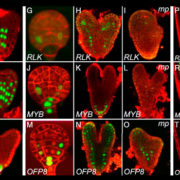
Cell-autonomously controlled ground tissue initiation by auxin in early Arabidopsis embryo ($)
Plant Science Research Weekly, Research0 Comments
/
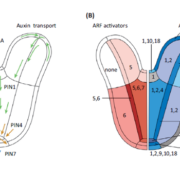
MONOPTEROS is an auxin-response factor (ARF) that is necessary for root formation during early embryogenesis. Its activity is modulated by BODENLOS (BDL), an Aux/IAA protein that is degraded in the presence of auxin. Möller et al. investigated the transcriptional targets of MP in very early embryos…
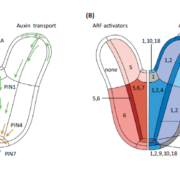
Review: The systems biology of auxin in developing embryos ($)
Plant Science Research Weekly, ResearchThe transcriptional response to auxin depends in large part on the interactions between ARF transcription factors and the Aux/IAA transcription inhibitors that interact with them. The crucial role of auxin in embryo patterning is revealed by the embryo patterning defects observed in mutants of ARF and…
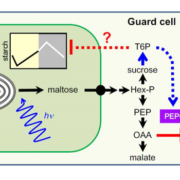
Update: Transitory starch metabolism in guard cells: unique features for a unique function
Plant Science Research Weekly, ResearchIn leaf mesophyll cells, some of the sugars produced by photosynthesis are stored as transitory starch, which is then broken down to provide the cells with energy during the night. Recent advances in imaging and staining and the use of mutants have enabled the pattern of accumulation of transitory starch…
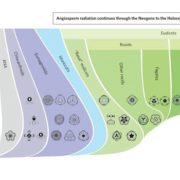
Review: Palaeobotanical redux: revisiting the age of the angiosperms
Plant Science Research Weekly, ResearchAlthough angiosperms are the dominant autotrophs in most parts of the world, their evolutionary origins remain somewhat mysterious. Herendeen et al. review the earliest evidence for angiosperms from the Early Cretaceous, and discuss fossil remains from earlier periods (Jurassic, Triassic) that have some…
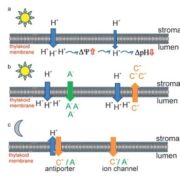
Review: Impact of the ion transportome of chloroplasts on the optimization of photosynthesis ($)
Plant Science Research Weekly, ResearchIn photosynthesis, light energy generates proton motive force (pmf) across the thylakoid membrane. The establishment and maintenance of pmf involves numerous membrane transporters as well as other ions. Szabò and Septea review how various ions (including K+, Na+, Fe2+, Cu+, Mn2+, Ca2+, Cl–) contribute…
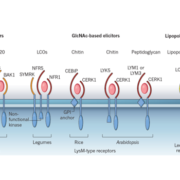
Reviews: Nature Insight: Plants ($)
Plant Science Research Weekly, ResearchNature journal published a special “Plant Insights” section featuring several excellent reviews. Zipfel and Oldroyd review Plant signalling in symbiosis and immunity (10.1038/nature22009), Bevan et al. write about Genomic innovation for crop improvement (10.1038/nature22011), Scheres and van der…
What We’re Reading: March 24
Blog, Research Blog
Have you seen an exciting new paper you’d like to summarize for the community? Contact Mary Williams to inquire about contributing to this series!
Reviews: Nature Insight: Plants ($)
Nature journal published a special “Plant Insights” section featuring several excellent reviews. Zipfel…
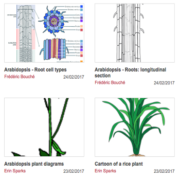
A community repository of plant illustrations
Blog, Research Blog, Writing/Reviewing/Publishing/CommunicatingGuest post by Erin Sparks, Guillaume Lobet, Larry York and Frédéric Bouché
It is midnight on a cold winter evening and you are scheduled to give a seminar at 8 am the next morning. All you are missing to complete your presentation is one last graphic to illustrate your conclusions. You wearily…

A Kinase- and Proteasome-Mediated Link Between Lipid Biosynthesis and Energy Homeostasis
Research, The Plant Cell: In BriefIN BRIEF by Nancy R. Hofmann [email protected]
The economy of living cells includes energy production, energy utilization, and energy storage. Thus, a plant’s energy budget must connect the decision to produce lipids (for energy storage) with its overall energy status. Energy sensor kinases, such…