

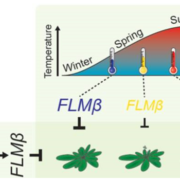
Natural haplotypes of FLM non-coding sequences fine-tune flowering time in two ambient spring temperatures in Arabidopsis
Plant Science Research Weekly, Research0 Comments
/
Delaying reproduction until conditions are favorable is a key to success. FLOWERING LOCUS C is a well-known regulator of flowering that delays flowering until after winter vernalization. In the spring, FLOWERING LOCUS M (FLM) fine-tunes flowering time in response to ambient temperatures between 5ºC…
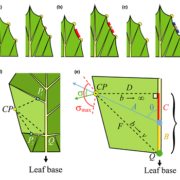
A common developmental program can produce diverse leaf shapes
Plant Science Research Weekly, ResearchThe plethora of diverse leaf shapes results from variations of shared molecular mechanisms that govern leaf growth and development. To better understand the molecular underpinnings of diverse leaf morphologies, Runions et al. constructed a computational model of leaf development that included multiple…
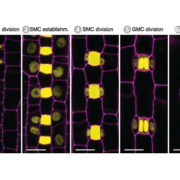
Mobile MUTE specifies subsidiary cells to build physiologically improved grass stomata ($)
Plant Science Research Weekly, ResearchPlants breathe through pores called stomata on leaf surfaces. Stomata are the point of contact with the outside world as they allow gas exchange (e.g., CO2 for photosynthesis) and transpiration. Grasses have evolved to form more efficient stomata in which the guard cells are flanked by additional subsidiary…

Root microbiota drive direct integration of phosphate stress and immunity
Plant Science Research Weekly, ResearchMany of the genes involved in the phosphate-stress response (PSR) have been identified from plants growing on sterile medium. Castrillo et al. examined how the root microbiota affectthe phosphate stress response, and how phosphate affects the association between roots and microbes. Plants deficient…
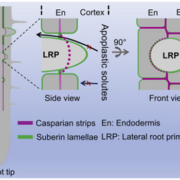
Role of LOTR1 in Nutrient Transport ($)
Plant Science Research Weekly, ResearchCasparian strips, named after the German botanist Robert Caspary who discovered them, are a cellular feature found in the roots of all higher plants. They are ring-like lignin polymers deposited in the middle of anticlinal cell walls (parallel to the root radius) between endodermal cells. Along with…
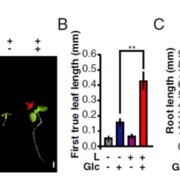
Differential TOR activation and cell proliferation in Arabidopsis root and shoot apexes
Plant Science Research Weekly, ResearchGrowth and cell proliferation at the shoot and root apexes are regulated by diverse factors including hormones, nutrients, and light. Previously, the protein kinase TOR (Target of Rapamycin), a transducer of glucose energy signals, was shown to phosphorylate and activate the transcription factor E2Fa,…

Evidence for Ancient Origins of Bowman-Birk Inhibitors from Selaginella moellendorffii
Plant Science Research Weekly, ResearchMany seeds produce protease inhibitors that are thought to help protect them from pathogens and predation. One class are the Bowman-Birk Inhibitors (BBIs), which form folded loops that specifically bind to and inhibit trypsin and/or chymotrypsin proteases. Originally characterized from legumes, BBIs…
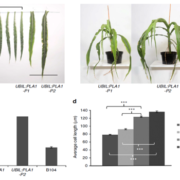
Altered expression of Maize PLASTOCHRON1 (CYP78A) increases auxin levels, extends cell division duration and increases biomass and seed yield
Plant Science Research Weekly, ResearchPreviously, the rice PLA1 gene encoding a CYTOCHROME P450 (CYP78A) was shown to increase vegetative growth. Sun et al. enhanced expressed maize PLA1 specifically in the leaf growth zone under the control of the GA2ox promoter. Transgenic plants produced larger leaves and larger seed yields than control…
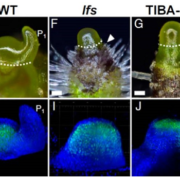
Coordination of auxin-triggered leaf initiation by tomato LEAFLESS ($)
Plant Science Research Weekly, ResearchCapua and Eshed explored the link between auxin and leaf initiation at the shoot apical meristem, using the tomato mutant leafless (lfs), which is an ortholog of the Arabidopsis DORNRONSCHEN (DRN) and DRN-like (DRNL) genes that encode AP2-type transcription factors. The lfs mutant and the drn/drnl double…