

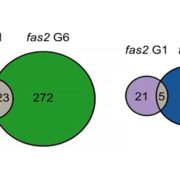
An epigenetic origin behind the transgenerational fitness decline in chromatin assembly impaired plants (New Phytol) ($)
Plant Science Research WeeklyPackaging of nuclear DNA in chromatin is critical for the maintenance of genome integrity as well as fundamental cellular processes such as DNA replication and transcription. Chromatin assembly is mediated by histone chaperones, such as Chromatin Assembly Factor 1 (CAF-1). CAF-1 ensures faithful replication-coupled…
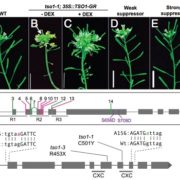
TSO1 and MYB3R1 form a regulatory module to coordinate cell proliferation with differentiation (PNAS)
Plant Science Research WeeklyIn order to ensure proper development, plants need to balance cell proliferation and differentiation. Mutation in TSO1 causes disorganization of cell layers, leading to drastic reduction in fertility. A mutagenesis screen for rescue of fertility in the tso1-1 background identified MYB3R1 as major partner…

Biosynthesis of redox active metabolites in response to iron deficiency in plants (Nature Chem Biol)
Plant Science Research WeeklyIron is an essential but poorly bioavailable micronutrient that serves as a co-factor in many processes involved in electron- or oxygen-transfer. Land-plants evolved at least two distinct mechanism for iron uptake based on chelation of iron by phytosiderophores, that are produced only by grasses, or…

Scopoletin 8-hydroxylase-mediated fraxetin production is crucial for iron mobilization (Plant Physiol)
Plant Science Research WeeklyAs iron is often limiting in the environment, plants use many strategies to support iron uptake, including secretion of small molecules such as coumarins that can help to mobilize iron from the soil. Tsai et al. examined the role of a gene involved in fraxetin (7,8-dihydroxy-6-methoxycoumarin) production…
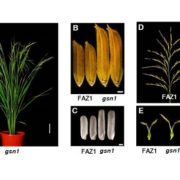
GSN1 coordinates grain number and grain size (Plant Cell)
Plant Science Research WeeklyGrain yield is determined by both grain number and grain weight. There is often a trade-off between these traits; for example, increased grain number is often associated with decreased grain weight. Using a forward-genetic approach, Guo et al. have identified a rice gene, GRAIN SIZE AND NUMBER1 (GSN1)…
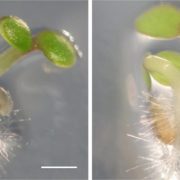
Cyclin-dependent kinase inhibitors ensure formation of one functional megaspore per ovule (PLOS Genet)
Plant Science Research WeeklyUsually the female germline starts with one MMC (megaspore mother cell) per ovule that becomes four megaspores through the process of meiosis. Out of these four, only one survives to produce a functional megaspore (FM); the other three undergo a degeneration process. The FM forms the embryo sac. In this…

An SPX-RLI1 module regulates leaf inclination in response to phosphate availability in rice (Plant Cell)
Plant Science Research WeeklyThe angle at which a rice leaf bends affects its ability to intercept light and also the density at which the plants can be sown. Previous work has shown that brassinosteroid hormones and the BRASSINOSTEROID UPREGULATED1 (BU1) gene affect leaf angle. Ruan, Guo, Xu et al. investigated the role of phosphate…

Review: The root transition zone: A hot spot for signal crosstalk (TIPS) ($)
Plant Science Research WeeklyPlant roots are an excellent system to study the interactions between endogenous (phytohormones) and exogenous (abiotic stresses) stimuli. The root can be considered as three sections: the meristematic zone (where active cell division occurs), the transition zone (acting as a boundary between meristem…
AUX1-mediated root hair auxin influx governs SCFTIR1/AFB-type Ca2+ signaling (Nature Comms)
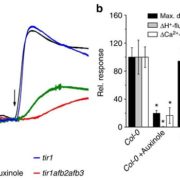
Plant Science Research WeeklyThe phytohormone auxin is transported in a polar fashion through PINs (PIN-FORMED) and PGPs (P–GLYCOPROTEIN) as auxin efflux carriers and AUX1 and LAXs (LIKE-AUX1) as influx carriers. Previous experiments from oat coleoptiles and corn root hairs indicate that one of quickest auxin responses is cell…