


Review: Mechanisms regulating PIF transcription factor activity at the protein level ($) (Physiol. Plant.)
Plant Science Research WeeklyAbsorption of red and far-red light by phytochromes dramatically affects plant development, and many of these effects are mediated by the PIF (PHYTOCHROME INTERACTING FACTOR) family of transcription factors. Favero reviews the many ways that PIF activity is regulated beyond through their interactions…
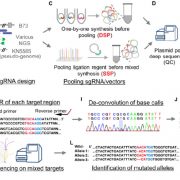
High-throughput CRISPR/Cas9 mutagenesis streamlines trait gene identification in maize (Plant Cell)
Plant Science Research WeeklyMaize has provided some fascinating mutants and developmental insights, but its genomic complexity has made it more difficult (for example as compared to rice) to identify agronomically important genes. Liu et al. describe a new high-throughput method to integrate forward- and reverse-genetics to identify…
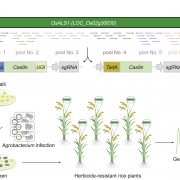
Base-editing-mediated artificial evolution of OsALS1 in planta to develop novel herbicide-tolerant rice germplasms (Mol. Plant)
Plant Science Research WeeklyThe trait of herbicide tolerance allows farmers to use chemical means to eliminate weed competitors. Acetolactate synthase (ALS) is an enzyme targeted by more than 50 different herbicides. In order to generate novel herbicide tolerance traits, Kuang et al. used a base-editing artificial evolution approach,…
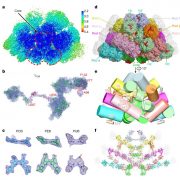
Structural basis of unidirectional energy transfer in Porphyridium purpureum phycobilisome (Nature)
Plant Science Research WeeklyCyanobacteria and red algae employ phycobilisomes (PBSs) as light-harvesting systems to adapt to fluctuating environments. PBSs are composed of phycobiliproteins, linker proteins and chromophores. Ma et al. used cryo-EM to determine the 2.82 Å structure of the very large (14.7-megadalton, 706 protein…
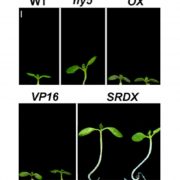
Chimeric activators and repressors define HY5 activity and reveal a light-regulated feedback mechanism (Plant Cell)
Plant Science Research WeeklyPlants take cues from the environment and decide when and how to regulate growth. When light is limiting, etiolated growth allows plants to reach the soil surface and gain access to light. After light perception, plants de-etiolate and go through a series of morphological and genetic changes. HY5 is…

Two MYB proteins in a self-organizing activator-inhibitor system produce spotted pigmentation patterns (Curr. Biol.)
Plant Science Research WeeklyThe questions of how patterns are formed is one of the oldest in biology, and even considered by the famous mathematician Alan Turing, who proposed that reaction-diffusion (RD) models underly de novo pattern formation. Briefly, a reaction that takes place in one place sends a signal that leads to a different…
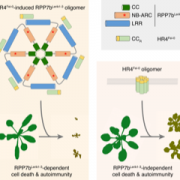
Hybrid autoimmunity and a plant resistosome complex ($) (Cell Host Microbe)
Plant Science Research WeeklyHybrid necrosis occurs when the progeny of a cross between two different plants show widespread cell death. It can be caused by autoactivation of nucleotide-binding and leucine rich repeat domain (NLR) proteins, intracellular immune receptors that play a central role in plant resistance to diverse pathogens.…
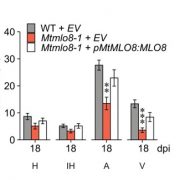
Mildew Locus O facilitates colonization by arbuscular mycorrhizal fungi in angiosperms (New Phytol.)
Plant Science Research WeeklyIn plants, disease resistance genes typically act in a dominant way – the presence of a resistance allele, even a single copy, is enough to confer resistance. The barley gene Mildew Resistance Locus O (MLO1) is different, as it acts in a recessive way; loss-of-function mlo1 plants are resistant to…
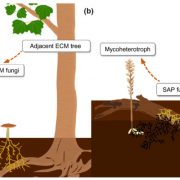
Some mycoheterotrophic orchids depend on carbon from deadwood: novel evidence from a radiocarbon approach (New Phytol.)
Plant Science Research WeeklyA mycoheterotrophic ("fungal-other-eating") plant takes carbon nutrients from a fungus, but as fungi are not themselves photosynthetic, the (ectomycorrhizal) fungus must get its carbon from somewhere, usually a plant. Thus the typical flow of carbon goes from autotrophic photosynthesizing plant to fungus…