

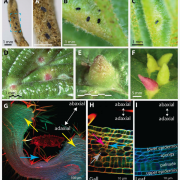
A novel family of secreted proteins linked to plant gall development (bioRxiv)
Plant Science Research WeeklyInsect-induced galls are abnormally patterned plant organs that provide insects with protection and a nutrient source, yet mechanisms underlying the development of these unique organs are mostly unknown. To identify insect factors that govern gall pattering, Korgaonkar et al. turned to the natural variation…
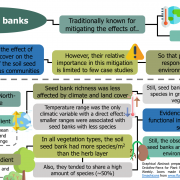
Buffering effects of soil seed banks on plant community composition in response to land use and climate (Glob. Ecol. Biogeogr.)
Plant Science Research Weekly
Plant communities seem to be able to mitigate the effects of climate and land-use change, given their responses are usually observed long after environmental conditions have changed. This lagged response has been attributed to the presence of persistent soil seed banks. Still, the evidence of their…
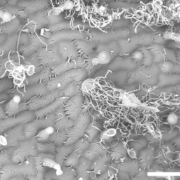
Plant Science Research Weekly: November 13, 2020
WWR Full PostReview: Homoeologous exchanges, segmental allopolyploidy, and polyploid genome evolution
Polyploidy or whole-genome duplication (WGD) is an important process in plant evolution and speciation. Additional sets of chromosomes can be derived from intraspecific genome duplication (autopolyploidy) or…
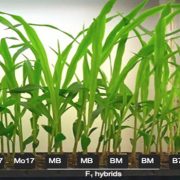
How circadian changes in metabolism affect hybrid vigor
Blog, Research, The Plant Cell, The Plant Cell: In a NutshellZhi Li, Andan Zhu, et al. compare inbred and hybrid lines to explore how daily changes in metabolic pathways affect hybrid vigor. The Plant Cell https://doi.org/10.1105/tpc.20.00320
Background: Heterosis or hybrid vigor refers to the superior growth or fitness in the hybrid progeny compared to one…

In a nutshell: Finally connecting PI3P to autophagy and endosomal sorting
Blog, Research, The Plant Cell, The Plant Cell: In a NutshellLiu et al., generate a novel collection of mutants impaired in PI3P biosynthesis and discovered new features and functions of this phosphoinositide in intracellular trafficking. The Plant Cell (2020). https://doi.org/10.1105/tpc.20.00285
By Richard S. Marshall and Richard D. Vierstra, Washington University,…
The Lure of Lignin: Deciphering High-value Lignin Formation in Seed Coats
Blog, Research, The Plant Cell, The Plant Cell: In BriefLignin is a major functional component of plant secondary cell walls and the second most abundant biological polymer on Earth after cellulose. Understanding the biosynthesis of lignin has huge practical implications because lignin is a major by-product of processes that use cellulosic biomass for industrial…

SAUR15 connects auxin perception to lateral and adventitious root formation
Blog, Plant Physiology, Plant Physiology: News and Views, ResearchCharles Copeland1
1Department of Plant Microbe Interactions, Max Planck Institute for Plant Breeding Research, 50829 Cologne, Germany
ORCID: 0000-0001-8535-8615
[email protected]
As plants grow, they produce new organs such as leaves, lateral roots, and flowers. Plant development…

MYB10 in Action
Blog, Research, The Plant Cell, The Plant Cell: In a NutshellCastillejo et al. describe how independent mutations in the transcription factor MYB10 drive natural variation in strawberry color. The Plant Cell (2020) https://doi.org/10.1105/tpc.20.00474
By Cristina Castillejo and Iraida Amaya
Instituto Andaluz de Investigación y Formación Agraria y Pesquera…

Recognizing Plant Direct authors: Roma Mukhopadhyay
Plant Direct, Plant Direct: Author ProfilesRoma Mukhopadhyay, co-first author of Measuring the dynamic response of the thylakoid architecture in plant leaves by electron microscopy
Current position: Postdoctoral Researcher, Institute of Biological Chemistry, Washington State University, USA
Education: PhD. in Chemistry, New Mexico State…