


Alternative splicing generates a MONOPTEROS isoform required for ovule development (Curr. Biol.)
Plant Science Research Weekly
Auxin shapes the plant body and drives the formation of lateral organs such as roots and ovules. In the current model, AUXIN RESPONSE FACTORs (ARFs) are transcription factors that regulate plant growth by activating signaling in an auxin dose-dependent manner, regulated by Aux/IAA proteins. Here,…
A long shot: Photosynthesis-derived systemic signal controls lateral root emergence (Plant Physiol.)
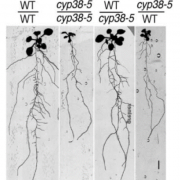
Plant Science Research WeeklyPhotosynthesis, in addition to generating ‘food’ for plants, is also known to control root growth, although the mechanism has been unknown. Duan and co-workers identified CYCLOPHILIN38 (CYP38) as necessary for photosynthesis-mediated lateral root (LR) emergence. The chloroplast-localized CYP38 is…
NO GAMETOPHORES 2 is a novel regulator of the 2D to 3D growth transition in the moss Physcomitrella patens (Curr. Biol.)
Plant Science Research Weekly
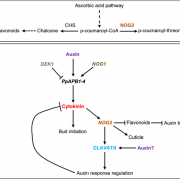
Three-dimensional (3D) growth was an essential evolutionary innovation that allowed the radiation and diversification of land plants. In most land plants the transition from two-dimensional (2D) to 3D growth takes place during embryo development and its disruption results in lethality, however, the…
Elevation filters seed traits and germination strategies in the eastern Tibetan Plateau (Ecography)
Plant Science Research Weekly
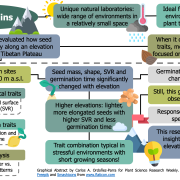
Mountains are extraordinary natural laboratories. They encompass a wide range of environments in a relatively small space, making them ideal for assessing how different environmental variables shape plant traits and communities. Here, Wang and colleagues evaluate how seed functional traits vary along…

A cell-surface receptor-like kinase mediates herbivore-sensing in legumes (Proc. Natl. Acad. Sci. USA)
Plant Science Research WeeklyInceptins are degraded fragments of host chloroplast ATP synthase subunit (cATPC) that are an important class of herbivore-associated molecular patterns (HAMPs). These peptides are abundant in herbivore oral secretions (OS). Using Vu-In, a conserved inceptin from cowpea, Steinbrenner and colleagues have…
Plant Science Research Weekly, December 18, 2020
WWR Full PostReview: Thriving under stress: How plants balance growth and stress response
What exactly is the growth/defense tradeoff? This review is an excellent place to ask. Zhang et al. review evidence that shows that it is much more than a competition for limiting resources – the plant actively responds…

Mutagenomics: The Future of Genetic Screens
Blog, Plant Physiology, Plant Physiology: News and Views, ResearchAnanya Mukherjee
ORCID ID: 0000-0003-1802-1806
University of Nebraska Lincoln
Genetic screens are a remarkable way of identifying mutations affecting various aspects of plant growth and development. Arabidopsis (Arabidopsis thaliana) (T)-DNA insertion lines enable rapid identification of mutant…

ZmABI19 Takes Center Stage during Maize Grain Filling and Development
Blog, Research, The Plant Cell, The Plant Cell: In a NutshellYang and colleagues set out to untangle the network of transcription factors controlling O2 expression during maize seed development
By Tao Yang and Yongrui Wu, National Key Laboratory of Plant Molecular Genetics, CAS Center for Excellence in Molecular Plant Sciences, Shanghai Institute of Plant Physiology…

Recognizing Plant Cell authors: Juan Zhang
The Plant Cell, The Plant Cell: Author Profiles
Juan Zhang, co-first author of Interdependent evolution of biosynthetic gene clusters for momilactone production in rice
Current Position: Postdoc in China Agriculture University; Incoming Associate Professor in the School of Chemistry and Biological Engineering, University of Science and Technology…