
Arabidopsis is not always enough: What a succulent taught us about stomatal development
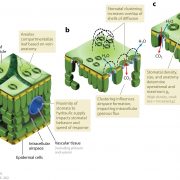
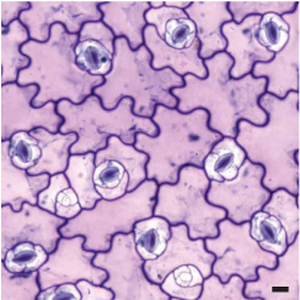 Some species are more studied than others, and it is common to assume that what happens in a model plant like Arabidopsis applies to all other plant species. This is far from true. Recently, Cheng et al. explored stomatal development in the CAM succulent Kalanchoë laxiflora. Stomata are epidermal pores that control gas exchange and water loss in leaves and vary in structure among plants. In Arabidopsis, guard cells (GCs) that form the epidermal pore gates are surrounded by non-specialized cells, whereas in K. laxiflora, guard cells are surrounded by three subsidiary cells (SCs) that are auxiliary in opening and closing stomata through turgor control of the guard cells via potassium mobilization. The authors also found that two transcription factors, KlaxMUTE1 and KlaxMUTE2, promote additional rounds of asymmetric cell division, which generate these subsidiary cells before guard cell differentiation. This contrasts with AtMUTE in Arabidopsis, which stops asymmetrical cell division and promotes guard mother cell formation. Grasses also form subsidiary cells, but through a different development pathway. There, MUTE acts in neighboring cells. which give rise to subsidiary cells from a different lineage from that leading to guard cells (perigene), whereas in Kalanchoë, subsidiary cells arise from the same lineage as guard cells (mesogene). The fact that divergent plant groups use the same transcription factor to develop functional subsidiary cells from different cell lineages is a clear case of evolutionary convergence at the level of regulatory networks. (Summary by Montserrat López-Coria). Science Advances. 10.1126/sciadv.aeb8145