
A mobile transcription factor regulates wood abundance and quality in Populus trichocarpa
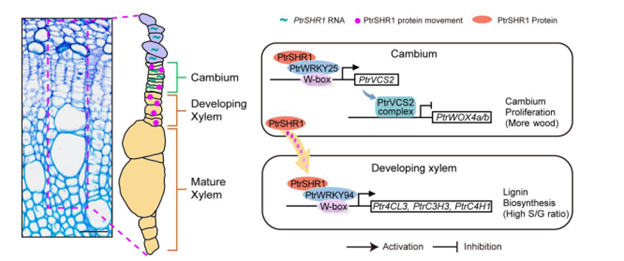
Wood is a major source of biomass on Earth and is valuable feedstock for multiple industries. Wood formation includes vascular cambium cell division and the maturation of the resulting stem-differentiating xylem (SDX) cells into mature xylem. Zhao et al. furthers our understanding of these processes by identifying and characterizing the function of PtrSHR1, a transcription factor (TF). Staining of Populus trichocarpa cross-sections demonstrated that PtrSHR1 protein is present in both vascular cambium and SDX cells, despite being transcribed only in the former, indicating intercellular mobility of the protein. Transgenic poplar overexpressing PtrSHR1 produced a truncated vascular cambium, leading to less woody biomass, while PtrSHR1 loss-of-function mutants exhibited an increased level of wood production. Functional analysis showed that PtrSHR1 operates via dimerization with the TF PtrWRKY25, forming a protein complex that can then promote PtrVCS2 expression. PtrVCS2 expression then reduces vascular cambium proliferation by repressing PtrWOX4a/b, which has been previously shown to reduce cambium growth. Analysis of wood samples in overexpressing and loss-of-function mutants demonstrated that PtrSHR1 expression can influence lignin deposition and cellulose levels, which are key metrics related to wood quality. This effect arises from the function of PtrSHR1 in SDX cells, where it dimerizes with the TF PtrWRKY94 to promote expression of three monolignol biosynthesis genes. This work by Zhao et al. provides insights into a novel TF that can regulate both wood quantity and quality. (Summary by Reed Arneson @Reed_Arneson) Plant Cell 10.1093/plcell/koag091