All roads lead to TOR: Virus-induced fungal genes metabolically converge on TOR signaling
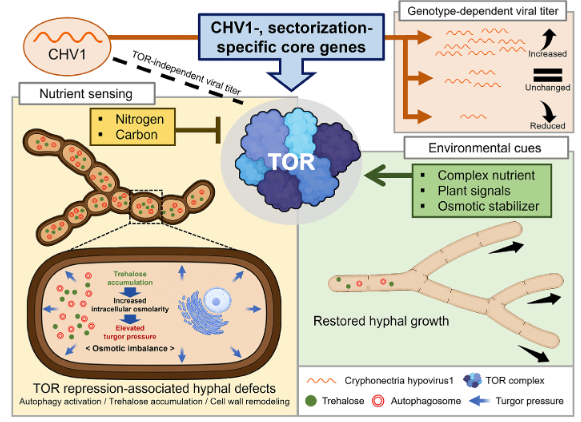
Cyphonectria parasitica is a fungal pathogen responsible for chestnut blight that shows reduced virulence upon infection with Cryphonectria hypovirus 1 (CHV1). Ko and Chun et al. analyzed 12 fungal genes representing diverse protein groups that are upregulated upon CHV1 infection. Interestingly, knocking out any of the 12 genes in Cyphonectria led to a common phenotype of restricted colony growth and reduced conidiation. Additionally, the mutants were sensitive to both carbon and nitrogen sources and limitation. Reduced growth and nutrient sensitivity are regulated by the master regulator TOR pathway, hence the authors tested for trehalose accumulation, a canonical response to TOR inhibition. The mutants accumulated trehalose and showed autophagy that is independent of CHV1. These observations suggest that disruption of these CHV1-responsive genes leads to similar cellular, metabolic and developmental outcomes including inhibition of the TOR pathway, thereby regulating fungal growth. (Summary by Atharv Ambekar) New Phytol. 10.1111/nph.71631