Putrescine (Put) protection: Genetically engineering Arabidopsis to be stress resistant during spaceflight by increasing Put
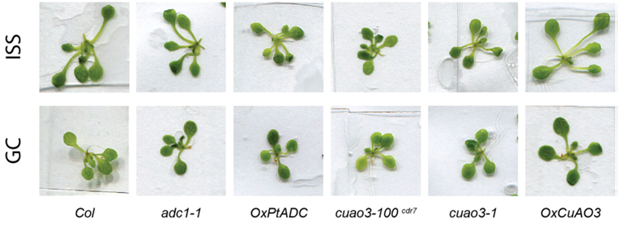 Polyamines such as putrescine (or put), which play essential roles in plant growth, development, and overall success, have been proposed as candidates for metabolic alteration and optimization to enhance plant stress resilience. Growing crops in space will be necessary to support astronauts by providing food, water cycling, oxygen, and waste decomposition, as well as natural materials such as medicines, through future self-sufficient Bioregenerative Life Support Systems (BLSS). However, many challenges remain in achieving full plant potential under the stresses of spaceflight, including microgravity and radiation exposure, both of which significantly influence plant phenotype and genotype. To increase the accumulation of Put in plant tissues and assess its impact on plant stress and growth, Su and Masson modified the Put metabolic pathway in Arabidopsis through two avenues, firstly by increasing expression levels of ARGININE DECARBOXYLASE (ADC) from Poncirus trifoliata in overexpression lines (OxPtADC), and secondly by knocking-out Copper-AMINE OXIDASE3 in mutant lines (cuao3). Using Golden gate cloning to create the constructs and Agrobacterium-mediated transformation, the scientists observed that both genetically engineered lines had fewer Differentially Expressed Genes (DEGs) than wild type, while Gene Ontology (GO) enrichment analysis showed fewer oxidative stress and hypoxia genes being sensitive to the spaceflight environment. Furthermore, the lines did not demonstrate the extended petiole phenotype typically seen in plants under hypoxic conditions. These findings suggest a potential path forward for generating stress tolerant plants engineered for the spaceflight environment. (Summary by Ruth Nichols ) npj Microgravity. 10.1038/s41526-026-00663-4