Botrytis virulence enzyme degrades plant defense compounds
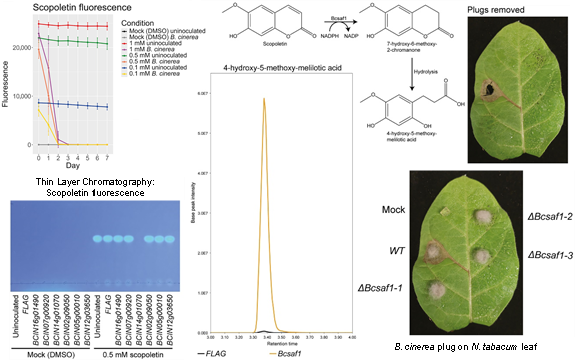 If you have ever bought berries and let them sit in the fridge for a little too long, you are probably already familiar with Botrytis cinerea, the humble grey mold. B. cinerea is a fascinating fungal pathogen with an arsenal of virulence proteins and toxins that contribute to its incredible success as a generalist on foliage, ornamental flowers, and fruit crops. Although plants make many defense compounds that inhibit most fungi, B. cinerea is able to overcome these defenses. Piro et al. examined how it evades the plant defense compound scopoletin, a coumarin-family compound made by many plant genera. In most fungi, scopoletin inhibits fungal spore germination and the formation of infection structures. The authors confirmed that B. cinerea can degrade scopoletin in artificial media and, via a metabolite-transcriptomic co-expression analysis, identified BCIN14g01070 (ABC transporter Bcsaf1) as the gene responsible for scopoletin detoxification. They determined that Bcsaf1 orthologs are found in related pathogenic fungi and share similar enzymatic activity that degrades the coumarin backbone. Finally, Piro and colleagues demonstrated that Bcsaf1 is necessary to completely detoxify scopoletin and for virulence on scopoletin-producing plants like Nicotana tabacum. Interestingly, the ∆Bcsaf1 mutation slows but does not completely nullify scopoletin detoxification by B. cinerea, suggesting that additional work is needed to fully understand the role of Bcsaf1 in B. cinerea growth and virulence across plant hosts. Summary by Iris Mollhoff (@iris.mollhoff) MPMI. 10.1094/MPMI-05-26-0041-R