


Recognizing Plant Physiology authors: Juan Zhao
Plant Physiology, Plant Physiology: Author ProfilesJuan Zhao, co-first author of RMS2 encoding a GDSL lipase mediates lipid hemostasis in anthers to determine rice male fertility
Current Position: Ph.D candidate, State Key Lab of Rice Biology, China National Rice Research Institute (CNRRI), Hangzhou, China
Education: Master of biochemistry and…

Recognizing Plant Cell authors: Cheng-Yu Hou
The Plant Cell, The Plant Cell: Author ProfilesCheng-Yu Hou, co-first author of Widespread Exon Junction Complex Footprints in the RNA Degradome Mark mRNA Degradation Before Steady-state Translation
Current Position: Bioinformatician, Bioinformatics team of technology department, Sofiva Genomics Company, Taiwan
Education: Master of Science in…

Recognizing Plant Cell authors: Bo-Han Hou
The Plant Cell, The Plant Cell: Author ProfilesBo-Han Hou, co-first author of Widespread Exon Junction Complex Footprints in the RNA Degradome Mark mRNA Degradation Before Steady-state Translation
Current Position: research assistant, Agricultural Biotechnology Research Center, Academia Sinica, Taiwan
Education: Bachelor of Nutritional Science,…

Recognizing Plant Cell authors: Wen-Chi Lee
The Plant Cell, The Plant Cell: Author ProfilesWen-Chi Lee, co-first author of Widespread Exon Junction Complex Footprints in the RNA Degradome Mark mRNA Degradation Before Steady-state Translation
Current Position: Research assistant, Agricultural Biotechnology Research Center, Academia Sinica, Taiwan
Education: M.S. and B.S. in Botany at National…

Roots Calling Leaves: Oxylipins in Induced Systemic Resistance
Research, The Plant Cell, The Plant Cell: In a NutshellWang et al. identify signals related to induced systemic resistance produced by a root-colonizing fungus. Plant Cell https://doi.org/10.1105/tpc.19.00487
Background: Trichoderma virens is an agriculturally-relevant root-colonizing fungus that provides its plant hosts many benefits, such as increased…
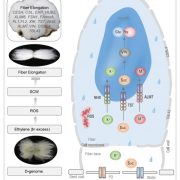
Review. Gossypium genomics: Trends, scope, and utilization for cotton improvement (Trends Plant Sci)
Plant Science Research WeeklyCotton (Gossypium spp.) provides the world’s most important natural fiber, and I suspect with our growing realization of the problems with plastics there will be still more demand for it. Yang et al. review the current state of Gossypium genomics. As a crop that has been domesticated for millennia,…
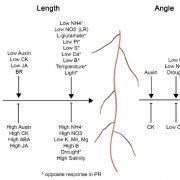
Review. Same, but different: growth responses of primary and lateral roots ($) (J. Exp. Bot.)
Plant Science Research WeeklyLateral roots arising from programmed cell division from primary roots in both monocots and dicots share some similarities and dissimilarities in developmental signaling. In this review, Waidmann et al. discuss lateral root organogenesis and elongation with respect to hormone, nutrient, and abiotic conditions.…

Reciprocal cybrids reveal how organellar genomes affect plant phenotypes (Nature Plants)
Plant Science Research WeeklyA cybrid is a cytoplasmic hybrid; in other words, a cell or organism in which the cytosolic genomes (mitochondria and plastid) have a different origin than the nuclear genome; the nuclear genome is inherited solely from the paternal parent, and the cytosolic genomes from the maternal parent. Starting…
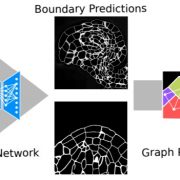
Accurate and versatile 3D segmentation of plant tissues at cellular resolution (bioRxiv)
Plant Science Research WeeklyAdvances in microscopy allow biologists to document and understand phenotypic changes at the tissue level. Despite this advancement, analysis of microscopic images to characterize changes in phenotypes is still under development. In this paper, Wolny et al. have developed an image analysis tool PlantSeg…