

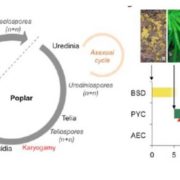
The rust fungus Melampsora larici-populina expresses distinct sets of secreted protein genes during infection of its two host plants, larch and poplar
Blog, Plant Science Research Weekly, Research, Research BlogRust fungi represent an important group of plant pathogens, many of which have heteroecious lifestyles (meaning that they require two alternate hosts). However, the molecular mechanisms used by these pathogens for suppression and colonization of multiple hosts are poorly understood. Lorrain et al.…
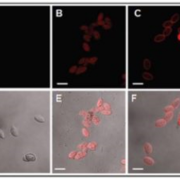
Plant extracellular vesicles are incorporated by a fungal pathogen and inhibit its growth ($)
Blog, Plant Science Research Weekly, Research, Research BlogExtracellular vesicles (EVs) are membrane-released structures that play a role in cell-to-cell communication. These vesicles in plants have been poorly studied although they are predicted to have a role in defense upon pathogen infection. Regente et al. have characterized EVs from sunflower by transmission…

What we're Reading: December 15th
Blog, Research, Research Blog, WWR Full PostPoint of View: A transatlantic perspective on 20 emerging issues in biological engineering studies
“Horizon scanning” describes the process of trying to rationally predict the future. Wintle et al. describe the results from a horizon-scanning exercise to identify emerging issues in biological…

Come In Out of the Cold into a New Career - December 13, 2017
Blog, Careers, Careers - Blog
ASPB and Plantae have already set a tone of collaboration and constant improvement by and for plant scientists. In keeping with our commitment to providing the best recruitment resources for our members, we are excited to announce the launch of our new and expanded online employment resource: the…
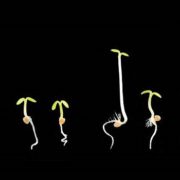
Update: Seedling establishment: a dimmer switch-regulated process between dark and light signaling
Blog, Plant Physiology, Plant Physiology: Updates, Research, Research BlogBy Charlotte M.M. Gommers and Elena Monte
Abstract
By being exquisitely sensitive to their light surroundings, plants are able to continuously adjust their growth to optimize fitness. Darkness is an important cue for plants and a time when they actively grow and develop through regulation of the…
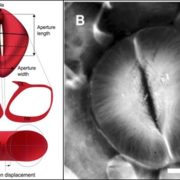
Update: Finite element modeling of shape changes in plant cells
Blog, Plant Physiology, Plant Physiology: Updates, Research, Research BlogBy Amir Bidhendi and Anja Geitmann
Abstract
Plant cells come in a striking variety of different shapes. Shape formation in plant cells is controlled through modulation of the cell wall polymers and propelled by the turgor pressure. Understanding the shaping aspects of plant cells requires knowledge…
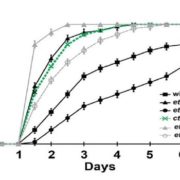
Non-Canonical Signaling of Ethylene Receptors
Blog, Plant Physiology, Plant Physiology: On The Inside, Research, Research BlogEthylene is a gaseous plant hormone that affects the growth and development of plants and mediates plant stress responses. Ethylene is perceived by a family of five receptors in Arabidopsis thaliana including ETHYLENE RESPONSE1 (ETR1) and ETR2. Surprisingly, there are cases where the different ethylene…
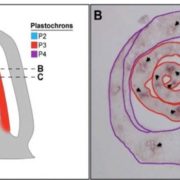
Engineering Increased Stomatal Density in Rice
Blog, Plant Physiology, Plant Physiology: On The Inside, Research, Research BlogThe coordinated differentiation of cell types during the metamorphosis of an organ is crucial for ensuring that the final form of the organ is appropriate for itsfunction. A case in point is the photosynthetic function of plant leaves that requires chloroplast-containing cells in the middle leaf layers…
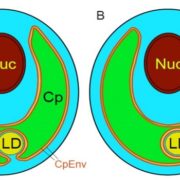
Do Lipid Droplets Exist in the Chloroplast Stroma?
Blog, Plant Physiology, Plant Physiology: On The Inside, Research, Research BlogUnderstanding the metabolic pathways underlying oil production and the precise intracellular localization of lipid droplets is crucial for successfully engineering microalgae for biofuel production. The microalga Chlamydomonas reinhardtii accumulates considerable amounts of starch and triacylglycerol…