
The Garden You Choose: A Post-PhD Career Guide for Plant Scientists
The journey so far
You finish high school, then a bachelor’s degree, then a master’s, and eventually a PhD. Each step can feel like the natural continuation of the one before it. Along the way, you collect the moments that remind you why you chose science: the smell of a greenhouse after watering, the first transgenic seedling glowing under a GFP filter, the excitement of a transformation that finally works, or the late night when an experiment gives you the first hint that your hypothesis might actually be right. You loved this. You still do. But somewhere during a PhD, another question begins growing alongside your research: What happens after this?
It is easy to look back and wonder whether you have simply been moving along a conveyor belt -school, university, master’s, PhD, and then whatever comes next. But a scientific career does not have to be a rat race. A rat race is movement without reflection: pursuing the next milestone because everyone else is doing the same. If you have taken time to think about what excites you, what you are good at, and what kind of life you want to build, your journey is something else. It is exploration.
The problem is that many researchers postpone this exploration. We become absorbed in experiments, manuscripts, conferences, thesis deadlines, and the next result. We assume the next opportunity will somehow appear when we need it. Sometimes it does. Often, it does not. Career planning therefore matters -not because you need to predict your entire future, but because understanding yourself is just as important as understanding your science.
A PhD opens more than one gate
A PhD does not lead to a single destination. It opens the gate to several different gardens. Some scientists choose academia, where they pursue unanswered questions, teach, mentor, and build research programs. Others move into industry, translating scientific knowledge into products, technologies, and solutions. Others find their place in government, policy, consulting, intellectual property, science communication, education, entrepreneurship, or research-support roles. None of these gardens is inherently better than another. The important question is: Which environment allows you to grow?
The numbers are useful here. A 2026 CRAC-Vitae study of more than 10,000 UK doctoral graduates found that fewer than 3% were unemployed 15 months after graduation, with a median salary of around £42,000. At the same time, only around 42% remained in academia. Globally, doctoral graduates continue to outnumber the permanent academic positions available to them (Kwon, 2025). ). Statistics show that only about 15% of postdoctoral scientists eventually secure a tenure-track position (McConnell et al., 2018), meaning that the majority will build their careers beyond the traditional academic faculty pathway. This is not a failure of scientific training; it simply reflects the breadth of opportunities available to researchers beyond the tenure track. These numbers do not mean that doctoral training has failed. They simply show that the academic faculty track is one possible destination rather than the default destination.
That distinction can actually be empowering. Knowing that you have options gives you time to explore careers, develop transferable skills, meet people outside your laboratory, and make decisions based on curiosity rather than panic. Career awareness is not about predicting the future. It is about being prepared for it.
Academia or Industry? Start with yourself
Academia and industry are not simply two versions of the same career. They reward different things and often offer very different working environments. Academic careers tend to emphasize scientific depth, originality, independence, publications, funding, teaching, and mentorship. Industry often places greater emphasis on solving practical problems, working in teams, managing projects, adapting to changing priorities, and delivering outcomes within defined timelines.
Before deciding, it is worth asking yourself a deceptively simple question: If both options were available to me tomorrow, which one would make me more excited about Monday morning?
The answer may not come immediately, and it may change over time. That is perfectly normal. You do not have to choose your entire career during your PhD. You need to understand yourself well enough to make the next decision deliberately.
If you choose the academic garden
For some scientists, the attraction of academia is difficult to explain because it is not simply about having a job in research. It is about being fascinated by unanswered questions. You enjoy standing at the edge of what is known and asking what lies beyond it. You imagine experiments, students, seminars, collaborations, grant proposals, and perhaps one day a research group of your own.
If that vision excites you, academia may be your garden. But it should be chosen deliberately. The academic pathway is highly competitive, and only a small proportion of people who begin a PhD eventually become professors. That reality should not automatically discourage you; rather, it should encourage you to understand what the path requires and whether you genuinely want to pursue it.
For many researchers, a postdoctoral position becomes an important transition between completing a research project and developing scientific independence. During a PhD, you are often focused on answering questions within an existing research framework. As a postdoc, the expectation increasingly shifts toward developing your own questions, establishing collaborations, building expertise, securing funding, and developing the scientific identity that could eventually support an independent research program.
Some researchers continue toward Principal Investigator, Group Leader, or Professor positions. Others discover that teaching and mentorship are the most rewarding parts of academic life and pursue careers where education plays a larger role. Research institutes such as the Max Planck Institutes and the John Innes Centre offer another environment for scientists who want to remain deeply involved in discovery, often with a different balance between research and teaching. Others eventually move into scientific leadership, research management, funding agencies, or institutional roles where their influence comes increasingly from shaping scientific programs and supporting other researchers.
Academia is bigger than the faculty track
There is an important part of the academic landscape that is often overlooked. Not everyone in academia wants to run a laboratory.
Some scientists discover that what they enjoy most is not writing grants or managing a research group but mastering a particular technology. Over the course of a PhD or postdoc, they may develop extraordinary expertise in bioinformatics, imaging, microscopy, proteomics, metabolomics, genome editing, or next-generation sequencing. They become the person colleagues turn to when an experiment fails, a pipeline breaks, or a new technique needs to be established.
Academia has a garden for these scientists too.
Universities and research institutes increasingly depend on core facilities and technology platforms staffed by scientific experts. Facility scientists, technology specialists, and platform managers help researchers design experiments, optimize protocols, analyze data, and implement cutting-edge methods (Priyadarshini, 2024). Their expertise can influence dozens of research groups and hundreds of projects rather than remaining within a single laboratory.
For scientists who genuinely enjoy a particular technology and want to spend their careers pushing its limits, these positions can be deeply rewarding. They allow you to remain close to scientific discovery, collaborate across disciplines, and contribute to the training of future generations of researchers. In many institutions, they can also offer greater long-term stability and fewer grant-writing responsibilities than traditional faculty careers.
There is also a growing ecosystem of research-support careers within academia. Graduate program coordinators, scientific project managers, laboratory managers, research administrators, outreach specialists, and science communication professionals help research organizations function effectively. If you enjoy organizing people, coordinating projects, building communities, or helping other scientists succeed, these careers can allow you to remain connected to academic research while applying a different set of strengths.
The academic garden, therefore, is much larger than the professor’s office. Beyond the traditional faculty pathway lies an ecosystem of scientific, technical, educational, managerial, and support roles that allow researchers to remain connected to discovery without necessarily becoming independent principal investigators.
Growing into an academic career
Technical expertise is only the beginning. Scientific independence becomes increasingly important as an academic career progresses. During a PhD, you are often evaluated on how well you execute a research project. As an independent scientist, you are increasingly expected to identify important questions, develop research programs, and convince others that those questions deserve attention.
Communication is equally important. Grant proposals, research papers, seminars, lectures, interviews, and collaborations all require you to explain not only what you discovered but why it matters. Grant writing becomes particularly important because even excellent ideas require resources. Mentorship and leadership also become increasingly central. The further you progress, the more your influence depends on the people you help develop rather than only the experiments you personally perform.
This preparation should begin before the final year of a PhD. During the middle years, build technical expertise while paying attention to the skills and experiences expected in the careers that interest you. Present at conferences, collaborate beyond your immediate research group, mentor junior researchers, and explore teaching if it appeals to you. Later, begin thinking about scientific independence: identify potential postdoctoral mentors, explore fellowships, attend relevant seminars, and practice discussing not only what you have discovered but what you would like to discover next.
Academic applications increasingly ask you to demonstrate a future research vision, teaching ability, collaboration potential, and scientific independence. Your publication record tells part of the story. Your ability to explain where your science could go next tells the rest.
If you choose the industry garden
Perhaps your ideal scientific life looks different. You still love science, but you want to see your work translated into something tangible. You may enjoy working in teams, solving practical problems, developing technologies, or working toward outcomes that have a defined application. If so, industry may be your garden.
The important shift is that a PhD demonstrates scientific rigor, but it does not automatically demonstrate readiness for a particular industry role. Employers want to understand how your scientific training can solve problems that matter to their organization. Instead of simply describing the experiments you performed, you need to communicate the problems you solved, how you approached them, how you handled setbacks, how you collaborated, and what you ultimately delivered.
Research and development is often the most obvious transition for plant scientists. Crop improvement, agricultural biotechnology, plant disease research, bioinformatics, and product development can allow you to remain close to scientific research while working toward defined objectives. But industry extends far beyond R&D. Quality assurance can suit scientists who enjoy structure, precision, documentation, and standards, while application or field scientists can become bridges between companies and customers, helping users understand technologies and troubleshoot problems (Pasini and Pochet 2024).
Regulatory affairs provides another route, particularly in agricultural biotechnology and related industries, where scientific knowledge must be combined with careful documentation, critical analysis, and an understanding of regulatory requirements. Intellectual property provides another intersection between science and the wider world, allowing scientists to evaluate inventions, understand prior art, and contribute to patent development.
Scientists with strong communication skills can move into technical writing, science communication, product training, or customer-facing roles. Others move into consulting, where they apply scientific and analytical thinking to problems across different organizations. And industry is not the only alternative to academia. Government agencies, non-profit organizations, international research centers, and policy institutions offer opportunities to work on agriculture, food security, plant health, biodiversity, and sustainability.
The broader lesson is that your PhD does not have to define you by the technique you used or the organism you studied. It provides a foundation from which you can move in several directions (Pasini and Pochet 2024).
Growing into industry
Where academia often rewards independence and depth, industry places greater emphasis on translation. Can you explain what your findings mean for a product, customer, budget, timeline, or business decision?
Teamwork becomes particularly important because projects often involve scientists working alongside engineers, regulatory specialists, managers, marketers, and other professionals. Project management, adaptability, communication, and decision-making therefore become valuable alongside technical expertise.
One useful exercise is to take your PhD CV and rewrite it as though you were applying for an industry position. Instead of listing only methods and experiments, emphasize problems solved, projects managed, collaborations, data analysis, leadership, communication, and outcomes. This exercise often reveals how many transferable skills you have already developed.
Keep the door open
Plant science is increasingly interdisciplinary. The boundaries between plant biology, ecology, biotechnology, environmental science, agriculture, computational biology, and data science are becoming less distinct (Plantae webinar 2026b) A plant scientist with strong computational skills may move into bioinformatics or data science. Someone interested in sustainability may find opportunities in environmental consulting or policy. A scientist who enjoys communication may discover a career in education or science outreach. Someone with an entrepreneurial mindset may explore agricultural technology, sustainable agriculture, biotechnology, or plant-based products.
Government and non-profit organizations offer another important route. Scientists working in these environments can contribute to policy, conservation, plant health, food security, sustainability, or public education. Their impact may extend far beyond the publication of a scientific paper. Entrepreneurship offers another possibility for scientists interested in turning scientific ideas into technologies, products, or services, although it requires a willingness to learn about business, finance, communication, and risk alongside science.
The point is not that every plant scientist should become a consultant, entrepreneur, policy expert, or data scientist. Rather, it is to recognize that plant science sits at the intersection of many disciplines. Your scientific training can travel much further than the boundaries of your PhD project.
Your network can change the direction of your career
Career decisions become much easier when you stop imagining careers from the outside and start talking to people who actually live them. A job description can tell you what an organization expects; a conversation with someone doing the job can tell you what that career actually feels like.
Conferences, seminars, workshops, webinars, and professional organizations are therefore more than places to present research. They are opportunities to meet people working in different parts of science. Professional societies such as ASPB and FESPB, as well as other plant science communities, provide opportunities for networking, mentorship, professional development, and exposure to careers that may not exist within your immediate research environment.
Online platforms can extend those connections. LinkedIn, ResearchGate, and professional scientific communities make it easier to follow researchers and professionals whose careers interest you. Networking does not have to mean collecting contacts or sending generic messages. Start with curiosity. Ask someone how they moved from their PhD into their current role, what surprised them, which skills mattered most, and what they would do differently.
These conversations can provide more useful career information than hours spent scrolling through job advertisements.
Mentorship can be equally valuable. A good mentor can help you recognize opportunities that are difficult to see from inside your own career bubble. You do not necessarily need one mentor for everything. Your supervisor may provide scientific guidance, while another mentor may understand industry, academic careers, communication, leadership, or another area that interests you. Multiple perspectives can help you make more balanced decisions.
Mentorship can also work in both directions. Early-career scientists often bring new technological knowledge, fresh perspectives, and different approaches to communication. Good mentoring is therefore not simply information flowing from senior to junior; it can become an exchange in which both people learn.
Let people see your science
Good research needs to be communicated effectively. Publishing and presenting your work remain important, particularly if you are considering academic research, but scientific visibility is broader than a publication list.
Conference presentations allow you to explain your work, receive feedback, and meet potential collaborators. Publications establish a record of your contribution, while preprints, institutional websites, blogs, and professional platforms can make your research accessible to wider audiences.
But visibility is not simply about producing more papers. It is about becoming known for something – a scientific question, a technical skill, a way of communicating, or a particular area of expertise.
Learning to communicate the same science to different audiences is therefore a valuable career skill. Your conference presentation, a conversation with an industry scientist, a grant proposal, and a public-facing article should not sound identical. The underlying science remains the same, but the story changes depending on who is listening.
The ability to translate science is valuable whether you remain in academia, move into industry, or build a career somewhere in between.
Build skills that travel with you
A PhD can make you technically excellent, but technical expertise alone rarely determines long-term career success. Some of the most valuable skills you develop during doctoral training are the ones that do not appear in a methods section.
Communication allows you to write clearly, present confidently, explain complex ideas simply, and adapt your message to different audiences. Leadership develops through coordinating projects, mentoring students, organizing activities, and taking responsibility for collaborations. Teamwork becomes increasingly important as modern science brings together researchers from different disciplines and professional backgrounds.
Time management and organization matter because scientific careers require you to balance competing priorities. Problem-solving and critical thinking are perhaps even more fundamental: scientists are trained to work with uncertainty, interpret imperfect evidence, question assumptions, and change direction when the data demand it.
Finally, adaptability and resilience are essential. Technologies change, funding priorities shift, projects fail, and organizations restructure. Your ability to learn, adjust, and continue moving forward may ultimately matter more than mastering any single technique.
Treat your career like an experiment
Scientists rarely know the answer before beginning an experiment. We form a hypothesis, gather evidence, evaluate the results, and revise our thinking. Career exploration can work in exactly the same way.
Think you might enjoy R&D? Talk to someone working in R&D, read real job descriptions, and start developing one of the skills those positions repeatedly request. Curious about science communication? Write something, volunteer for outreach, or contribute to a science blog. Interested in consulting? Speak to a consultant and find out what their working week actually looks like.
You may discover that your original hypothesis was wrong. That is not failure. That is data.
The earlier you run these small career experiments, the less pressure you place on the final months of your PhD.
Your first career is not your final career
One of the most reassuring truths about scientific careers is that your first destination does not have to be permanent. Scientists move between academia and industry. Others transition into policy, consulting, communication, management, government, technology platforms, or entrepreneurship (John Innes Centre blog 2026). Skills accumulate, and many of them travel with you.
Your first job after the PhD is therefore not a life sentence. It is the first planting (John Innes Centre blog 2026).
You can transplant. You can change direction. You can discover that the garden you imagined from a distance is not the one where you actually thrive and choose another.
The garden you choose
By the end of a PhD, you have accumulated much more than experimental results. You have learned patience from experiments that refused to work, resilience from failed hypotheses, critical thinking from confusing data, and persistence from projects that took far longer than expected.
Those lessons belong wherever you choose to take them.
Stay in academia, and they may become the foundation for discovery, teaching, mentorship, and scientific leadership. Move into industry, and they may help you develop technologies, solve practical problems, and bring scientific knowledge closer to the people who need it. Move into government, policy, communication, consulting, technology platforms, research management, or another field, and your scientific training can take a different form without losing its value.
Leaving academia is not abandoning science. Staying in academia is not automatically success. Running a laboratory is not the only way to be a scientist. Choosing industry does not mean you have given up on research.
There is no single correct garden.
The important thing is to understand what each garden asks of you and what it gives back.
So as your PhD draws toward its final chapter, do not ask only, “What job can I get?”
Ask something bigger:
What kind of life do I want my science to help me build?
You do not need the complete answer today. Start exploring. Talk to people. Try things. Build skills. Stay curious.
Because a career, much like a garden, rarely becomes beautiful by accident.
It is cultivated.
And when the gate finally opens after your PhD, the garden you choose is yours.
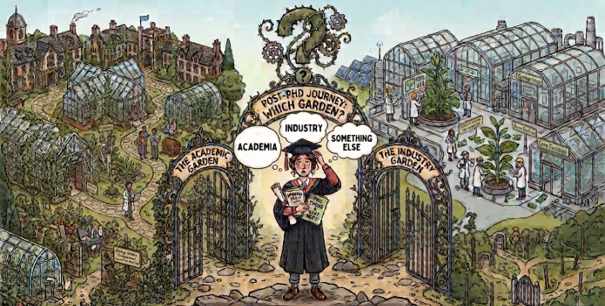
Image created with the help of nanobanana2
References
CRAC Vitae’s long running series of analyses of doctoral graduates’ early careers in the UK 2026. (https://vitae.ac.uk/wp-content/uploads/2026/06/Vitae-WDRD-2026-Policy-Brief.pdf)
Kwon, D. (2025). How many PhDs does the world need? Doctoral graduates vastly outnumber jobs in academia. Nature.
Pasini, Carlo and Pochet Isabel (2024). Careers in plant science and beyond. Plantae.
McConnell, S. C., Westerman, E. L., Pierre, J. F., Heckler, E. J. & Schwartz, N. B. United States National Postdoc Survey results and the interaction of gender, career choice and mentor impact. eLife 7, e40189 (2018).
Priyadarshini, 2024. Strategic career planning for plant scientists: Navigating your path to success. Plantae.
Plantae. (2026). Plantae Presents: Alternative career paths for plant scientists. Plantae Webinar Series.
John Innes Centre 2026. https://www.jic.ac.uk/blog/green-horizons-plant-science-careers-for-a-food-secure-future/#new_tab. John Innes Centre blog
______________________________________________
About the Authors
Jahed Ahmed
Jahed is a Marie Curie Postdoctoral Fellow at the Laboratory of Membrane Biogenesis, CNRS/University of Bordeaux and a 2026 Plantae Fellow . His research focuses on deciphering the roles of reactive oxygen species and calcium signaling in plant-virus interactions, exploring how pathogens hijack host membrane nanodomains to facilitate infection.
Gourav Arora
Gourav is a second year doctoral researcher in the Coupland department at the Max Planck Institute for Plant Breeding Research, Cologne. His work focuses on the regulation of flowering time in Arabidopsis, specifically through the FT-FD module. Originally from Haryana, Gourav completed his master’s degree at the University of Delhi, India. Passionate about science communication, Gourav enjoys sharing scientific concepts with the general public. In his free time, he loves capturing the beauty of nature through photography, particularly flowers and plants. He also enjoys watching anime, playing table tennis, and reading Hindi poetry. You can find him on X: @gourav_arora_g.