

Terraforming with Plants: Can Green Life Make Mars Habitable?
Why go to Mars
Everyone wants to have a house with a garden later on in life. Producing your own vegetables, or just having a glass of wine in an armchair in the light spring wind, sounds charming. Imagine this on another planet, retiring to Mars and doing some gardening. Throughout history, when people have settled into new locations, they brought plants and seeds from their old locales, allowing them to transform unfamiliar destinations into places where they could live, thrive, and maintain a connection to their identity. A thriving garden on Mars would represent much more than a scientific achievement; it would signify something remarkable about humanity’s adaptability and our ability to acclimate to a wide variety of environments.
The first Moon landing occurred exactly 57 years ago, on the 20th of July in 1969. Next to the Moon, Mars has been a promising prospect for human exploration and settlement beyond Earth. A primary reason for this is that, billions of years ago, the planet contained rivers, lakes, and possibly oceans. The evidence of this previous water presence suggests that Mars’s climate was previously much warmer and wetter than it is today. Water in the form of ice deposits remains present on Mars (NASA/JPL, 2023). However, it should be noted that the presence of water on Mars does not mean that it is currently hospitable to plants. There are many other environmental challenges that must be accounted for before crops can successfully grow on Mars.
Establishing a long-term presence on any planet outside of Earth will require more than just transporting astronauts there. Future settlements need reliable food production systems to be effective. Additionally, plants can contribute to overall life support systems by aiding in the conversion of carbon dioxide to oxygen through photosynthesis. Plants also can potentially contribute to water recycling within these habitats (Wheeler, 2017). Beyond these highly important practical uses, plants can also provide important psychological benefits for the inhabitants of these settlements by softening these environments by including sensory experiences that enrich the lived environment (Landon et al., 2025). Even considering all of these potential benefits, growing plants on Mars presents several challenges that researchers are working to overcome.
Challenges of going to Mars
Understanding the challenges of growing plants on Mars begins with understanding its climate. Global climate change is not specific to Earth; it has happened to Mars as well. The once watery globe with lakes and rivers is today a planet with harsh environmental conditions, such as the lack of water, toxic soil with high concentrations of perchlorates (Oze et al., 2021), and high UV radiation. Next to those, the extreme cold temperature, as low as -153°C (-225°F), would also be a challenge, even though summers with a maximum of 20°C (70°F) sound lovely (NASA Mars Facts, 2026).
These conditions make the prospect of growing plants on Mars very challenging. Water is essential for plant growth. However, much of Mars’s water is inaccessible in the form of ice deposits (NASA/JPL, 2023). Additionally, the presence of perchlorates makes Martian soil difficult to use for agriculture (Oze et al., 2021). High levels of radiation and extremely cold temperatures put stress on plants (NASA Mars Facts, 2026). Given these factors, controlled growth environments are essential for successful crop production on Mars (Wheeler, 2017). Fortunately, several solutions for these issues are under development.
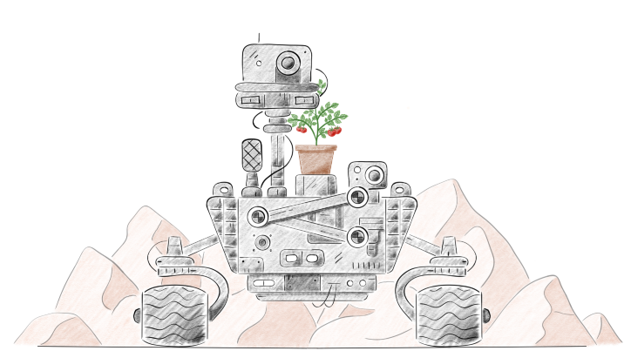
Mars rover with a tomato plant. (Drawing by Sophie Farkas, based on the Mars rover design by Alex Kunchevsky)
Growing plants on Mars
The idea of terraforming Mars has been in the minds of great thinkers for a long time, trying to overcome the above-mentioned challenges. Next to domed habitats, there are potential methods to increase Mars’s global temperature, which would release liquid water currently trapped as ice. Such methods include heat-trapping aerosols or greenhouse gas factories, but we will leave that to the climate scientists. In this paragraph, we focus on the current state of research regarding greening Mars.
“Restoring a habitable planet is harder than sustaining one…”
Based on the recent work of Servetto et al. (2026) on maize, we know that lower gravity and the magnetic field are not the limiting factors regarding growth, but the soil composition of Mars. We could transfer terrestrial soil or build hydroponic cultures, but the most efficient option would be to use the land at hand. Why is Martian regolith so toxic for plants? It contains perchlorate (ClO₄⁻), which inhibits plant growth already at concentrations as low as 1 wt.% in the soil, and in Martian regolith it reaches up to 2 wt.% (Oze et al., 2021). On Martian-like soil without perchlorate, several plant species performed well (Wamelink et al., 2014). As it turned out later, soil simulants can differ in many aspects from real Martian regolith, such as nutrient availability and the presence of strong oxidants and toxic salts (Eichler et al., 2021).
When perchlorate was mixed into terrestrial soil, grain amaranth and common bean plants still germinated, but showed severe growth defects. In the case of Martian soil, perchlorate already inhibited the germination of seeds, and probably due to the lack of nutrients, plants could not overcome its toxicity. In addition to being toxic itself, it also increases the release of different metals and phosphorus in the soil, which could cause problems even if we could wash perchlorate out of the soil (Oze et al., 2021). Nevertheless, perchlorate is not only harmful to plants, but to us humans too. The consensus is that we have to start with perchlorate-reducing bacteria. Then continue with other microbes, such as cyanobacteria and nitrogen-fixing bacteria. We need extremophile autotrophic pioneer organisms, which would thrive in an extreme environment using an abiotic source for energy, as the first organisms on Mars. And in the future, we might be able to engineer functional plant–microbe–regolith ecosystems on Mars (Fackrell et al., 2024).
Future prospects and challenges
Although there have been many successes, various challenges remain to be solved before any plants can be grown to their full potential in outer space. According to NASA (Massa et al., 2024), open questions include:
- Ventilation, aeration, and watering issues. On the Moon or Mars, these can result in such plant complications as fungal disease and abnormal growth, leaf curling, and excessive guttation.
- Food Sanitation. Even after resolving crop production issues, we then need to ensure proper food processing for safe consumption! There are some distinct concerns when it comes to agriculture in regolith in particular, given the chances of toxic metal exposure and accumulation.
- Radiation Effects. One interesting fact of plants is their natural protection against radiation damage to DNA, given their ability to undergo endoreduplication, providing themselves with several genome copies in case of genotoxic injury.
- Yield Data Collection, and Need to Select/Engineer/Breed for Improved Yields. Standardization and protocols for phenotyping and assessing yields are needed to provide clear answers on current capabilities and emerging needs.
- Similarly to yield, selecting specific crops for and collecting data on nutritional aspects. Although plants also contribute to psychological well-being, they play a significant role in crop production, and therefore, appropriate plants should be selected for a well-rounded astronaut diet.
In addition, we need:
- Non-invasive plant health monitoring systems
- Water and nutrient delivery for different gravity levels
- Resource recovery from inedible plant waste and human waste
- Test a wider variety of crops. Could we someday grow watermelons or even trees in space conditions?
Moving forward, while crop production and yield remain priorities, identifying the underlying molecular mechanisms behind these growth patterns and phenomena in these foreign environments needs further investigation (Ruyters & Braun, 2014). Spaceflight opportunities for hardware and experiments remain highly competitive and scarce, necessitating a more accessible space biology research landscape with affordable flight and simulator options (Kiss, 2015).
Why this research is important for Earth
Many may wonder, why should we care? Why should we study how to grow plants on other bodies rather than our own planet Earth? Well, most people don’t know that various agricultural technologies, including LED lights, were originally developed at NASA and later commercialized for public use (Kim et al., 2006). Termed technological spinoffs, these and other such technologies continue to contribute mutually to both agriculture on Earth and in space (Hertzfeld, 2002).
With the rising challenge of global climate change, certain parts of Earth are becoming more “Mars-like” with increasing desertification and the production of nutrient-poor soils, somewhat similar to Mars regolith (Burrel et al., 2020). In fact, some parts of Earth are so similar to sites on Mars that they are termed “analog sites”, used for field research involving geology and technology testing to prepare for missions to Mars (Hays et al., 2017). Plus, several Martian regolith simulants manufactured today, such as Mars Mojave, while expected to be physically and chemically similar to regolith on Mars, are sourced from locations found on Earth, such as the Mojave Desert (Peters et al., 2008). Overall, by preparing to grow plants on Mars, we as a society gain new knowledge about our own planet as well as new sustainable techniques involving Controlled Environment Agriculture and other approaches to mitigate the dangerous effects of pollution and climate change on global food security (Wright et al., 2023).
If you would like to hear more about space agriculture, watch this Plantae webinar from last year, titled “Plantae Presents – Role of Plant Scientists in Space Agriculture: Gardening the Galaxy”, featuring Simon Gilroy, Veronica De Micco, and Jenny Mortimer (https://youtu.be/4CuZj4_bM8w?si=nD7JXISWXZe_QheA).
References
Burrel, A. L., Evans, J. P., & Kauwe, M. G. (2020). Anthropogenic climate change has driven over 5 million km2 of drylands towards desertification. Nature, 11, 3853. https://doi.org/10.1038/s41467-020-17710-7
DeBenedictis, E. A., Kite, E. S., Wordsworth, R. D., Lanza, N. L., Cockell, C. S., Silver, P. A., … & McKay, C. P. (2025). The case for Mars terraforming research. Nature Astronomy, 9(5), 634-639. https://doi.org/10.1038/s41550-025-02548-0
Eichler, A., Hadland, N., Pickett, D., Masaitis, D., Handy, D., Perez, A., … & Palmer, A. (2021). Challenging the agricultural viability of martian regolith simulants. Icarus, 354, 114022. https://doi.org/10.1016/j.icarus.2020.114022
Fackrell, L. E., Humphrey, S., Loureiro, R., Palmer, A. G., & Long-Fox, J. (2024). Overview and recommendations for research on plants and microbes in regolith-based agriculture. npj Sustainable Agriculture, 2(1), 15. https://doi.org/10.1038/s44264-024-00013-5
Hays, L. E, Graham, H. V., Des Marais, D. J., Hausrath, E. M., Horgan, B., McCollom, T. M., Parenteau, M. N., Potter-McIntyre, S. L., Williams, A. J., & Lynch, K. L. (2017). Biosignature preservation and detection in Mars analog environments. Astrobiology, 17(4), 363–400. https://doi.org/10.1089/ast.2016.1627
Hertzfeld, H. R. (2002). Measuring the economic returns from successful NASA life sciences technology transfers. The Journal of Technology Transfer, 27, 311–320. https://doi.org/10.1023/A:1020207506064
Kim, H. H., Wheeler, R. M., Sager, J. C., Gains, G. D., & Naikane, J. H. (2006). Evaluation of lettuce growth using supplemental green light with red and blue light-emitting diodes in a controlled environment – a review of research at Kennedy Space Center. ISHS Acta Horticulturae, 711, 111–120. https://doi.org/10.17660/ActaHortic.2006.711.11
Kiss, J. (2015). Conducting plant experiments in space. Methods in Molecular Biology, 1309, 255–283. https://doi.org/10.1007/978-1-4939-2697-8_19
Landon, L. B., Massa, G. D., Wheeler, R. M., & Romeyn, M. W. (2025). Behavioral health benefits of space crop production. NASA Technical Reports Server. https://ntrs.nasa.gov/citations/20250000411
Massa, G., Wheeler, R. M.., Mickens, M., & Smith, T. (2024). Space crop production gaps and challenges. NASA Technical Reports, 20240010669. https://ntrs.nasa.gov/citations/20240002669
NASA Jet Propulsion Laboratory. (2023, October 26). NASA is locating ice on Mars with this new map. https://www.jpl.nasa.gov/news/nasa-is-locating-ice-on-mars-with-this-new-map
NASA. (2026, Jun 22). Mars Facts. https://science.nasa.gov/mars/facts
Oze, C., Beisel, J., Dabsys, E., Dall, J., North, G., Scott, A., … & Fendorf, S. (2021). Perchlorate and agriculture on Mars. Soil Systems, 5(3), 37. https://doi.org/10.3390/soilsystems5030037
Peters, G. H., Abbey, W., Bearman, G. H., Mungas, G. S., Smith, J. A., Anderson, R. C., Douglas, S., & Beegle, L. W. (2008). Mojave Mars simulant–Characterization of a new geologic Mars analog. Icarus, 192(2), 470–479. https://doi.org/10.1016/j.icarus.2008.05.004
Ruyters, G., & Braun, M. (2014). Plant biology in space: recent accomplishments and recommendations for further research. Plant Biology in Space, 16(s1), 4–11. https://doi.org/10.1111/plb.12127
Servetto, G. P., Botta, P., Rossi, G., Bernasconi, A., Caldo, F., Vigliaturo, R., & Maffei, M. E. (2026). Maize (Zea mays L.) survival on Mars depends on regolith’s chemical composition rather than reduced gravity or lack of magnetic field. Scientific Reports. https://doi.org/10.1038/s41598-026-50840-4
Wamelink, G. W., Frissel, J. Y., Krijnen, W. H., Verwoert, M. R., & Goedhart, P. W. (2014). Can plants grow on Mars and the moon: a growth experiment on Mars and moon soil simulants. PLoS One, 9(8), e103138. https://doi.org/10.1371/journal.pone.0103138
Wheeler, R. M. (2017). Agriculture for space: People and places paving the way. Open Agriculture, 2(1), 14–32. https://doi.org/10.1515/opag-2017-0002
Wright, H. C., Fountain, L., Moschopoulos, A., Ryan, A. J., Daniell, T. J., Cullen, D. C. , Shaughnessy, B., & Cameron, D. D. (2023). Space controlled environment agriculture offers pathways to improve the sustainability of controlled environment agriculture on Earth. Nature Food, 4, 648–653. https://doi.org/10.1038/s43016-023-00819-5
______________________________________________
About the Authors
Sophie Zoe Farkas
Sophie is a final-year PhD student at the University of Freiburg and a 2026 Plantae Fellow. Her research focuses on root system architecture, specifically the regulation of lateral root angle by genetic factors and environmental stimuli. When she’s not in the lab, you can find her on the football field or playing tunes on her alto saxophone. Find her on Bluesky: @sophiezoe.bsky.social | X: @fsophiezoe.
Jordan Hester-Moore
Jordan Hester-Moore is a returning student at University of Hawaiʻi at Mānoa pursuing a degree in plant biology and a 2026 Plantae Fellow. She brings to the American Society of Plant Biologists Plantae Fellows cohort a dedication to sustainable landscape science, science communication, and growing inclusive networks for early-career plant scientists.
Ruth Nichols
Ruth is a first year Plant Biology graduate student at Cornell University and a 2026 Plantae Fellow.. In the Julkowska Lab at the Boyce Thompson Institute, she is interested in studying the Pareto front optimality of root system architectures for water transport under abiotic stress, namely microgravity and outer space conditions. She enjoys reading sci-fi, watching scary movies, camping, drawing, and drinking too much coffee.
