

Saying No in Academia: Setting Boundaries Without Guilt
In research, work never really ends
“Happy to give this presentation.” “Sure, I can take on teaching hours.”
“I can do an extra side project.” “I’ll take care of this experiment over the weekend.”
Do phrases like that sound familiar?
Whether it comes from enthusiasm or guilt, the answer to every demand in academia is often “yes.”
From day one, we are taught that to thrive and stand out, we must work harder than everyone else. However, at some point in our research careers, many of us face an uncomfortable realization: that working hard is never enough, and that the finish line keeps moving.
Saying yes to every extra task can quickly lead to burnout, affecting not only your work but, more importantly, your mental health.
To thrive in academia, we need to stop waiting for the workload to decrease and start learning how to set boundaries—even when it feels like we are not “supposed” to.
Academia is not always a safe environment for mental health
Numbers don’t lie. We are facing a mental health crisis in academia, with one-third of PhD and master’s students worldwide experiencing depression (Evans et al., 2018). The severity of this situation is also reflected in postdocs’ mental health, with rising rates of depression and anxiety (Gewin, 2025; Russell et al., 2024).
These mental health issues seem to affect researchers at every stage of their careers and often arise from constant pressure, long working hours, and toxic research culture (Hall et al., 2023).
Why it is hard to say “no” in academia
One of the reasons it is so hard to say “no” in academia is that pressure exists at every level.
- Principal investigators (PIs) are often overworked to secure funding, manage their teams, teach, and keep projects running.
- Postdocs are expected to design and carry out experiments, support students, and publish consistently.
- PhD and master’s students are learning new skills while trying to generate results, publish, and contribute to lab work.
All of these consume a significant amount of time each day.
No matter the career stage, there is always more to do—writing, supervising, presenting, planning experiments. Everyone has a lot on their plate.
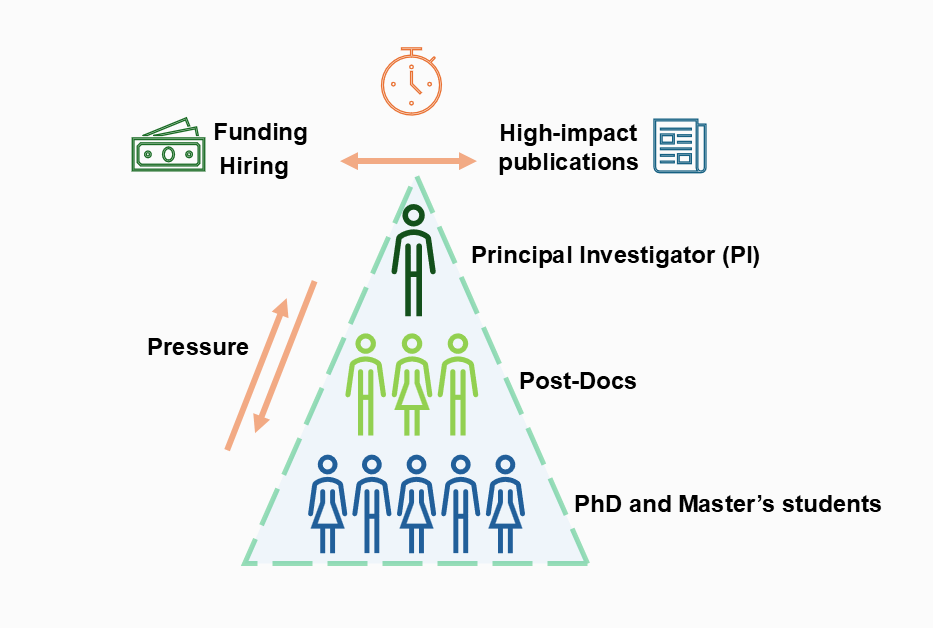
This creates a system where people constantly push themselves— and each other within research teams—to work harder, aiming for high-impact publications, strong scientific profiles, and funding success.
In such an environment, saying ‘no’ to additional tasks or unrealistic expectations can feel uncomfortable and risky, often being seen as a lack of commitment, particularly when the pressure is on and the clock is ticking.
But after spending enough time in this system, you may start to wonder:
“Where did the joy go?” “Can we be successful and still enjoy science and life?”
This can only happen if we take a step back, set boundaries, and make time for life outside the lab as well.
How to set your boundaries and say “no”
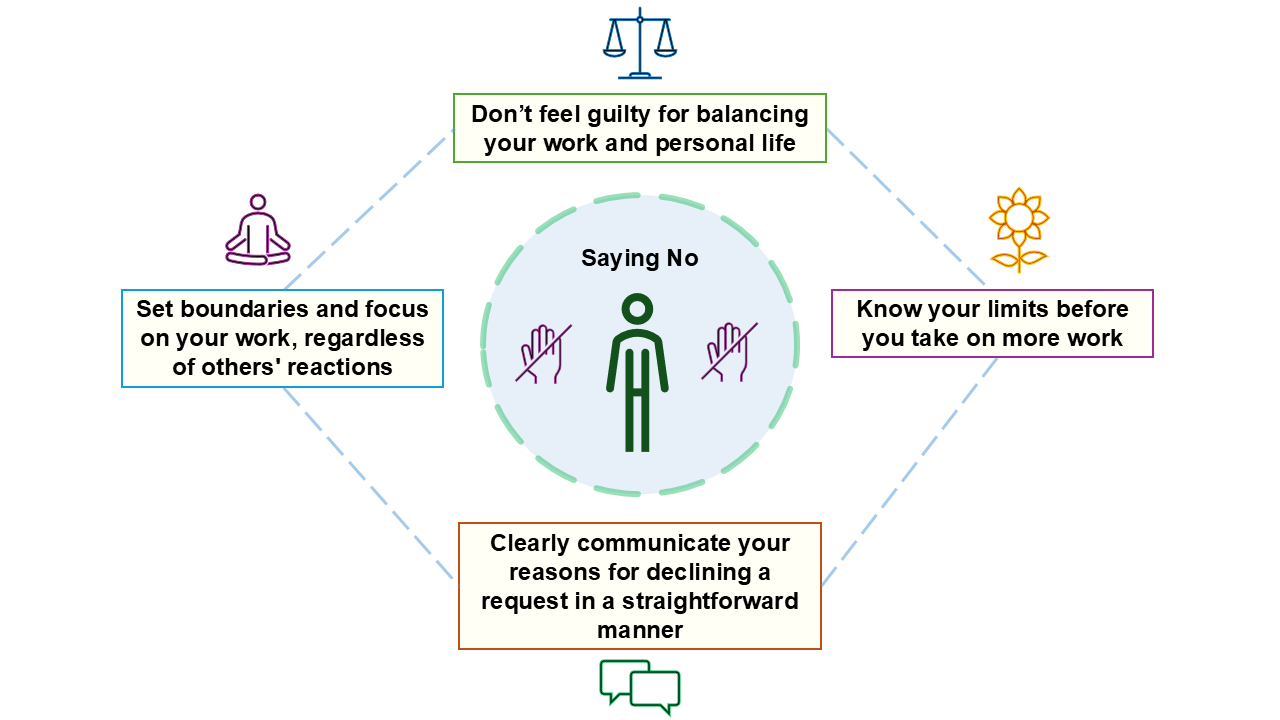
Learning to say “no” in academia is not about being unhelpful or unmotivated. It is about protecting your time and energy so you can do meaningful work without burning out and preserving time to enjoy life outside the lab.
- Set aside guilt and fear
- Sometimes we stress ourselves due to the guilt we feel when we spend time outside work doing things we enjoy, instead of finishing lab tasks.
- Other times, it is fear—fear that your supervisor expects too much in too little time, and that failing to meet those expectations will lead to disappointment or frustration.
Whatever the reason, these are not healthy patterns, and the first step is to accept that it is okay to want to change this situation.
- Recognize your limits and set boundaries
You cannot do everything, and you should not be expected to do this.
Taking on too much does not make you more successful—it just makes you exhausted and sometimes leads to mistakes during experimental setup.
- When your workload feels overwhelming (e.g. more than 40h of work every week, working at home after the lab all the time), prioritize and allow some tasks to wait for the next week.
- If you realize you no longer have time for activities you enjoy outside academia, it is a clear sign you are overdoing it. Protect your time and energy so you can still engage in things that make you feel good.
- Avoid working every weekend just because others are waiting for your results—unless there is a real deadline, a few extra days rarely make a difference.
- And when you push hard to meet a deadline, take time off afterward to recover. Don’t continue working from home—step away and recharge.
- Negotiate workload and say no when needed
There are times when taking on extra work can be beneficial for your skills, publications, and CV. But there are also tasks—like endless side projects—that add little value.
- Give yourself time before agreeing to new tasks. Instead of saying yes immediately, try saying, “I’ll have to think about it because right now I have these priorities … and I want time to do everything well and stay focused”
This small pause can help you make a more thoughtful decision. For example, evaluating if a new suggestion for an extra experiment is meaningful at your current work. - Before accepting new work, it can also help to ask yourself: Do I have the time to do this well without sacrificing my current priorities or my well-being?
- If possible, offer alternatives. You might suggest a later time, a smaller contribution, or recommend someone else. This allows you to stay collaborative without overcommitting and is also a way for example to decline joining a collaborative project where your contribution is not clearly defined or you don’t like it.
- When someone asks too much of you, just be honest and say it’s not realistic.
- When you do need to say no, keep it simple and respectful:
“I won’t be able to take this on right now due to my full schedule.” “I can’t take on anything else right now—I already have a full schedule and plan to take some time off.”
You do not need long explanations or apologies.
- Handle difficult reactions when setting boundaries
In practice, supervisors may continue asking for more. But being fully engaged in your job and contributing meaningfully to your research is enough, even when experimental outcomes are sometimes negative. That’s just how science is!
If a supervisor reacts negatively—through silence, pressure, or unfair treatment —even after you have clearly explained that you cannot take on additional work, remember that you are not responsible for their reaction.
In such cases, you may need to seek support, reassess the situation, or, if possible, consider a change. But most importantly, do not take responsibility for other people’s lack of boundaries. Focus on your work without constantly worrying about unrealistic expectations and accept that you are doing your part responsibly.
Final thoughts
It is also important to separate guilt from responsibility. Saying no can feel uncomfortable, especially in a culture where being busy is often seen as a sign of dedication. But overcommitting helps no one—not you, and not your work.
Every situation might be different. If you struggle to say no to every task and you feel overwhelmed, you can always reach out to a more experienced colleague to help you navigate how to set boundaries and avoid conflicts.
Finally, remember that rest is not something you earn after everything is done. In academia, the work is never truly finished. Rest is necessary to stay focused, creative, and engaged.
References
Evans TM, Bira L, Gastelum JB, Weiss LT, Vanderford NL. Evidence for a mental health crisis in graduate education. Nat Biotechnol. 2018 Mar 6;36(3):282-284. https://doi: 10.1038/nbt.4089
Gewin V. Postdoc depression and anxiety rates are rising, finds survey of 872 researchers 2025. Nature. CAREER NEWS. doi: https://doi.org/10.1038/d41586-025-02450-9
Hall S. A mental-health crisis is gripping science — toxic research culture is to blame. 2023. Nature. Nature 617, 666-668. doi: https://doi.org/10.1038/d41586-023-01708-4
______________________________________________
About the Authors
Fengoula Avgeri
Fengoula is a recent PhD graduate in Plant Molecular Biology from the Agricultural University of Athens, Greece and a 2026 Plantae Fellow. Her research expertise focuses on plant proteostasis and mitochondrial biology, while she sees science as an adventure without boundaries. Beyond her scientific pursuits, she enjoys the company of a good book, hiking in nature, and creating illustrations. Find her on Bluesky: @fengoulaavgeri.bsky.social and X: @AvgeriF.

