

What Vanilla, Morphine, and Denim Have in Common
Think about the last thing you ate. Maybe there was a hint of vanilla. Or a bitter edge to your coffee. Perhaps you drank something dark red: a berry smoothie, a glass of red wine. Now think about the last medicine you took, the fragrance you sprayed on this morning, or the blue jeans you are wearing. Plant chemistry is woven through all of it, and most of it traces back to a single category of compound: secondary metabolites.
What even is a secondary metabolite?
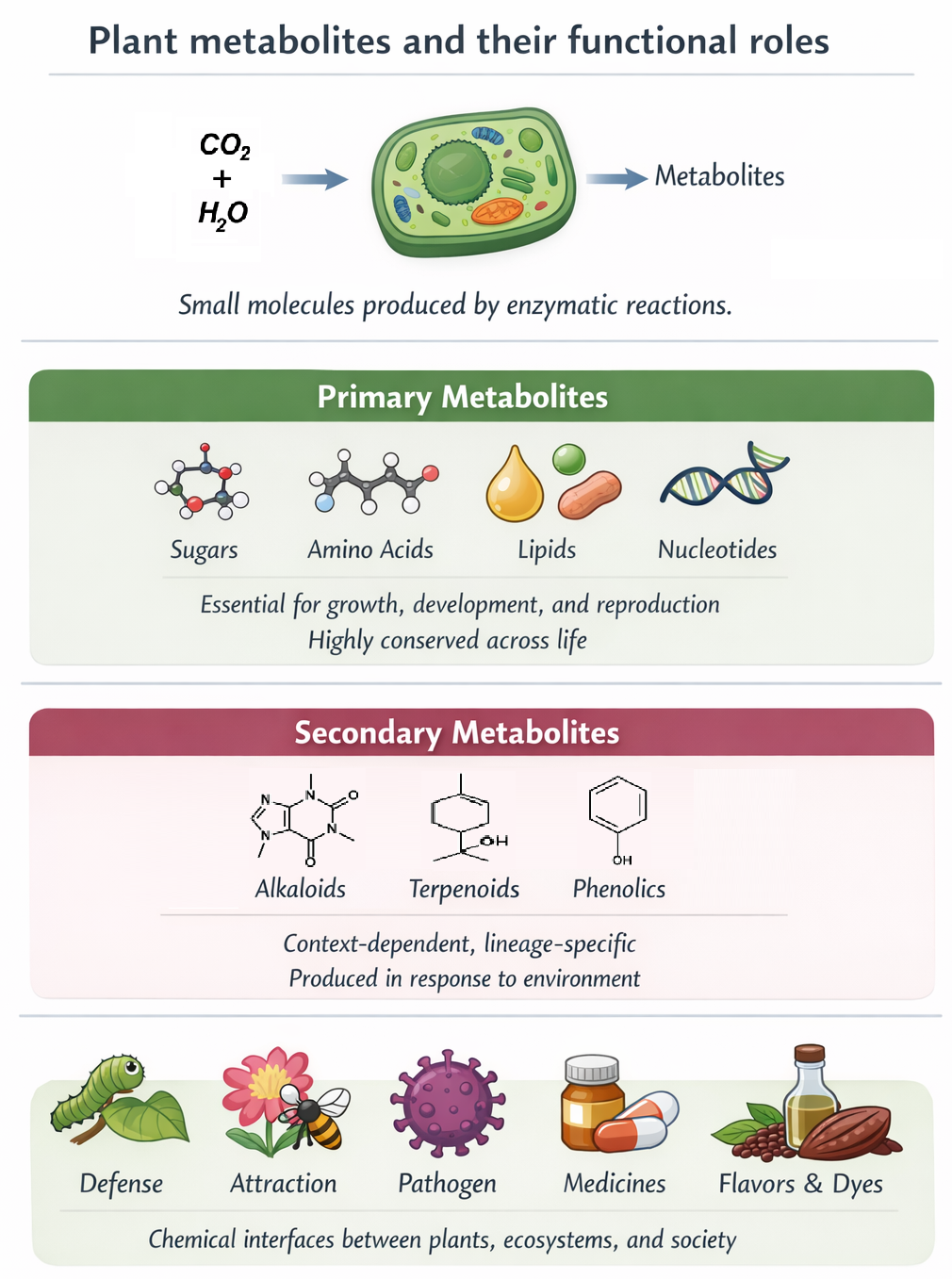
A quick refresher. Primary metabolites (sugars, amino acids, fatty acids) are the housekeeping molecules: universal, essential, and conserved across all life. Secondary metabolites are everything else (e.g. alkaloids, terpenoids, phenolics, glucosinolates). They are not required for basic survival, but they are critical for how plants navigate the world, deterring herbivores, fighting pathogens, luring pollinators, and coping with UV stress and drought. They tend to be taxonomically restricted, structurally diverse, and produced in specific tissues or in response to specific signals.
Ecologically, they are sophisticated chemical strategies refined over hundreds of millions of years. For us, they have been medicines, dyes, flavours, and tools. Seen from this angle, secondary metabolites are not peripheral products of plant metabolism, but chemical interfaces linking plant biology, ecosystems and society.
On your plate
Vanilla’s iconic flavour comes entirely from vanillin, a secondary metabolite produced in Vanilla planifolia seed pods. Once scientists determined its structure, vanillin became one of the first natural flavour compounds to be synthesised cheaply at scale (Khoyratty et al., 2018). Blueberries get their deep blue-purple colour from anthocyanins, flavonoid pigments that double as powerful antioxidants and are produced in response to environmental stress (Kalt et al., 2020). Mustard’s sharp heat comes from glucosinolates, the same family of defence compounds responsible for the notorious bitterness of Brussels sprouts. Breeding programmes have now produced Brussels sprout varieties that selectively reduce the most bitter glucosinolate profiles while maintaining agronomic performance, essentially dialling down the plant’s chemical defences to improve palatability (Qin et al., 2023).
Secondary metabolites also preserve our food. Cinnamaldehyde, which gives cinnamon its characteristic smell and flavour, has been used as a natural antimicrobial for millennia (Sun et al., 2020). Coumarins, found across dozens of plant families, have antimicrobial properties that can delay spoilage and inhibit rancidity (Reen et al., 2018). And then there is stevia: steviol glycosides from Stevia rebaudiana leaves that mimic sucrose sweetness without being sugars at all, now widely used as a low-calorie sweetener (Ahmad et al., 2020).
These are not marginal applications. Secondary metabolites define what food tastes like, how long it lasts, and increasingly, what we choose to put in it.
In your medicine cabinet
It is often said that most pharmaceuticals are derived from natural products, and plants sit at the heart of that. Before synthetic chemistry existed, plant extracts were medicine, and many of the compounds found in traditional herbal practices turned out to have remarkably precise biochemical activities (Wink, 2015).
Alkaloids are perhaps the most pharmaceutically prolific class. Morphine and codeine from the opium poppy remain cornerstones of pain management. Quinine from Cinchona bark was the first effective antimalarial. Vincristine and vinblastine from Catharanthus roseus are still used in chemotherapy. Galanthamine, an Amaryllidaceae alkaloid, is approved for Alzheimer’s disease (Kalola et al., 2024). Reserpine, once a mainstay antihypertensive, came from Rauwolfia serpentina and Ayurvedic medicine (Roy, 2018).
Beyond alkaloids: quinones such as shikonin and plumbagin show anti-cancer activity across multiple mechanisms, including topoisomerase inhibition, cell-cycle arrest, and apoptosis induction (Lu et al., 2013). Coumarins have given us warfarin (anticoagulant), methoxsalen (used in phototherapy for psoriasis and vitiligo), and calanolides with potent anti-HIV activity (Sharifi-Rad et al., 2021; Kashman et al., 1992). Stilbenes, including resveratrol from grapes and peanuts, are being actively investigated for cardioprotection, cancer prevention, and neurodegeneration (Sirén, 2024). Saponins from licorice and ivy are used in cough medicines and have shown activity against COVID-19 variants (Pastorino et al., 2018; Yi et al., 2024). Camptothecin and its derivatives, sourced from a Chinese ornamental tree, form the basis of several first-line cancer treatments (Suma et al., 2014)
Up to 65% of anticancer drugs trace back to plant secondary metabolites or their derivatives (Pérez-Ortega et al., 2025). That statistic alone should make any plant scientist feel proud of what their study organisms contribute to human health.
What you wear and how it smells
The fragrance industry runs on terpenes. Limonene gives citrus perfumes their brightness. Linalool is the calming floral note you recognise in lavender. The olfactory world we navigate daily is largely constructed from plant volatiles, most of them secondary metabolites (Barrales-Cureño et al., 2021).
Textiles have a longer history with plant pigments than most people realise. Indigo is a plant secondary metabolite and still one of the most recognisable dyes in the world, the colour behind billions of pairs of denim jeans. Anthocyanins and flavonoids provided red and blue dyes before synthetic chemistry arrived. Berberine gives a yellow colour; betalains provide violet through yellow tones (Rana et al., 2022). More recently, researchers are engineering carotenoid biosynthesis pathways directly into cotton fibres to produce naturally coloured fabric, embedding the metabolite pathway into the textile itself (Wang et al., 2025). Flaxseed oil, rich in lignans and alpha-linolenic acid, has long been used to impart waterproofing, softness, and antimicrobial properties to fabrics (Yildiz et al., 2025).
Surprising places you might not expect
Lignosulfonates are byproducts of wood pulping derived from lignin. They are used as dust suppressants in coal mining and road construction, and as binders in lead-acid battery paste (Fan et al., 2018; Ta’negonbadi & Noorzad, 2017). Plant chemistry is embedded in industrial infrastructure.
Some secondary metabolites mimic insect pheromones or act as behaviour-modifying compounds, which has proven useful in pest management in agriculture, poultry, and aquaculture (Hassemer et al., 2019; Rizvi et al., 2021). Catnip compounds (nepetalactones) are currently being investigated as insect repellents and have shown activity that may rival DEET (Reichert et al., 2019).
Perhaps the most elegant example is the auxin-inducible degron system. It exploits the plant hormone auxin to trigger rapid, targeted protein degradation in non-plant cells: yeast, human cell lines, chicken cells, nematodes. A piece of plant signalling machinery, transplanted into animal systems, became a precision tool for studying protein function (Nishimura et al., 2009).
Where things are heading
The trajectory is shifting from discovery toward deliberate design. Gene editing now allows more precise tuning of metabolite profiles in crops, removing bitterness, enhancing colour, and adjusting nutritional value without compromising yield. Hairy root cultures, induced by Agrobacterium rhizogenes, offer scalable production platforms for root-specific metabolites that are difficult or impossible to produce any other way. Synthetic biology is beginning to reconstruct entire secondary metabolite pathways in heterologous hosts.
There is also a conceptual shift underway. The term “secondary” was always a misnomer. These compounds are not optional extras bolted onto primary metabolism; they are how plants engage with the world. As their functions become clearer, the primary/secondary distinction is starting to look like a historical artefact rather than a biological truth.
There is nothing secondary about compounds that flavour our food, cure our diseases, colour our clothes, and underpin billions of dollars of industry. They are among the most chemically important molecules on earth. The next time you eat a cake, take a painkiller, or pull on a pair of jeans, you’ll know what to thank.
References
Ahmad, J., Khan, I., Blundell, R., Azzopardi, J., & Mahomoodally, M. F. (2020). Stevia rebaudiana Bertoni.: an updated review of its health benefits, industrial applications and safety. Trends in Food Science & Technology, 100, 177–189. https://doi.org/10.1016/j.tifs.2020.04.030
Barrales-Cureño, H. J., et al. (2021). Use of Secondary Metabolites from Medicinal and Aromatic Plants in the Fragrance Industry. In Medicinal and Aromatic Plants (pp. 669–690). Springer. https://doi.org/10.1007/978-3-030-58975-2_26
Fan, T., Zhou, G., & Wang, J. (2018). Preparation and characterization of a wetting-agglomeration-based hybrid coal dust suppressant. Process Safety and Environmental Protection, 113, 282–291. https://doi.org/10.1016/j.psep.2017.10.023
Hassemer, M. J., et al. (2019). Development of pull and push–pull systems for management of lesser mealworm, Alphitobius diaperinus, in poultry houses using alarm and aggregation pheromones. Pest Management Science, 75(4), 1107–1114. https://doi.org/10.1002/ps.5225
Kalt, W., et al. (2020). Recent Research on the Health Benefits of Blueberries and Their Anthocyanins. Advances in Nutrition, 11(2), 224–236. https://doi.org/10.1093/advances/nmz065
Kashman, Y., et al. (1992). HIV inhibitory natural products. Part 7. The calanolides, a novel HIV-inhibitory class of coumarin derivatives from Calophyllum lanigerum. Journal of Medicinal Chemistry, 35(15), 2735–2743. https://doi.org/10.1021/jm00093a004
Khoyratty, S., Kodja, H., & Verpoorte, R. (2018). Vanilla flavor production methods: A review. Industrial Crops and Products, 125, 433–442. https://doi.org/10.1016/j.indcrop.2018.09.028
Liyanage, N. S., et al. (2025). Coclaurine N-methyltransferase-like enzymes drive the final biosynthetic reaction of the anti-Alzheimer’s drug galanthamine in Amaryllidaceae. Plant Physiology and Biochemistry, 226, 110067. https://doi.org/10.1016/j.plaphy.2025.110067
Lu, J.-J., et al. (2013). Quinones Derived from Plant Secondary Metabolites as Anti-cancer Agents. Anti-Cancer Agents in Medicinal Chemistry, 13(3), 456–463. https://doi.org/10.2174/1871520611313030008
Nishimura, K., et al. (2009). An auxin-based degron system for the rapid depletion of proteins in nonplant cells. Nature Methods, 6(12), 917–922. https://doi.org/10.1038/nmeth.1401
Pastorino, G., et al. (2018). Liquorice (Glycyrrhiza glabra): A phytochemical and pharmacological review. Phytotherapy Research, 32(12), 2323–2339. https://doi.org/10.1002/ptr.6178
Pérez-Ortega, H. U., et al. (2025). Camptothecin in Cancer Therapy: Current Challenges and Emerging Strategies with Nanoemulsions. Pharmaceutics, 17(11), 1414. https://doi.org/10.3390/pharmaceutics17111414
Qin, H., et al. (2023). Developing multifunctional crops by engineering Brassicaceae glucosinolate pathways. Plant Communications, 4(4), 100565. https://doi.org/10.1016/j.xplc.2023.100565
Rana, R., Dhiman, K., & Ashawat, M. S. (2022). Natural Coloring Agents for Fibers and Their Medicinal Values: A Review. Journal of Natural Fibers, 19(16), 14755–14770. https://doi.org/10.1080/15440478.2022.2068730
Reen, F. J., et al. (2018). Coumarin: a novel player in microbial quorum sensing and biofilm formation inhibition. Applied Microbiology and Biotechnology, 102(5), 2063–2073. https://doi.org/10.1007/s00253-018-8787-x
Reichert, W., et al. (2019). Repellency Assessment of Nepeta cataria Essential Oils and Isolated Nepetalactones on Aedes aegypti. Scientific Reports, 9(1), 1524. https://doi.org/10.1038/s41598-018-36814-1
Rizvi, S. A. H., et al. (2021). Latest Developments in Insect Sex Pheromone Research and Its Application in Agricultural Pest Management. Insects, 12(6), 484. https://doi.org/10.3390/insects12060484
Roy, P. (2018). Global pharma and local science: The untold tale of reserpine. Indian Journal of Psychiatry, 60(6), 277. https://doi.org/10.4103/psychiatry.IndianJPsychiatry_444_17
Sharifi-Rad, J., et al. (2021). Natural Coumarins: Exploring the Pharmacological Complexity and Underlying Molecular Mechanisms. Oxidative Medicine and Cellular Longevity, 2021. https://doi.org/10.1155/2021/6492346
Sirén, H. (2024). Current research on determination of medically valued stilbenes and stilbenoids from spruce and pine with chromatographic and spectrometric methods — A review. Journal of Chromatography Open, 6, 100169. https://doi.org/10.1016/j.jcoa.2024.100169
Sun, Q., et al. (2020). The antifungal effects of cinnamaldehyde against Aspergillus niger and its application in bread preservation. Food Chemistry, 317, 126405. https://doi.org/10.1016/j.foodchem.2020.126405
Ta’negonbadi, B., & Noorzad, R. (2017). Stabilization of clayey soil using lignosulfonate. Transportation Geotechnics, 12, 45–55. https://doi.org/10.1016/j.trgeo.2017.08.004
Wang, Y., et al. (2025). Perspectives on developing natural colored cotton through carotenoid biofortification. New Crops, 2, 100054. https://doi.org/10.1016/j.ncrops.2024.100054
Wink, M. (2015). Modes of Action of Herbal Medicines and Plant Secondary Metabolites. Medicines, 2(3), 251–286. https://doi.org/10.3390/medicines2030251
Yi, Y., et al. (2024). Licorice-saponin A3 is a broad-spectrum inhibitor for COVID-19 by targeting viral spike and anti-inflammation. Journal of Pharmaceutical Analysis, 14(1), 115–127. https://doi.org/10.1016/j.jpha.2023.05.011
Yildiz, Z., et al. (2025). Bio-Derived Polymers for Eco-Friendly Textile Finishing. In Advancements in Textile Finishing (pp. 195–227). Springer Nature Singapore. https://doi.org/10.1007/978-981-96-6385-9_8
______________________________________________
About the Authors
Atharv Ambekar
Atharv is a second year PhD student at the Swammerdam Institute of Life Sciences (SILS) in University of Amsterdam (UvA) and a 2026 Plantae Fellow . His current research focusses on the metabolic dialogue between plants and microorganisms in the rhizosphere, and its role in orchestration of biotic interactions in the rhizosphere. Find him on X: @AtharvAmbekar2 | Bluesky: @atharvambekar2.bsky.social.
Adrián González Ortega-Villaizán
Adrián is a postdoctoral researcher at the Center for Plant Biotechnology and Genomics (CBGP) in Madrid (Spain), soon be joining the University of Nottingham (UK), and a 2026 Plantae Fellow . Adrián is a postdoctoral researcher at the Center for Plant Biotechnology and Genomics (CBGP) in Madrid (Spain) and he will soon be joining the University of Nottingham (UK). Find him on X: @adrigov98 | Bluesky: @adrigov.bsky.social.
Kavita Joshi
Kavita is a 2026 Plantae Fellow with a background in plant biology who is passionate about plant science research, science communication, and education.She is interested in creating content for ASPB that makes plant science accessible and engaging for both the general public and the broader plant science community through simple and approachable communication. In her free time, she enjoys crafting, gardening, and exploring nature as an eco-enthusiast.
Charlay Wood
Charlay is a postdoctoral researcher at the University of Wisconsin–Madison and a 2026 Plantae Fellow . Her research is a blend of plant biochemistry and synthetic biology, where she engineers crops to both capture more atmospheric carbon and transform it into high-value aromatic compounds. Find her on LinkedIn and X: @Charlaywood.
