
Promoting Scientific Visibility of Plant Sciences
Plant science drives the future of sustainable agriculture, climate resilience, and food security. Yet, the impact of plant science research remains invisible to the public eyes, and we call this plant awareness disparity (PAD), also referred to as plant blindness (Parsley et al, 2020). This blindness is not only overlooked in general community level but in education too. This lack of visibility affects everything from funding to motivation for research, slows down the progress of research projects, and limits the future opportunities for early-career researchers. Improving scientific visibility in plant science is not an option anymore; it has become essential and a central component for accelerating research and successful research careers for plant scientists. Scientific visibility is coined to refer to the extent to which ideas and research outputs are discoverable and accessible by the broader scientific community and public. The authors share a few current strategies promoting scientific visibility of this important yet much underhyped field.
K–12 Engagement: Transforming Young Minds into future plant Scientist
School-based outreach is one of the most effective ways to spark curiosity about plant sciences at an early age. Students learn about plants as living, dynamic creatures through interactive classroom activities like seed planting, microscopy sessions, transpiration experiments, etc. Field trips can help students understand plant sciences outside the classroom in a more engaging way (Friesner et al, 2021). At Phoenix’s Desert Botanical Garden, students get a chance to explore science during an outdoor field trip by touching the cool surface of cactus spines, walking on sandy trails, and breathing in the strong aroma of creosote. They experience science in the live desert in a way that no textbooks and classroom teaching can replicate. Likewise,the University of Nebraska–Lincoln hosts an annual “Plants Day” and invites school students to visit plant science stations, greenhouses, and meet researchers. Similarly, BRIC-National Institute of Plant Genome Research is a plant research institute that organizes annual “Open Day” events for school and college students with the aim of popularizing and showcasing various facets of plant research among young students and teachers. Such outreach events act as an interface with school and college students to acquaint them with the ongoing research in plants, foster an enthusiasm for plant biology, and motivate them to develop a scientific temper at a young age.
Beyond this, guest lectures by plant scientists in schools and colleges also offer students an exciting opportunity to learn about lab and fieldwork. Scientists help students see how classroom theories work in the real world, and what textbook images look like in a microscope. These interactions give new wings to their curiosity to imagine science beyond textbooks.
SciArt makes scientific learning more interesting and colorful. “Gerania-Mania” is a perfect example of it, where science blends with art and scientists help the young minds to translate their scientific imaginations into artwork. For example, in collaboration with Sullivan Plant Ecology Lab and Cedar Creek Ecosystem Science Reserve, an 8-week program is organized for 7th-grade students to analyze geranium productivity that includes drawing geraniums, conducting experiments, gathering data, and interpreting results.
Community-Level Outreach
Community-focused programs can make plant science visible, engaging, and meaningful to everyday audiences in an informal learning space. The Montgomery County Agricultural Fair serves as an impactful outreach model that has evolved into a community tradition, integrating family entertainment with practical experiences in agricultural science. Activities like the Mobile Science Laboratory provide real-world experience of biotechnology, aquatics, and agricultural science to young children and allow them to experience science with touch and experiments. Edinburgh’s Christmas at the Botanic is a widely celebrated public engagement event that includes light, sound, and firework displays that connect science with emotions and traditions. Visitor Interaction with illuminated trees, winter-adapted plants, and greenhouse collections leaves a deeper sense of understanding of plants as living organisms with histories, functions, and environmental roles.
Citizen science initiatives
Various Citizen science initiatives, such as phenology monitoring or biodiversity mapping, encourage the public to actively participate in scientific research in collaboration with plant scientists. Online platforms like iNaturalist and National Phenology Network (NPN) are a large network of researchers, policy makers, environmentalists, and educators, where anyone can submit plant-related data/information, which can be used by researchers globally. As an example, iNaturalist is used by scientists for tracking and monitoring alien species distribution patterns (López-Guillén et al. 2024). Similarly, a weather-forecasting app DROP was co-designed with northern Ghana’s local farmers for rainfed African agriculture, a perfect example of active community engagement in scientific advancements. Scientists integrate the local farmers’ knowledge about crops and cropping calendars, soil moisture, and indigenous ecological indicators, and integrate with meteorological data to develop this app. This enables farmers to decide when to plant and sow, when to use fertilizers and herbicides, and even schedule post harvesting (Sutanto et al, 2025).
While online platforms foster conversation, NGOs translate plant science into practice. For example, Planta!, a non-governmental conservation-focused community-based organization, promotes community-based projects to develop skills for effective conservation and raise public awareness about the importance of plants, building local capacity to create innovative solutions to environmental challenges through community networking and sharing.
Digital platforms as a virtual classroom
Digital media have become a powerful tool for early-career researchers to build their professional identities, connect with people, and promote individual research work with the community (Plantae blog, 2025). The Global Plant Council (GPC) is a key coordinator in promoting plant science globally in this rapidly evolving digital era. One of its targeted programs, ECRi supports early career researchers with job hunting, networking, grant funding,and dissemination of research results. One of the main pillars of such an ecosystem is Plantae, an online digital platform of the American Society of Plant Biologists (ASPB), which encourages and publishes plant biology research and promotes the interests, development, and education of plant scientists in society. ASPB Plantae blogs emerged as an effective platform for promoting plant science visibility that translates complex research into accessible and engaging content for the general audience. It provides diverse content ranging from highlighting current research in plant sciences to career inspiration stories and education-based articles.
Short reels and fast-motion recording on social media have become popular and engaging ways of efficient science communication by various ECRs. Similarly, podcasts bridge the gap between scientific research and society. “Beyond Shodh” podcast hosted by Dr. Sonia Balyan highlights the life of researchers and innovators in STEM, providing gleams in their personal journey in the form of inspiring stories. Podcasts depict relatable narratives and personal elements that resonate with listeners’ emotions, making scientific stories more engaging. In today’s world, YouTube vlogs have become a popular medium for promoting awareness of STEM research and innovation. A trained scientist, Sarah Habibi has emerged as a full-time content creator and a prominent digital science communicator. She relates scientific ideas to her personal life scenarios, making it exciting, relatable, and engaging for the audience
Scientific storytelling is a powerful approach for plant scientists to engage with the public and make them believe in plant sciences. This work requires training a diverse community of plant scientists according to the need to interact with the diverse community as a storyteller, public-facing figure, and science diplomat. These people make plant science more approachable, inclusive, and visible to society by using life experiences, cultural viewpoints, and communication skills (Henkhaus et al, 2019) .
Promoting visibility of plant sciences is for shaping a society that understands and values the role of plants in sustaining life. It is also not about self-promotion; it is about ensuring that important knowledge reaches the people who need it most. When scientists share their work openly, they help society recognize plants as an active essential partner in addressing global challenges. Long-term outreach impact also depends on institutional support and partnerships because when more voices are heard, science becomes richer, more innovative, and more representative of the global community it serves. When communication feels human, grounded, and relevant, people respond, they ask questions, they grow curious, and slowly the once invisible world of plant science becomes impossible to ignore.
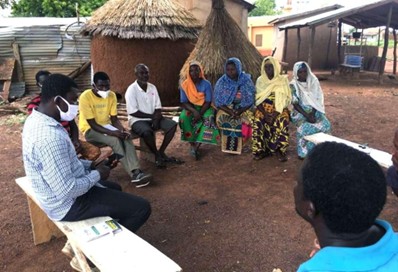
Showcasing the DROP app to participants in Nakpanzoo community, Northern Ghana. (Photo credit: Richard Kwame Dogbey)
References
Friesner J, Colón-Carmona A, Schnoes AM, Stepanova A, Mason GAX, Macintosh GC, Ullah H, et al. (2021) Broadening the impact of plant science through innovative, integrative, and inclusive outreach. Plant Direct 5: e00316. https://doi.org/10.1002/pld3.316
Henkhaus, N. A. et al. (2019). Removing systemic barriers to equity, diversity, and inclusion: Report of the Plant Science Research Network workshop ‘Inclusivity in the Plant Sciences’. https://doi.org/10.1002/pld3.432
López-Guillén, E., Herrera, I., Bensid, B., Gómez-Bellver, C., Ibáñez, N., Jiménez-Mejías, P., Mairal, M., Mena-García, L., Nualart, N., Utjés-Mascó, M., & López-Pujol, J. (2024). Strengths and Challenges of Using iNaturalist in Plant Research with Focus on Data Quality. Diversity, 16(1), 42. https://doi.org/10.3390/d16010042
Parsley KM (2020) Plant awareness disparity: A case for renaming plant blindness. Plants, People, Planet 2: 598–601. https://doi.org/10.1002/ppp3.10153
Plantae. (n.d).(2025) Promoting Science Communication Through Community Engagement, American Society of Plant Biologists. https://plantae.org/promoting-science-communication-through-community-engagement/
Sutanto SJ, Paparrizos S, Nauta L, Supit I, Lefèvre V, Kranjac-Berisavljevic G, Gandaa BZ, Dogbey R, Jamaldeen BM, Ludwig F (2025) DROP app: A hydroclimate information service to deliver scientific rainfall, local rainfall, and soil moisture forecasts for agricultural decision-making. Heliyon 11: e42740. https://doi.org/10.1016/j.heliyon.2025.e42740
______________________________________________
About the Authors
Priyanka Babuta
Priyanka is a 2026 Plantae Fellow and an enthusiastic plant biologist, currently working as postdoctoral researcher at National Institute of plant Genome research, New Delhi, India. Her research resolves around free radical biology and nitric oxide signaling with the focus to decipher molecular insights into the S-nitrosylation and denitrosylation in plants.
Kavita Joshi
Kavita is a 2026 Plantae Fellow with a background in plant biology who is passionate about plant science research, science communication, and education.She is interested in creating content for ASPB that makes plant science accessible and engaging for both the general public and the broader plant science community through simple and approachable communication. In her free time, she enjoys crafting, gardening, and exploring nature as an eco-enthusiast.

