

Plant Science in STEM Education
What is STEM education?
STEM, an abbreviation for Science, Technology, Engineering, and Mathematics, is a holistic approach to learning and the development of problem-solving skills by integrating these subjects. The interdisciplinary STEM educational framework not only provides basic knowledge but also equips students with the ability to apply that knowledge to real-world scenarios and problem-solving (DeVille, 2024).
STEM education has its roots in the 19th century. Global events such as World War II and the space race accelerated the need for a workforce skilled in “SMET” (Science, Mathematics, Engineering, and Technology). It was initially implemented as individual subjects, which were later integrated. In 2001, the term STEM was modified from the previous acronym “SMET” to improve learning efficacy by encouraging the pedagogy of interdisciplinary teaching, facilitating problem-based learning in the United States (Salinger and Zuga, 2009). Today, STEM has expanded globally. It has also included another stream, “A”, making it STEAM, adding a component of Arts to foster creativity with technical skills. STEM education reflects the up-to-date social dynamics. It can therefore be unique to the local culture.
Integrating Plant Science in STEM Education
Plant science directly connects with challenges that students can relate to in their own day-to-day life, such as food security, climate change, drought, flooding, and sustainable agriculture. Plant science naturally crosses interdisciplinary boundaries
- Biology: Plants provide opportunities to introduce fundamental biological concepts such as photosynthesis, respiration, genetics, cell biology, development, reproduction, and plant–microbe interactions. For example, to investigate the effects of environmental factors on seed germination or plant growth, instead of simply learning that light is necessary for photosynthesis, students can formulate hypotheses, design experiments, collect measurements, and interpret their observations.
- Chemistry: Plants are also an excellent platform for understanding chemistry. For example, students can perform simple chromatography experiments using plant extracts to separate pigments; explore changes in pH, or study enzyme kinetics in plants. In the most recent development, the use of nanoparticles in agriculture also depicts the use of chemistry in plant science.
- Physics: Plants can be regarded as natural physical laboratories. Physical factors like light, temperature, water, and gravity influence plant growth and development. Phototropism in sunflowers provides a simple example to correlate light direction and biological sensing. Plant transport can also be used to discuss concepts related to fluid movement, pressure, and diffusion.
- Mathematics: Plant experiments generate enormous amounts of measurable data, such as seed germination percentages, root and shoot lengths, plant height, biomass, growth rates, and others. These measurements need the use of mathematical analysis to transform the numerical values into graphs and tables. This proves that mathematics is an indispensable part of plant science.
- Engineering: This is an important part where scientific knowledge is applied to design solutions to real-world problems. The best examples include growth chambers with a controlled environment to grow plants, fast-breeding technology and vertical gardens. Plant science is also contributing to the development of technology. For example, nitric oxide is being used as a potential gas to reduce postharvest losses.
- Technology: Technology is further expanding in plant-based STEM learning. Advanced tools for image analysis and state-of-the-art instruments for precise research are increasing the scope of research in plant biology. Most importantly, tools like digital phenotyping and artificial intelligence are also helping in plant science research.
Case Study: Integrating Plant Science in Youth Activities
STEM education can be unique to the local culture. In this article, we take a youth camp in Hong Kong to showcase how plant science can be incorporated into youth activities.
In Hong Kong, instead of “STEM”, the term “STEAM” is more popularly used, with the letter A usually representing “Arts”. In a summer youth camp co-organized by a social enterprise and an academy for gifted education, the letter A further represents “liberal Arts”, referring to holistic development as a global citizen. The youth camp was organized in the campus of a local university, enabling high school students to taste hostel life, learn kitchen chemistry, conduct molecular biology experiments in a laboratory, and present their camp experience in a lecture theatre. Students from different high schools formed groups and participated in various activities, including tofu production and cooking, soybean genotyping, and video presentation. The activities enabled the students to gain different knowledge and skills.
Tofu production and cooking
Tofu is a popular plant-based food in East Asia. In the camp, the students produced tofu from soy milk and cooked it for dishes (Figure 1). They had to choose the coagulant that fits their dish choice. Since they were given different amounts of tokens for trading food ingredients and cooking tools, they had to do the accurate maths to successfully prepare the dish. They then presented the tofu dish to the judge for tasting, explained their ideas, and discussed how the dish choice was related to sustainability. In this activity, the students gained knowledge on kitchen chemistry and sustainability. They also gained skills including resource and risk management since most of them were not experienced chefs.
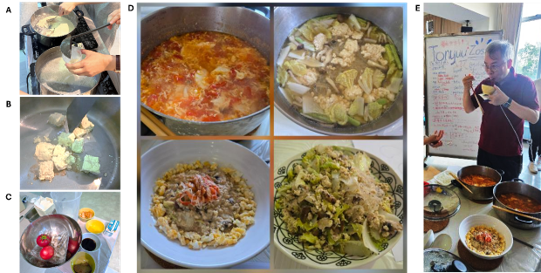
Figure 1. The students used soy milk to produce tofu for cooking (A-B). They then used different ingredients to prepare dishes using the tofu (C-D). The students presented their dishes to the judge for tasting and explained their ideas.
Soybean genotyping
In the laboratory, the students extracted genomic DNA from two different soybean varieties, which have different allelic forms of a major gene regulating salt tolerance. They then amplified the gene by polymerase chain reaction (PCR) and analysed the amplicons by electrophoresis (Figure 2). In this activity, the students learnt the genetic basis of stress tolerance regulation as well as the molecular techniques for the analysis. They also gained hands-on experience by doing the experiments by themselves.
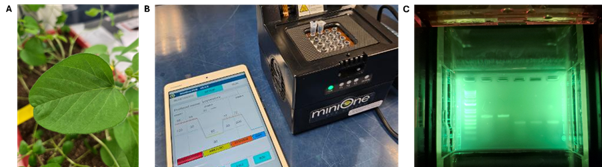
Figure 2. The students extracted genomic DNA from soybean leaves (A), amplified the target gene by PCR (B), and analysed the amplicons by electrophoresis (C).
Video presentation
During the above activities, the students had to start planning how they were going to present their experience. They needed to think about the storyline, then took suitable photos and videos for the presentation. In a lecture theatre, they presented their experience to judges, who were professors at the university and supervisors of the camp (Figure 3). In addition to video production, they gained skills including planning, storytelling, and discussion with the audience.
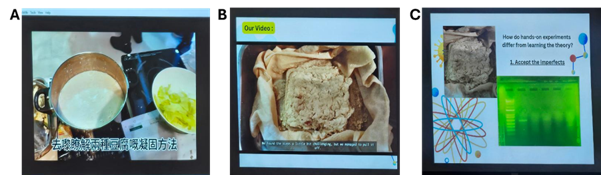
Figure 3. The students played their videos during the presentation. They explained the kitchen chemistry they learnt (A), the hands-on experience (B), and personal reflections (C).
Since all the activities were carried out in groups, the students learnt to cooperate with each other, despite their different backgrounds. The organizer also invited them to describe how they appreciated their group members, with prizes given to the best team player and the student who put in the most effort to appreciate others, in addition to challenging championships.
Summary
- STEM education facilitates students to apply knowledge to solve problems in the real world.
- STEAM education emphasizes Arts and liberal Arts.
- Plant science connects different domains of knowledge, including food security, climate issues, and sustainability.
- STEM education can be unique to the local culture with the intention to let students relate the knowledge to their own day-to-day life.
References
DeVille K. What is STEM? What You Need to Know. 2024. https://stemeducationguide.com/what-is-stem/. Retrieved October 8, 2026
Salinger G and Zuga K. Background and History of the STEM Movement. In The Overlooked STEM Imperatives: Technology and Engineering K-12 Education. (International Technology Education Association).
Acknowledgement:
We would like to thank the STEAM youth camp organizers, Soyvestors Co. Limited and The Hong Kong Academy for Gifted Education, for their consent to report on the activities in the camp.
______________________________________________
About the Authors
Priyanka Babuta
Priyanka is a 2026 Plantae Fellow and an enthusiastic plant biologist, currently working as postdoctoral researcher at National Institute of plant Genome research, New Delhi, India. Her research resolves around free radical biology and nitric oxide signaling with the focus to decipher molecular insights into the S-nitrosylation and denitrosylation in plants.
Yee-Shan Ku
Yee-Shan is a postdoctoral researcher at State Key Laboratory of Agrobiotechnology, The Chinese University of Hong Kong, a 2026 Plantae Editor. She is interested in comprehending life sciences at the molecular level. Her research focuses on plant metabolites, plant-microbe interaction, and agricultural biotechnology for crop improvement. X: @YeeShanKu1