In planta directed evolution: Turning a single leaf into a laboratory of quasi-infinite variants
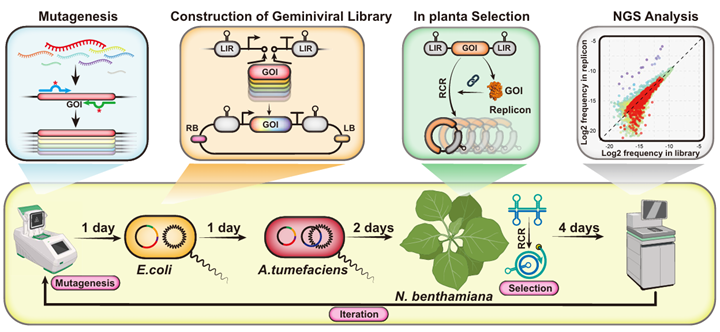 Directed evolution aims to identify variants of a gene of interest (GOI) with improved or novel functions by accelerating mutation and selection under experimental conditions. However, in planta platforms have been hindered by slow plant cell division. Recently, Zhu et al. introduced the geminivirus replicon–assisted in planta directed evolution (GRAPE) platform, enabling rapid improvement or reprogramming of gene function. It combines Nicotiana benthamiana cells for transient expression, GOI variant libraries generated through error-prone PCR or saturated mutagenesis, and a self-replicating artificial replicon engineered from a geminivirus. Replicons carrying GOI variants and replication proteins were delivered separately for controlled replication. Experimental conditions were optimized to ensure unbiased transmission of gene variants. Up to 10⁵ variants were tested in a single leaf within four days. Variant frequencies were quantified by deep sequencing, and performance was inferred by linking phenotype to replication levels. The system was validated by evolving two nucleotide-binding domain leucine-rich repeat-containing (NLR) immune receptors, using a selection scheme in which functional variants triggered hypersensitive response, cell death and their own depletion from the replicating pool. The NLR protein required for cell death, NRC3, evolved to escape inhibition by the nematode effector SPla/RYanodine receptor domain–containing Secreted protein 15 (SPRYSEC15), and iterative evolution of rice NLR receptor Pikm-1 generated variants capable of recognizing all six alleles of the Magnaporthe oryzae avirulence effector AVR-Pik. GRAPE turned the leaf into a “cellular multiverse” for accelerated Darwinian-like selection: each cell acted as a microcosm where variants replicated, were expressed, and became enriched or depleted according to their phenotype, transforming the leaf into an immense, nanoscale evolutionary laboratory. (Summary by Flavia Darqui @flavia-darqui.bsky.social) Science 10.1126/science.ady2167