A conserved pollen signal unifies intra- and interspecific reproductive barriers in Brassicaceae
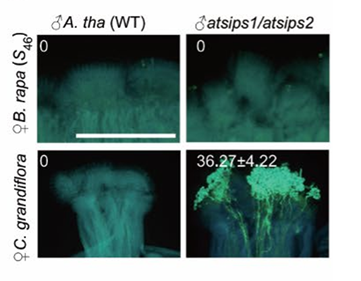 Distant hybridization is an important route for crop improvement, enabling the transfer of disease resistance and stress tolerance from wild relatives, but in Brassicaceae it is strongly restricted by stigma-based interspecific incompatibility. While self-incompatibility (SI) signaling via SCR–SRK is well established, the pollen signals responsible for rejecting heterospecific pollen have long been unknown. A recent study published in Science by Cao et al. resolves this gap. Through yeast two-hybrid screening and immunoprecipitation–mass spectrometry, the authors identified a family of pollen coat peptides from Arabidopsis thaliana, termed SIPS (SRK-interacting Interspecific Pollen Signals). Two members, AtSIPS1 and AtSIPS2, are secreted proteins that bind the extracellular domain of Brassica SRK with high affinity, comparable to canonical SCR–SRK interactions. SIPS perception recruits the receptor kinase FER, activates RBOH-dependent ROS production in the stigma, and rapidly reduces pollen viability. Genetic analyses show that SIPS-triggered ROS accumulation strictly depends on the SRK–FER pathway. Pollen lacking SIPS fails to induce ROS and survives much longer on heterospecific stigmas, identifying SIPS as the key initiator of interspecific pollen rejection. Comparative genomics reveals that SIPS homologs are restricted to a subset of Brassicaceae species and absent from non-Brassicaceae plants. Unlike SCR, SIPS binds conserved regions of SRK, allowing broad recognition across different S-haplotypes. (Summary by Yuanyuan Liu @YuanyuanLiu12) Science 10.1126/science.ady2347