
Rooted in Knowledge: How Plant Science Shapes Edible Landscapes Worldwide
Plant scientists often find themselves rethinking the boundaries between research and life experience. Understanding edible landscapes requires more than identifying species, their complex biology, and reproduction–it involves listening to the people who live with these plants every day, whose knowledge often precedes the academic lens by centuries. This became especially clear during the early months of the COVID-19 pandemic, when lockdowns and disrupted food supply chains spurred a surge in home and community gardening worldwide. Neighbors exchanged seeds over fences, apartment dwellers grew herbs on windowsills, and shared plots transformed vacant land into sources of fresh vegetables and shared purpose. These grassroots efforts mirrored the principles of edible landscaping–blending beauty, biodiversity, and food production–while reminding us that food plants are not just agricultural commodities but also threads in the fabric of community resilience.
Edible landscapes are defined as designed or managed spaces, be it urban, rural, or wild, where plants with nutritional, culinary, or otherwise edible uses integrate into the environment for both aesthetic and practical purposes. These landscapes may range from public parks planted with fruit trees to traditional home gardens or forest systems where edible species grow alongside other components of a functioning ecosystem (Rupprecht et al., 2023). This piece explores how scientists and communities across the world are working together to blend plant exploration, traditional knowledge, and the sustainable use of natural food resources to create innovative and culturally rooted approaches to nourish people and the planet.
From Tradition to Innovation: Aboriginal Partnerships in Native Food Conservation in Australia
With a strong emphasis on indigenous partnerships, Aboriginal communities in Australia are called upon to be stewards of their traditional lands, managing the landscapes and their natural resources. One flagship program is the Kakadu National Park in the Northern Territory of Australia. The Kakadu region, a UNESCO World Heritage Site, has been inhabited by Aboriginal communities for over 65,000 years, and is home to the oldest living culture on Earth.
Kakadu National Park is jointly managed by the government (Parks Australia) and the Bininj and Mungguy people. This formal partnership ensures these traditional owners retain management responsibilities, such as bushfood mapping, for their land. Also colloquially known as “bush tucker”, Australian bushfoods have been historically used and cultivated by people for sustenance and medicine for millennia. Bushfood mapping identifies and monitors native food and medicine traditionally used in the Kakadu region. Through the combination of traditional and scientific knowledge, elders and rangers employ sustainable management practices to preserve the biodiversity, culture, and landscape of Kakadu (Cooper et al., 2024). Aboriginal youths are also involved in the preservation of these management practices as the program aims to bolster participation via employment and education or through the promotion of bushfood-based social enterprises “to ensure the continuation of the transmission of traditional knowledge to the younger generation of indigenous stakeholders.”, said Giselle Cruzado Melendez. Giselle is a PhD student with the Fenner School of Environment and Society at the Australian National University, studying the social impacts of Australian bushfoods, and has kindly shared some insights into how indigenous-led programs maintain the edible landscape. Often, these programs can evolve into entire institutions dedicated to studying the social impacts and nutritional biochemistry of Australian native botanicals. One example is the Australian Research Council Training Centre for Uniquely Australian Foods, spearheaded by the University of Queensland. The institution focuses on “scientific, social, economic and legal research on native foods, plants and ingredients”, in collaboration with academic, industry, and indigenous partners. For instance, one research project explores the commercialization of the Kakadu Plum (Terminalia ferdinandiana), a fruit-bearing tree of considerable nutritional value. Wild harvesting of the Kakadu Plum should abide by cultural norms and current and emerging sustainable use practices. It is where research into the biology of the plant comes into the equation. The current state of traditional ownership towards edible landscapes is promising, but it takes continued effort from multiple stakeholders to support and maintain these edible landscapes.
Nurturing Nature and Community: The Edible Legacy of Colombia
In megadiverse countries like Colombia, which harbors some 4,200-4,800 useful plant species and about 3,805 edible plant species–nearly 3,688 of which are considered Neglected and Underutilized Species (NUS)–plant science offers critical insights into conservation and sustainable use (Gori et al., 2022; Negrão et al., 2022). Mapping this diversity reveals both botanical richness and conservation gaps, highlighting regions and species that remain under-documented. For plant scientists, such data provide the foundation for understanding edible plant distributions, ecology, and potential roles in climate-resilient food systems. Assessing the edible potential of local ecosystems begins in the field alongside local communities.
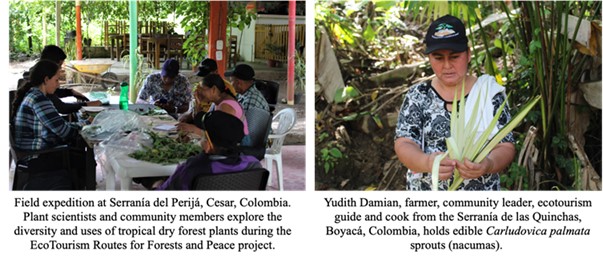
Several initiatives exemplify efforts by diverse stakeholders to bring together scientists and communities around edible landscapes. For instance, the EcoTourism Routes for Forests and Peace project has applied biodiversity research to the design of community-based ecotourism in two biodiversity-rich but conflict-affected regions of Colombia: the Serranía de las Quinchas (Boyacá) and the Serranía del Perijá (Cesar). Led in partnership with local community organizations, national NGOs, private tourism operators, and international collaborators such as the Royal Botanic Gardens, Kew, the project integrated floristic surveys–documenting endemic and useful plant species–with capacity building in guiding, gastronomy, and sustainable business practices. The scientific data informed route design and interpretation materials, while market analyses identified niche tourism segments such as birding, academic field visits, and community-led nature tourism. Indigenous and traditional knowledge was central both to shaping the tourism experiences and as a key input for scientists, enriching species inventories with information on local uses, management practices, and cultural significance. Over three years, this approach reduced reliance on extractive land uses, strengthened local plant knowledge, and positioned communities to connect biodiversity conservation with viable, market-ready tourism products.
Moreover, public research entities such as the Humboldt Institute are advancing the social appropriation of knowledge, conservation, and sustainable use of biodiversity–particularly plants–through national projects and policies. Under its missions of Biodiverse Productive Landscapes, Resilient Urban-Regional Landscapes, and Bioeconomy and Bio-based Businesses, the Institute supports efforts that integrate biodiversity into productive systems, urban planning, and market-based ventures. For example, the BiodiverCity Expedition in Barranquilla (the fourth largest city in Colombia and a major port located on the Caribbean coast) documented edible plant species in urban markets and co-created culinary prototypes with local cooks, while agrobiodiversity expeditions in Montes de María (a biodiverse mountainous region in northern Colombia, known for its rich ecosystems and ongoing social and environmental recovery after years of conflict) have strengthened the role of native crops in local food systems (Cárdenas Botero et al., 2023).
Other collaborative research efforts show how edible plant knowledge travels through generations and adapts to changing contexts. In the Pacific region, researchers working with Afro-Colombian communities have explored the rich local diversity of Vanilla species–some known for their aromatic potential, others for their cultural significance (Cárdenas Botero et al., 2018). Although traditionally used as perfume rather than food, these wild relatives of commercial vanilla hold promise not only for sustainable agroforestry but for opening new conversations about plant management and value. In these initiatives, science contributes methods for species identification and propagation protocols, while communities guide decisions about access, use, and meaning.
Colombia’s growing movement to link gastronomy and biodiversity, has also opened new paths for edible landscape research. Partnerships between chefs, scientists, local producers, restaurants and commerce are helping to recover and reimagine the use of native species–from Bactris palms harvested for sustainable palmito in Putumayo, a biodiverse Amazon region in southern Colombia, known for its indigenous cultures and ongoing post-conflict recovery, to criollo maize varieties protected and grown by campesino families in the Andes (Cárdenas Botero et al., 2018). These alliances demonstrate how supply chains can reinforce both biodiversity conservation and rural economies.
Heritage and Health: Revitalizing Edible Landscapes in the Asian Subcontinent
The Indian subcontinent’s extraordinary botanical diversity of over 18,000 flowering plant species has sustained sophisticated edible landscaping traditions for millennia, where deliberate arrangements in courtyards, temple gardens, and village commons create multifunctional spaces that blend aesthetics with nutrition. Plant scientists across India are now working to preserve and enhance these traditional systems, where fruit trees like mango (Mangifera indica) and jackfruit (Artocarpus heterophyllus) provide canopy cover for nitrogen-fixing drumstick trees (Moringa oleifera), while aromatic curry leaves (Murraya koenigii) and holy basil (Ocimum tenuiflorum) create layered gardens that serve daily cooking needs alongside cultural practices. Contemporary researchers at institutions like CSIR-NBRI and agricultural universities are documenting these traditional polyculture systems, analyzing soil health benefits, pollinator relationships, and nutritional outcomes to provide scientific validation for practices that have sustained communities across generations. This research reveals how traditional Indian edible landscapes maximize biodiversity and food security through sophisticated understanding of plant ecology, seasonal rhythms, and cultural integration that modern sustainable agriculture is only beginning to appreciate.
In the Indian context, any discussion of edible landscaping is deeply intertwined with Ayurveda–the ancient system that views plants as sources of food, medicine, and spiritual well-being. Today, urban gardening initiatives across India are breathing new life into this holistic Ayurvedic tradition by integrating medicinal herbs such as ashwagandha (Withania somnifera), known for its stress-relieving properties, and amla (Phyllanthus emblica), valued for its rich vitamin C content, alongside everyday kitchen staples. This scientific validation of Ayurvedic plant combinations is helping urban dwellers reconnect with India’s 5,000-year-old tradition of using food as medicine, transforming rooftops and balconies into therapeutic landscapes. In Mumbai, UGF Farms has planted over 10,000 kgs of micro-greens and educated 4,000 people about growing food organically in urban spaces (GFID India, 2024), while enterprises like iKheti and the UrbanMali Network facilitate urban farming by setting up and maintaining gardens of different scales across the city (Patil et al., 2023). The practical application of this scientist-community collaboration is further demonstrated by initiatives like the 25,000 sq ft volunteer-run urban farm at Tata Memorial Centre in Navi Mumbai, demonstrating how scientific insights are being applied to create community gardens and school programs that teach younger generations both practical skills and ecological principles rooted in India’s traditional knowledge systems.
The success of urban edible landscaping initiatives in India reflects broader Asian innovations where plant scientists are collaborating with communities to create food-producing landscapes that demonstrate remarkable productivity and sustainability. Thailand’s Thammasat University has created Asia’s largest organic rooftop farm, growing more than 40 edible species while mimicking traditional rice terraces to serve as an all-in-one solution–functioning as a public green space, water management system, urban organic food source, and outdoor classroom (Landprocess, 2019; Times Higher Education, 2020). Similarly, the integration of plant science with urban planning has produced concrete results in Singapore through organizations like Edible Garden City, which creates social change through community-centric agriculture by growing food in under-utilized spaces like rooftops.
The enduring success of edible landscapes across Asia demonstrates how plant scientists serve as crucial bridges between traditional wisdom and contemporary urban planning solutions, with documented outcomes that prove the viability of integrated food-producing systems. Research by the Indian Institute for Human Settlements suggests that urban agriculture, even on a small scale, can alleviate environmental challenges while providing organic food, tackling air pollution, building community connections, and promoting sustainable lifestyles (Abera et al., 2025). These initiatives show how traditional knowledge of plant combinations, soil fertility management, and seasonal timing translates into modern urban contexts through scientific validation and community partnerships.
Closing remarks
The urban, rural and forested edible landscapes of the world are not yet fully mapped, and perhaps they never will be in a conventional sense. But for plant scientists, these are not gaps–they are invitations. By working collaboratively, respecting local expertise, and acknowledging the deep time embedded in food traditions, we move toward a science that not only describes plants, but helps sustain the people who live with them.
References
Abera LE, Jumani S, van Rees CB, Krishnaswamy J, Seigerman CK, Nelson DR, et al. (2025) Integrating Nature-based Solutions for urban water security in global south. PLOS Water 4(6): e0000372. https://doi.org/10.1371/journal.pwat.0000372
Cárdenas Botero, K., Norden Medina, N., Flórez, M., Neita Moreno, J. C., Garzón, F., Santamaría, A. R., Martínez Callejas, S. J., & Espitia Reina, D. P. (2023). Ecosistemas culinarios. Uso de la agrobiodiversidad para la conservación del bosque seco en los Montes de María. Instituto de Investigación de Recursos Biológicos Alexander von Humboldt. http://hdl.handle.net/20.500.11761/36244
Cárdenas Botero, K., Waldron, T., & Hernandez-Manrique, O. L. (2018). Gastronomia y Biodiversidad (pp. 44–45).
Cooper, V., Calma, B., Nayinggul, C., Rawlinson, M., Dobbs, R., Rossiter-Rachor, N., & Douglas, M. (2024). Kakadu Research Strategy 2025—2035. Department of Climate Change, Energy, the Environment and Water. https://www.dcceew.gov.au/parks-heritage/national-parks/kakadu-national-park/management-and-conservation/research-strategy
Gori, B., Ulian, T., Bernal, H. Y., & Diazgranados, M. (2022). Understanding the diversity and biogeography of Colombian edible plants. Scientific Reports, 12(1), 7835. https://doi.org/10.1038/s41598-022-11600-2
Landprocess. (2019). Thammasat University Urban Rooftop Farm. Project documentation. Bangkok, Thailand.
Negrão, R., Monro, A., Castellanos-Castro, C., & Diazgranados, M. (2022). Catalogue of Useful Plants of Colombia. Kew Publishing.
GFID India. (2024). Urban agriculture in India. Grassroots Foundation for Integrated Development. https://gfidindia.org/UAII.php
Patil, S., Rao, N., Koduganti, M., Singh, C., Poonacha, P., Sharma, S., Roy, P., Mahalingam, A., and Singh, N. (2023). Sowing Sustainable Cities: Lessons for urban agriculture practices in India https://doi.org/10.24943/SSC12.2023.
Rupprecht, C.D.D., Gärtner, N., Cui, L., Sardeshpande, M., McGreevy, S.R., and Spiegelberg, M. (2023). Defining edible landscapes: a multilingual systematic review. Preprint at SocArXiv, https://doi.org/10.31235/osf.io/64uvj https://doi.org/10.31235/osf.io/64uvj
Times Higher Education. (2020). Thammasat University – Asia’s largest organic rooftop farm. Times Higher Education. https://www.timeshighereducation.com/research/thammasat-university/thammasat-university-asias-largest-organic-rooftop-farm
______________________________________________
About the Authors
Aditi Bhat
Aditi is postdoctoral researcher in Haney lab at University of Pittsburgh and a 2025 Plantae Fellows. She currently investigate the diverse role of receptor-like-kinases in regulating plant autoimmunity. Outside of lab, she like exploring new areas through food and hikes taking copious pictures along the way! You can find her on X: @jumpy_botanist.
Gabriela Doria
Gabriela is a botanist and paleobotanist exploring plant evolution, flower development, and pollination biology. She’s currently a lecturer at EAFIT University (Medellin, Colombia) and a 2025 Plantae Fellows. With a strong awareness of environmental issues, she incorporates sustainable practices into her daily lab and academic work. During her PhD at the University of Cambridge, she served as her lab’s Green Representative, co-leading the campaign to eliminate single-use plastic cups and supporting initiatives that earned the Department a “Green Impact Labs” Gold Award. You can find her on X: @gabidoria | Bluesky: @gabidoria.bsky.social | LinkedIn: https://www.linkedin.com/in/gabriela-doria-7b267526/.
Marvin Jin
Marvin is a PhD student in the Research School of Biology at the Australian National University and a 2025 Plantae Fellows. Curious about plant developmental biology, his research focuses on identifying putative gene targets regulating root angle growth in hopes to engineer better crop root systems for future climates and environments. X: @MarvinJYS.
