
Hooked hairs: A new cell type aiding seedling survival in common bean
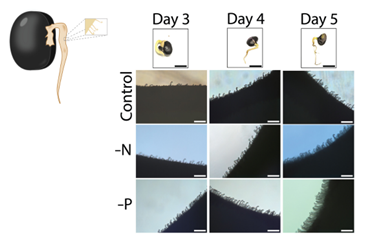 Roots play a critical role in determining seedling resilience mechanisms to abiotic stress conditions. Despite advancements in the characterization of root systems at phenotypic and cellular levels, the diversity of belowground epidermal microstructures remains poorly understood, particularly prior to root hair emergence. A recent study by Cervantes-Pérez et al. describes the “hooked hair”, a previously unrecognized unicellular epidermal microstructure in Phaseolus vulgaris that emerges 1 to 3 days post-germination, well before root hairs develop. Using an integrated approach combining image-based phenotyping with single-cell transcriptomics and weighted gene coexpression network analysis (WGCNA), the authors show that hooked hairs are morphologically and transcriptionally distinct from root hairs and trichomes. Hooked hairs elongate significantly under phosphorus and nitrogen limitation. Their transcriptomes are enriched for nitrate transporters (NRT1, NRG2), suberin biosynthesis genes, and hydrogen peroxide transport functions. Physiological assays confirmed phosphatase activity, suberin deposition, and ROS accumulation, supporting roles in nutrient acquisition, water retention, and biotic stress defense. The irreversible nature of suberin biosynthesis argues that hooked hairs constitute a discrete cell type rather than a transient state. The findings expand the known diversity of plant epidermal cells and identify a candidate target for engineering climate-resilient seedlings in nutrient-limited and drought-affected soils. (Summary by Sonia Balyan) Sci. Adv. 10.1126/sciadv.adz6873