

Review: Nitrogen sensing in plants ($)
Plant Science Research Weekly, Research0 Comments
/
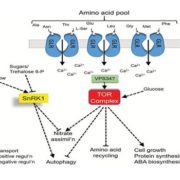
Like other organisms, plants have developed mechanisms to sense and respond to changes in the availability of nutrients. Nitrogen (N), being very essential for the growth and development of plants, must also be strongly monitored by plants. N sensing and signaling in plants are highly researched topics,…
Review: Stomatal development in time: the past and the future ($)
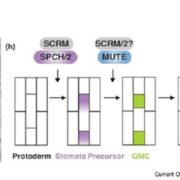
Plant Science Research Weekly, ResearchStomata, epidermal pores for gas exchange, first appeared about 400 million years ago. Since then, there has been functional and structural diversification. Qu et al. synthesize the developmental genetics underpinning diverse stomata, spanning from bryophytes through monocots and the astomatous (without…
Meeting Review: Auxin 2016 ($)
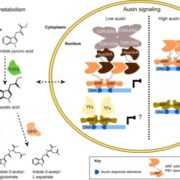
Plant Science Research Weekly, ResearchVernoux and Robert discuss research presented at the Auxin 2016 meeting, held in October 2016 on the island of Hainan, China. The result is a nice review of very current research, spanning auxin metabolism and signaling, the role of auxin in development, interactions between auxin and other signals,…
Reviews: Challenges in bacterial molecular plant pathology
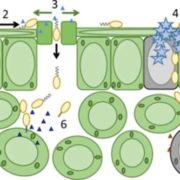
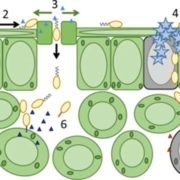
Plant Science Research Weekly, ResearchMolecular Plant Pathology has released a new series of free reviews on “Challenges in Bacterial Molecular Plant Pathology.” Topics so far:
Morris et al. Frontiers for research on the ecology of plant-pathogenic bacteria: fundamentals for sustainability 1111/mpp.12508
Pfeilmeier et al. Bacterial…
Reviews: Challenges in bacterial molecular plant pathology
Plant Science Research Weekly, ResearchMolecular Plant Pathology has released a new series of free reviews on “Challenges in Bacterial Molecular Plant Pathology.” Topics so far:
Morris et al. Frontiers for research on the ecology of plant-pathogenic bacteria: fundamentals for sustainability 1111/mpp.12508
Pfeilmeier et al. Bacterial…
Perspective: Periodic lateral root priming: What makes it tick
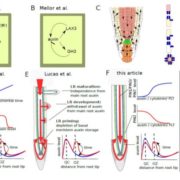
Plant Science Research Weekly, ResearchThe very earliest step in lateral root formation is “priming”, a still-elusive process that establishes a subset of cells as competent to form lateral roots. In this Perspective, ten Tusscher and Laskowski review evidence for priming, which involves oscillations of auxin level or responsiveness…
What We're Reading: February 24
Plant Science Research Weekly
Insight: Why we need more non-seed plant models
There is much to be learned from comparing plant genomes, but as Rensing writes, currently available genomic data are skewed heavily towards angiosperms. He argues that a richer understanding of plant evolution depends upon gaining insights into…
Insight: Why we need more non-seed plant models
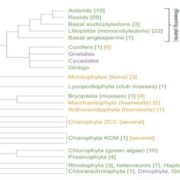
Plant Science Research Weekly, ResearchThere is much to be learned from comparing plant genomes, but as Rensing writes, currently available genomic data are skewed heavily towards angiosperms. He argues that a richer understanding of plant evolution depends upon gaining insights into the non-seed plants, including ferns, mosses and liverworts,…
A Histone Chaperone and a Specific Transcription Factor Modulate GLABRA2 Expression in Root Hair Development
Research, The Plant Cell: In BriefIN BRIEF by Jennifer Mach [email protected]
To navigate its essential function of producing mRNAs, RNA polymerase II (Pol II) must navigate the thread of DNA, which winds around thousands of nucleosomes. If you’ve ever tried to use a sewing machine but got your bobbin thread tangled, then the task faced…