


Lateral root priming synergistically arises from root growth and auxin transport dynamics (bioRxiv)
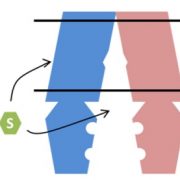
Plant Science Research WeeklyRoot system architecture is primarily determined by branching of the lateral roots. The position of a new lateral root is determined by oscillating auxin concentrations in the main root meristem. To understand the nature of auxin oscillations Van den Berg and ten Tusscher developed a multiscale root…
How to identify the substrates of ATP-binding cassette (ABC) transporters (Plant Physiol)
Plant Science Research WeeklyPlant genomes encode many ATP-binding cassette (ABC) transporters, which mediate the transport of many different substrates involved in development, nutrition and stress responses. Mutants and transgenic plants have been used to understand the in planta roles, yet the identity of substrates transported…
Review. Out of shape during stress: a key role for auxin
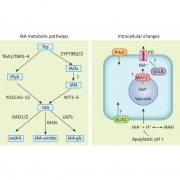
Plant Science Research WeeklyThe plant hormone auxin is a major player in determining root growth and architecture, but we are just starting to understand how auxin distribution is altered by abiotic stresses. Kover et al. discuss how the “upside-down fountain” of auxin in the root is affected by abiotic stress conditions. Auxin…
Review. Brachypodium: A monocot grass model system for plant biology (Plant Cell)
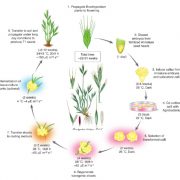
Plant Science Research WeeklyBrachypodium distachyon is an annual C3 grass that has become an important model species. Scholthof et al. review the genetic tools and resources (sequences and mutants) as well as robust protocols for transformation that have been developed for it. The presence of wild and perennial species within the…

Review. Actions of plant Argonautes: Predictable or unpredictable? (COPB $)
Plant Science Research WeeklyThe Arabidopsis genome encodes nine Argonaute proteins and an AGO pseudogene. The nine functional proteins fall into three clades based on sequence. Ma and Zhang update what we know about these proteins. It turns out, the simple assumptions made early on have not entirely been borne out. For example,…
Review. Genetically encoded biosensors in plants: Pathways to discovery (Annu. Rev. Plant Biol. $)
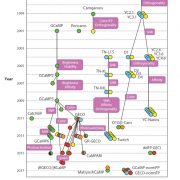
Plant Science Research WeeklyGenetically-encoded biosensors are produced from genes, and provide a specific readout (usually fluorescence or luminescence) of the amount and distribution of a compund of interest (the analyte). We’ve all see data obtained from genetically encoded biosensors, such as the widely-used cameleon family…
What We're Reading: July 13th
Blog, WWR Full PostReview. Genetically encoded biosensors in plants: Pathways to discovery ($)
Genetically-encoded biosensors are produced from genes, and provide a specific readout (usually fluorescence or luminescence) of the amount and distribution of a compund of interest (the analyte). We’ve all see data obtained…
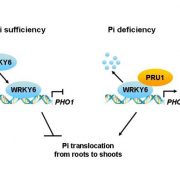
Phosphate Translocation from Roots to Shoots is Precisely Modulated
Research, The Plant Cell, The Plant Cell: In a NutshellYe et al. discover a protein that mediates phosphate translocation and is dependent on environmental phosphate supply. Plant Cell (2018). https://doi.org/10.1105/tpc.17.00845
By Qing Ye and Yi-Fang Chen
Background: Phosphorus is a major essential nutrient for plant growth and development, and phosphate…
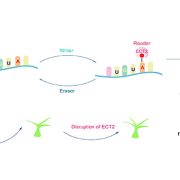
Function of m6A in Arabidopsis
Research, The Plant Cell, The Plant Cell: In a NutshellWei et al. Study m6A binding protein ECT2 in Arabidopsis. The Plant Cell (2018). https://doi.org/10.1105/tpc.17.00934
By Lian-Huan Wei
Background: N6-methyladenosine (m6A) is the most abundant chemical modification of eukaryotic messenger RNA (mRNA). The regulation of m6A modification plays important…