

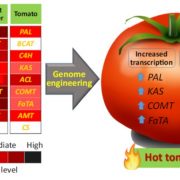
Opinion: Capsaicinoids: Pungency beyond Capsicum (Trends Plant Sci)
Plant Science Research WeeklyYou probably saw this article being discussed in your favorite news channel (in the UK, coverage spanned from the Daily Mail to the Guardian). In an Opinion article, Naves et al. discuss the genetics, biochemistry, ecology and health-benefits of capsaicinoids (the “heat” in chili pepper), and consider…
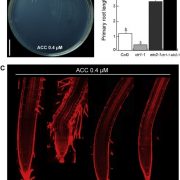
CONSTITUTIVE TRIPLE RESPONSE 1 and PIN2 coordinately regulate indeterminate root growth (Plant Sci)
Plant Science Research WeeklyMéndez-Bravo et al. explored the mechanism for the dramatic phenotype of the ctr1 mutant (CONSTITUTIVE TRIPLE RESPONSE 1), which inhibits both cell division and elongation. In the ctr1-1 mutant background, auxin response is induced at the root tip and an increase in expression of the auxin transporter…
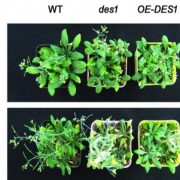
Hydrogen sulfide regulates energy production to delay leaf senescence induced by drought stress in Arabidopsis (Front Plant Sci)
Plant Science Research WeeklyPremature leaf senescence can occur due to a mutation of a L-cysteine desulfhydrase1 (DES1) gene that encodes an enzyme that produces hydrogen sulfide (H2S), a "gasotransmitter" with functions in plants as well as mammals. Jin et al. explored the physiological functions of H2S in Arabidopsis. In addition…

PID/WAG-mediated phosphorylation of PIN3 mediates polarity switches during gravitropism (Sci Reports)
Plant Science Research WeeklyAuxin distribution depends on the polar localization of PIN-FORMED or PIN proteins. Based on different development and environmental stimuli, PIN proteins switch polarity to redirect the auxin flux. Additionally, phosphorylation of PIN is required for its function. For instance, PIN3 phosphorylation…
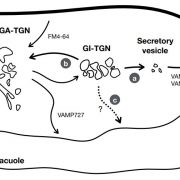
A Golgi-released subpopulation of the trans-Golgi network mediates protein secretion in Arabidopsis ($)
Plant Science Research WeeklyThe plant trans-Golgi network (TGN) plays the role of early endosomes and acts as hub for the both secretory and vacuolar trafficking pathways. Two types of TGN, GA-TGN (Golgi-associated TGN) and GI-TGN (Golgi-released independent TGN), have been observed in plants. Here, Uemura et al. explore the cellular…
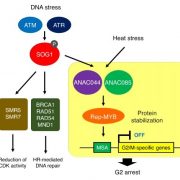
A regulatory module controlling stress-induced cell cycle arrest in Arabidopsis (bioRxiv)
Plant Science Research WeeklyProgression of the cell cycle central to growth, but during stress conditions plants arrest cell cycle progression to enable the organism to survive. SUPPRESSOR OF GAMMA RESPONSE 1 (SOG1), a plant-specific NAC-type transcription factor, regulates the expression of almost all genes induced by double-strand…
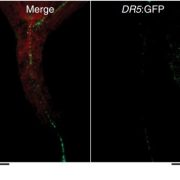
Interplay of auxin and MEcPP regulates adaptive growth (Nature Comms)
Plant Science Research WeeklyMEcPP, methylerythritol cyclophosphate, is an essential bifunctional plastidial metabolite that serves as a precursor of isoprenoids and is produced by the plastidial methylerythritol phosphate (MEP) pathway. Jiang et al. demonstrated that MEcPP controls adaptive growth by regulating auxin responses…

Recognizing Plant Cell first authors: Liyun Jiang
The Plant Cell, The Plant Cell: Author ProfilesLiyun Jiang, first author of The APETALA2-like transcription factor SUPERNUMRARY BRACT controls rice seed shattering and seed size
Current Position: Ph.D candidate, Department of Plant Genetics and Breeding, China Agricultural University, Beijing, China
Education: 2012–B.S., Agronomy, Jiangxi Agricultural…

A Root Endoploidy Map: The Spatial and Temporal Arrangement of Dividing and Endocycling Cells
Research, The Plant Cell, The Plant Cell: In a NutshellBhosale et al. computationally predicted and experimentally verified the DNA ploidy level of all cells in the Arabidopsis root tip, revealing that endoreplication is spatiotemporally regulated, stress-responsive, and likely important to coordinate cell expansion with changes in cell wall structure. Plant…