

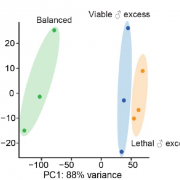
Father Knows Best? Small RNA Pathway Controls Endosperm Response to Paternal Genomic Dosage
Research, The Plant Cell, The Plant Cell: In BriefIn flowering plants, seed viability is dependent upon the endosperm, a triploid tissue produced by fertilization of a diploid central cell by a haploid sperm. Most endosperm genes are expressed in a 2:1 maternal to paternal ratio reflecting the genomic DNA content. Consequently, balance between maternal…
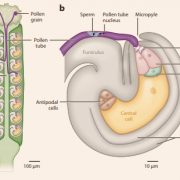
Review: A fruitful journey: Pollen tube navigation from germination to fertilization ($)
Plant Science Research WeeklyWhen pollen is deposited on a flower’s stigma, pollen tubes penetrate the stigma and elongate towards ovules where two non-motile sperm will double fertilize an egg and a central cell, which requires cooperation between many cell types. Johnson et al. review our current understanding of these processes.…
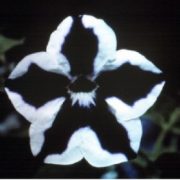
Reflections on Classics: Plant Cell‘s 30th anniversary
Plant Science Research Weekly“The 1980s were an exciting and revolutionary time for biology, and plant molecular biology in particular,” begins an editorial by Bob Goldberg, Brian Larkins, and Ralph Quatrano, the three Founding Editors of The Plant Cell. They describe why the American Society of Plant Physiologists (ASPP; later,…
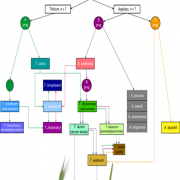
Wheat exome sequencing and wheat ancestry (Nature Genetics)
Plant Science Research WeeklyWheat is of course a hugely important food for humans, and has been selectively bred across the globe for millennia. Modern bread wheats are hexaploid and contain three distinct subgenomes (AABBDD). As with other crops, there is a need to understand wheat’s ancestry and explore the greater genetic…
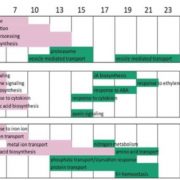
Identification of transcription factors regulating senescence in wheat through gene regulatory network modelling (Plant Physiol)
Plant Science Research WeeklyLike other seed crops, wheat yields depend in part on the efficiency with which nutrients stored in leaves are mobilized into the developing seeds. This depends on the several processes from macromolecule breakdown to transport, as well as the timing of leaf senescence. Borrill et al. used RNA analysis…
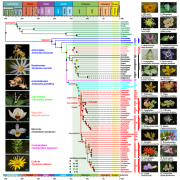
Origin of angiosperms and the puzzle of the Jurassic gap (Nature Plants)
Plant Science Research WeeklyUnderstanding the origin and evolution of flowering plants is key to explaining the development of major terrestrial ecosystems. The rapid diversification of angiosperms into over 360,000 extant species was famously termed ‘an abominable mystery’ by Charles Darwin. Here, Li et al reconstruct the…
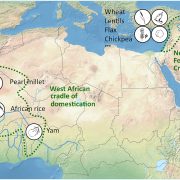
Yam genomics supports West Africa as a major cradle of crop domestication (Sci Advances)
Plant Science Research WeeklyYams (Dioscorea spp.) were domesticated independently in three continents. African yam (Dioscorea rotundata) is the second most produced crop in Africa, after cassava but ahead of maize, rice and sorghum. Scarcelli et al. use a genomic approach to learn more about its domestication, by sequencing many…
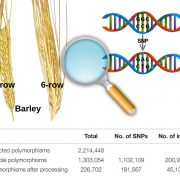
Development of genome-wide SNP markers for barley via reference- based RNA-Seq Analysis (Front Plant Sci)
Plant Science Research WeeklyThe availability of marker-assisted systems is key for crop improvement, allowing trait selection by identifying consensus polymorphisms. However, for discriminating between related strains, these DNA markers are limited, time-consuming and expensive. Here, Tanaka et al. developed a RNA-Seq-based genotyping…

Loss-of-function of a tomato receptor-like kinase impairs male fertility and induces parthenocarpic fruit set (Front Plant Sci)
Plant Science Research WeeklyThe flower-to-fruit transition (fruit set) and parthenocarpy, the pollination-independent development of seedless fruits, are controlled by complex hormone networks. Takei et al. identified a tomato gamma-ray induced mutant named small parthenocarpic fruit and flower (spff) with small fruits and flowers,…