


Auxin-induced nanoclustering of membrane signaling complexes underlies cell polarity establishment (bioRxiv)
Plant Science Research WeeklyMembranes have long been considered somewhat inert materials in a cell’s organization, but it is becoming clear that lipid composition and distribution contributes actively to cell shape and dynamics. Pan et al. examined the contribution of lipids to the shape of epidermal pavement cells in Arabidopsis…
Predicting metabolism during growth by osmotic cell expansion (bioRxiv)
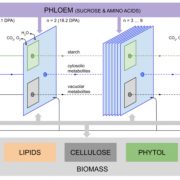
Plant Science Research WeeklyGrowth is driven by cell expansion, which is driven by both synthesis of metabolites and osmotically-driven expansion. This latter contribution is typically overlooked in metabolic flux analysis. To remedy this, Shameer et al. have developed a model, GrOE-FBA (Growth by Osmotic Expansion- Flux Balance…
Evolution of fast root gravitropism in seed plants (Nature Comms)
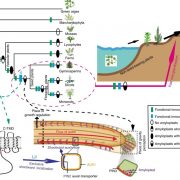
Plant Science Research WeeklyPlants’ invasion of land was accompanied by the evolution of a root system which in seed plants includes a fast gravitropic response. Gravitropism occurs through three distinct steps – (1) gravity perception by dense starch-filled amyloplasts, (2) transmission of gravitropic signal by auxin through…

Divergent gene expression networks underlie morphological diversity of abscission zones in grasses ($)
Plant Science Research WeeklyGrasses scatter their seeds through the process of cell abscission. Losing this trait, in a process known as loss of shattering, was an early step in the domestication of cereals. Interestingly, the abscission zone (AZ) is positionally and morphologically different in different cereals. In order to understand…

A positive feedback loop of LHW-TMO5 and local auxin biosynthesis in vascular development ($) (Plant Cell Physiol)
Plant Science Research WeeklyProper development of root vascular tissue is necessary for plant growth, as these tissues are responsible for nutrient and water uptake. Multiple key players including transcriptional factors (TF) and hormones are involved in vascular development. In this paper Ohashi-Ito et al. have identified a feedback…

ABA receptor abundance, thus ABA sensitivity, is regulated by ALIX ($) (Plant Cell)
Plant Science Research WeeklyTo balance water loss and CO2 assimilation, stomatal aperture is tightly controlled in accordance with environmental changes, mediated by ABA signaling. Here, García-León et al. found that ABA sensitivity and stomatal aperture are regulated by the trafficking and vacuolar degradation of ABA receptors…

Glyphosate-based herbicide effectiveness can be maximized by considering plant circadian rhythms (Nature Comms)
Plant Science Research WeeklyPlants’ internal circadian clocks regulate the timing of many physiological and developmental processes. This circadian clock also controls plant sensitivity to the herbicide glyphosate, which is maximally effective at dawn. Here, Belbin et al. showed that the minimum effective dose varies with time…

Plant Science Research Weekly: August 23rd
Blog, WWR Full PostReview: Developmental thermal responses in Arabidopsis
Plants can modify their growth in response to environmental challenges. In a recent review, Vu et al. summarize the molecular mechanisms underlying high temperature responses during the Arabidopsis life cycle. At early stages, high temperature…

Recognizing Plant Physiology first authors: Kirtikumar R. Kondhare
Plant Physiology, Plant Physiology: Author ProfilesKirtikumar R. Kondhare, co-first author of PcG proteins MSI1 and BMI1 function upstream of miR156 to regulate aerial tuber formation in potato
Current position: DST - Inspire Faculty fellow, Biochemical Sciences Division, CSIR - National Chemical Laboratory (NCL), Pune, Maharashtra, India
Non-scientific…