

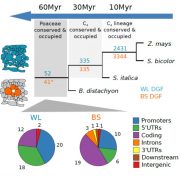
Genome-wide transcription factor binding in leaves from C3 and C4 grasses (Plant Cell)
Plant Science Research WeeklyMost plants use the C3 photosynthesis pathway, however many have evolved strategies like C4 photosynthesis that accumulate CO2 around RuBisCO. Burgess et al. performed DNAseI-SEQ in three C4 plants: S. bicolor, Z. mays and S. italica, and one C3: B. dystachion, to offer an insight into the cis-element…

Plant Science Research Weekly: Sept. 13
Blog, WWR Full PostReview: Revolutions in agriculture chart a course for targeted breeding of old and new crops ($)
A few traits are associated with domestication across many species. Eshed and Lippman provide an overview of the changes to plant stature and flowering time that have been repeatedly selected by our…

The nucleolus protects the repetitive rDNA during meiosis
Research, The Plant Cell, The Plant Cell: In a NutshellSims et al. examine the mechanisms protecting the highly repetitive ribosomal DNA from double-strand break formation and homologous repair during meiosis. https://doi.org/10.1105/tpc.19.00367
Background: Meiosis is a specialized cell division in sexually reproducing organisms, where one round of DNA…

The SNARE SYP132 fine-tunes proton transporter levels at the plasma membrane during plant growth
Plant Physiology, Plant Physiology: News and Views, ResearchBy Lynn GL Richardson
The acid-growth theory was proposed over 40 years ago based on early observations that low apoplastic pH promotes growth in a pathway involving the plant hormone auxin (Rayle and Cleland, 1992; Hager, 2003; Arsuffi and Braybrook, 2018). Since this discovery, a clearer understanding…
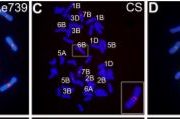
Polyploid Pairing Problems: How Centromere Repeat Divergence Helps Wheat Sort It All Out
Research, The Plant Cell, The Plant Cell: In BriefBy Jennifer Mach, Science Editor
I don’t know how polyploids get their chromosomes paired correctly in meiosis— I can’t even sort my socks. Sometimes I give up and pair random socks, but plants can’t go with random pairings, because that’s a route to death, and with genomes in the dozens…

Recognizing Plant Direct first authors: Anahit Galstyan
Plant Direct, Plant Direct: Author ProfilesAnahit Galstyan, first author of Auxin promotion of seedling growth via ARF5 is dependent on the brassinosteroid-regulated transcription factors BES1 and BEH4
Current Position: Alexander von Humboldt postdoctoral fellow, Max Planck Institute for Plant Breeding Research, Cologne, Germany
Education:…

Recognizing Plant Physiology first authors: Nishikant Wase
Plant Physiology, Plant Physiology: Author ProfilesNishikant Wase, first author of Remodeling of Chlamydomonas metabolism using synthetic inducers results in lipid storage during growth
Current Position: Senior Research Associate, Department of Biochemistry, University of Nebraska-Lincoln, USA
Education: 2011 PhD Department of Chemical and Biological…

Recognizing Plant Physiology first authors: Adrian Dauphinee
Plant Physiology, Plant Physiology: Author ProfilesAdrian Dauphinee, first author of Chemical screening pipeline for identification of specific plant autophagy modulators
Current Position: NSERC Postdoctoral Fellow at SLU, Uppsala
Education: PhD in Biology
Non-scientific interests: travel, cycling, graphic design, hockey, swimming, kayaking,…
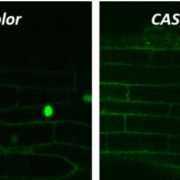
Perception of Ectomycorrhizal Signals by Poplar Induces Root Colonization
Research, The Plant Cell, The Plant Cell: In BriefBy Gregory Bertoni
Symbiotic associations with microorganisms are widespread among both woody and herbaceous plant species, including most agronomic crops (Brundrett and Tedersoo, 2018). Mycorrhizal fungi provide their hosts with mineral nutrients absorbed from the soil in exchange for fixed carbon…