

Developmental robustness from antagonizing cis-elements
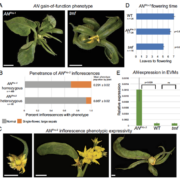
Plant Science Research WeeklyDevelopmental transitions in plants are tightly regulated by transcriptional networks that require fine-tuned temporal and spatial control, with noncoding sequences in gene promoters playing a key role. The conserved transcriptional regulator UNUSUAL FLORAL ORGANS (UFO) is essential for floral development.…
Single cell analysis of wheat spike development
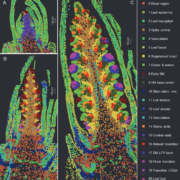
Plant Science Research WeeklyThis preprint wins the award for “most beautiful paper” this week. Xu, Lin et al. carried out an expression analysis of developing wheat spikes at three developmental stages, using both single-cell RNA sequencing and single-molecule fluorescence in situ hybridization (smFISH). The wheat spike is…
A mutation in a nuclear-membrane localized calcium channel enhances symbiosis
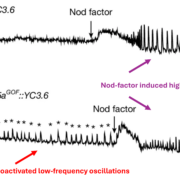
Plant Science Research WeeklyCalcium oscillations are widely employed molecular signals, but how signals are encoded and decoded remains largely unknown. In a new study, Cook et al. investigated mutations in the nuclear envelope-localized calcium channel CNGC15 from the legume Medicago truncatula. This protein normally forms a complex…
Fungal pathogen hijacks phosphate signaling to promote pathogenicity
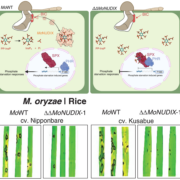
Plant Science Research WeeklyWeakening your opponent is an effective way to win a battle. A new paper by McCombe et al. shows that several pathogenic fungi weaken their plant hosts by disrupting their phosphate signaling pathways. Phosphate is indispensable for plant growth, as a component of ATP, nucleotides, phospholipids, and…
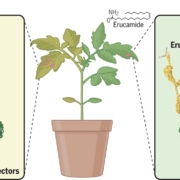
Blocking bacterial invasion: Erucamide inhibits the type III secretion system
Plant Science Research WeeklyThe interaction between plants and pathogens is often described as an evolutionary arms race, in which plants develop multilayered immune signaling to counteract direct extracellular attacks and intracellular chemical effectors. The type III secretion system (T3SS) of Gram-negative bacteria serves as…
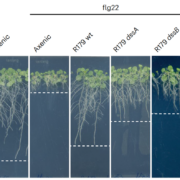
Stealth mode: How Rhodanobacter R179 evades plant immunity
Plant Science Research WeeklyThe soil microbiome harbors a vast diversity of microorganisms that can be pathogenic, beneficial, or commensal to plants. A fundamental question in plant biology is how plants actively detect, differentiate, and optimize their associations with the microbiome to maintain optimal fitness. In a recent…
Plant Science Research Weekly: March 7, 2025
WWR Full PostReview: The complexities of metabolite transport in C4 photosynthesis
C4 photosynthesis, an adaptive mechanism to spatially concentrate CO2 around Rubisco to enhance carbon fixation, has evolved independently at least 60 times in plants. This process spatially separates the initial carbon fixation…
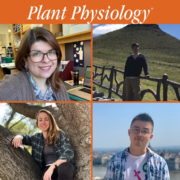
Plant Physiology Spotlights October 2024 First Authors
Blog, Community, Plant Physiology: Author ProfilesBehind the Plant Physiology manuscripts are researchers, professors, professionals and students dedicated to advancing the field of plant science. You’ve seen our First Authors on Facebook and Twitter — now, read more about why they chose to pursue plant sciences and click on the links below to read…

Perspective: How should the advancement of large language models affect the practice of science?
Plant Science Research Weekly
Perspective: How should the advancement of large language models affect the practice of science?
In this thought-provoking Perspective, four sets of authors express their opinions about the use of Large Language Models (such as ChatGPT) in the practice of science. Each essay is well reasoned,…