

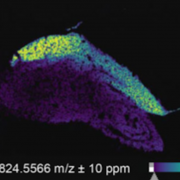
Shielding the oil reserves: the scutellum as a source of chemical defenses (Plant Physiol.)
Plant Science Research WeeklyIf you work with grasses, you are probably familiar with the scutellum –the shield-like cotyledon typical of seeds from these plants. This structure has a renowned role in transferring nutrients to the growing embryo. However, Murphy and colleagues show us that not only does this structure look like…

Structural organization of the spongy mesophyll (New Phytol.)
Plant Science Research WeeklyDespite a large variation in leaf morphology, laminar leaf anatomy is largely conserved, comprising two developmentally distinct mesophyll tissues, the palisade and spongy mesophyll. Spongy mesophyll cells along with intercellular spaces form an interconnected network to maximize the surface area for…

Microtubule-based perception of mechanical conflicts controls plant organ morphogenesis (Sci. Adv.)
Plant Science Research WeeklyMorphogenesis is a critical process in plants and animals that allows a cell, tissue, or organism to reach its final shape. In Arabidopsis thaliana, the formation of lateral root primordia (LRP) is an excellent example of organ morphogenesis that involves cell remodeling throughout differential growth…

Cell-by-cell dissection of phloem development links a maturation gradient to cell specialization (Science)
Plant Science Research WeeklyIn this seminal paper, Roszak et al. present a deeper understanding of the development of the protophloem cell lineage. The differentiation process from the phloem stem cell to the enucleated cell state spans approximately 19 cells. Using live imaging, FACS sorting and single-cell RNA sequencing, the…
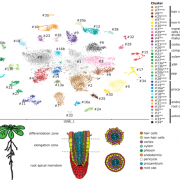
Shoot and root single cell sequencing reveals tissue- and daytime-specific transcriptome profiles (Plant Physiol.)
Plant Science Research WeeklyMany biological processes are controlled by the circadian clock in plants, yet studies often don't report sampling timepoints, leaving much to be discovered about the plant circadian rhythm. Apelt et al. have utilised single cell RNA sequencing to examine almost 70,000 Arabidopsis cells from above and…

Ethylene augments root hypoxia tolerance through amelioration of reactive oxygen species and growth cessation (bioRxiv)
Plant Science Research WeeklyFlooding presents a dual threat to plants; not only is mitochondrial respiration supressed during the resulting hypoxic conditions, but once the floodwaters recede, the return to ambient oxygen levels triggers a cascade of harmful reaction oxygen species (ROS). One of the most well-studied responses…
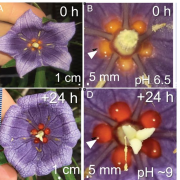
Convergent evolution of red nectar in vertebrate-pollinated flowers (PNAS)
Plant Science Research WeeklyNesocodon mauritianus is about one out of 70 plant species that produce colored nectar. The nectar of Nesocodon starts off yellow in newly opened flowers and progresses to blood-red in color as the flowers mature. The authors showed that the red colored nectar is both visible and attractive to geckos,…
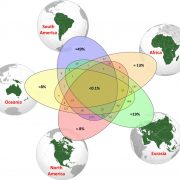
How many tree species are there? (PNAS)
Plant Science Research WeeklyDo you know how many tree species are there? The global Forest Biodiversity Initiative (GFBI) database has annotated about 28,000 tree species, while some studies indicate there could be around 60,000. But why this difference? Many of the species are found in unapproachable areas. Additionally, human…
Plant Science Research Weekly: February 18th, 2022
WWR Full PostCarbon flux through photosynthesis and central carbon metabolism show distinct patterns between algae, C3, and C4 plants
Photosynthesis is an attractive target for improving crop yields, and tailoring downstream photosynthesis-associated metabolism is a relatively unexplored path for achieving this.…