
Bidirectional root-shoot signaling via CCR1 regulates cluster root and nodule development in legumes
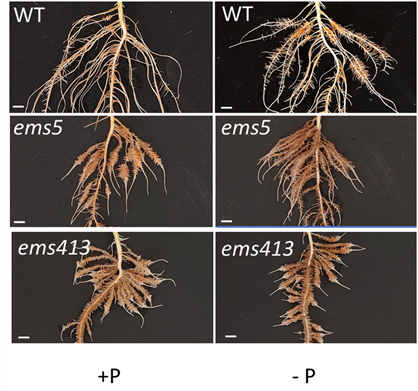 Legume plants are renowned for their ability to form symbiotic relationships with nitrogen-fixing bacteria (rhizobia) in specialized root tissues called nodules. This symbiosis enables the conversion of atmospheric nitrogen into ammonia, a form of nitrogen that plants can readily use for growth. This trait also makes legumes valuable as green manure for sustainable agriculture. However, nodule formation is energetically costly, making excessive nodule production inefficient. To regulate this, legumes have evolved an inhibitory mechanism known as autoregulation of nodulation (AoN), which prevents the overproduction of nodules. AoN involves systemic long-distance signaling: an initial signal originates in the root, is perceived in the shoot, and triggers a second signal from the shoot back to the root to suppress further nodulation. White lupin (Lupinus albus) is a legume with an unusual root adaptation to low phosphorus, in that it produces small, dense lateral roots called cluster roots (CRs) that are specialized for nutrient uptake. In a forward genetic screen in white lupin aimed at identifying regulators of CR formation, Marquès and colleagues discovered four allelic mutants that formed constitutive CRs even under high-phosphate (suppressive) conditions. The affected gene, CONSTITUTIVE CLUSTER ROOT 1 (CCR1), corresponds to homologs known to regulate AoN in other legume species. Interestingly, the EMS-induced ccr1 mutants also exhibited excessive root nodule formation, suggesting that CCR1 functions in both CR and nodule development. Transcriptome analyses further revealed that CCR1 influences genes involved in lateral root development as well as ethylene and cytokinin signaling pathways. The authors thus propose that CCR1-mediated bidirectional long-distance signaling governs a broader root developmental program in legumes, which they term Autoregulation of Cluster Root and Nodule Development (AoDev). (Summary by Ching Chan @ntnuchanlab) PNAS 10.1073/pnas.2418411122