


A jasmonate signaling network activates root stem cells and promotes regeneration ($) (Cell)
Plant Science Research WeeklyPlants possess plasticity for regeneration of organs after damage by physical, biotic or abiotic stress. The mitotically less-active organizer cells, quiescent center (QC) and surrounding initials form the stem cell niche, which is known to play a very important role in activation of the regeneration…

Genetic compensation mechanisms for maintaining plant stem cell robustness ($) (Nature Genetics)
Plant Science Research WeeklyIn shoot meristems, the CLAVATA (CLV)-WUSCHEL(WUS) signaling module contributes to the continuous stem cell proliferation for plant development. In Arabidopsis, core CLV-WUS signaling includes the peptide ligand CLV3 and its receptor protein kinase CLV1 together with the transcription factor WUS. These…

Review. Multicellular systems biology: Applying network science to plant organ patterning and function (Mol Plant)
Plant Science Research WeeklyI really enjoyed this review article, which very successfully introduces the reader to the why and how of how to apply network science to plant science. Bassel never veers off into abstraction or “math-speak”, but instead roots his explanations in familiar biological or ordinary terms. As an example,…
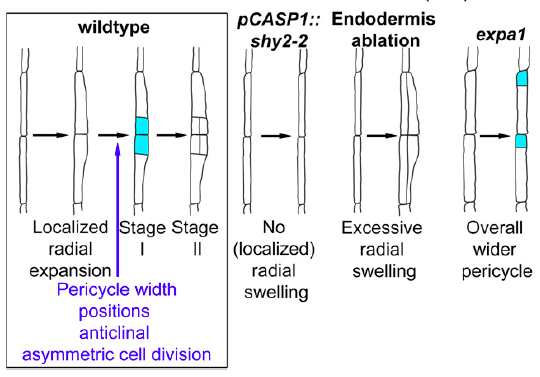
EXPANSIN A1-mediated radial swelling of pericycle cells positions anticlinal cell divisions during lateral root initiation ($) (PNAS)
Plant Science Research WeeklyLateral root development helps plants explore the soil for mineral nutrients and water, and there are environmental and internal cues that precede the formation of lateral root primordia. In Arabidopsis thaliana, some of these internal cues include increased auxin concentrations around lateral root founder…

Moonlighting activities and control of meristem maintenance in maize ($) (Nature Plants)
Plant Science Research WeeklyThe phosphorylated disaccharide trehalose 6-phosphate (T6P) is a regulator of meristem fate. Mutations in enzymes related to T6P metabolism (such as TPS, the synthase, or the phosphatase trehalose 6-phosphate phosphatase TPP, i.e., RAMOSA3 that dephosphorylates T6P to trehalose), are linked to defects…

Review: Tackling plant phosphate starvation by the roots (Devel. Cell)
Plant Science Research WeeklyThe root is remarkably responsive to nutrient status of both the local environment and the whole plant. These external and internal factors affect the expression of transporters, interactions with mycorrhizal symbionts and also the overall pattern of growth and development of the root system. In this…

High-temporal-resolution transcriptome landscape of early maize seed development (Plant Cell)
Plant Science Research WeeklySeeds determine the yield and quality of the plants. In maize, seed development initiates from a double fertilization event where one pollen sperm fuses with the egg and the other with the central cell of female gametophyte to produce the progenitors of embryo and endosperm, respectively. The embryo…

Single-cell RNA sequencing reveals developmental trajectories of Arabidopsis root cells
Plant Science Research WeeklyNew advances in sequencing technologies have made possible the understanding of the dynamics of developmental processes in an unprecedented manner. In a recent study, Denyer, Ma, et al. profiled nearly 5,000 cells from Arabidopsis roots using single-cell RNA sequencing technology. Gene expression profiles…

Control of proliferation in the haploid meristem by CLE peptide signaling in Marchantia polymorpha (PLOS Genetics)
Plant Science Research WeeklyThe peptide/hormones CLE (CLAVATA3/EMBRYO SURROUNDING REGION-related) and their receptors are a fascinating cell signal system that regulates meristems activity in angiosperms and is crucial for the establishment of 3D forms. How this system works in bryophytes is very relevant to understand its evolution…