Review.When the sun becomes too hot: Non-photochemical quenching in plants
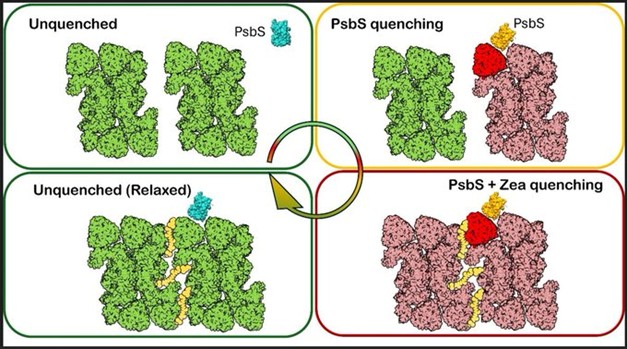 Plant photosynthetic machinery can easily be overwhelmed by strong sunlight. Therefore, plants developed a set of processes called Non-Photochemical Quenching, a safety valve that dissipates excess light energy as heat. In a recent review, van Amerongen and Croce synthesize decades of often contradictory research to clarify how this vital photoprotective process works. The authors focus on qE, the fastest and most dynamic quenching component, triggered within seconds of excess light exposure. Central to qE are two key players: the pH-sensitive protein PsbS, which detects lumen acidification and induces conformational shifts in light-harvesting complexes, and zeaxanthin, a xanthophyll pigment that enhances energy dissipation and expands the quenching domain. Contrary to earlier views that minor antennae like CP29 are primary quenching sites, new evidence points to LHCII as the main locus of quenching activity. The authors propose a model where only a few antenna complexes switch into a “quenched” state through PsbS activation, while zeaxanthin improves inter-complex connectivity, creating what they call “economic photoprotection.” This refined framework not only reconciles competing hypotheses but also highlights the potential of optimizing non-photochemical quenching regulation to boost photosynthetic efficiency and crop yields. (Summary by Katarina Kurtović, katarinakurtovic.bsky.social) The Plant Cell 10.1093/plcell/koaf240