
Pectin modifications regulate plant stem cell dynamics
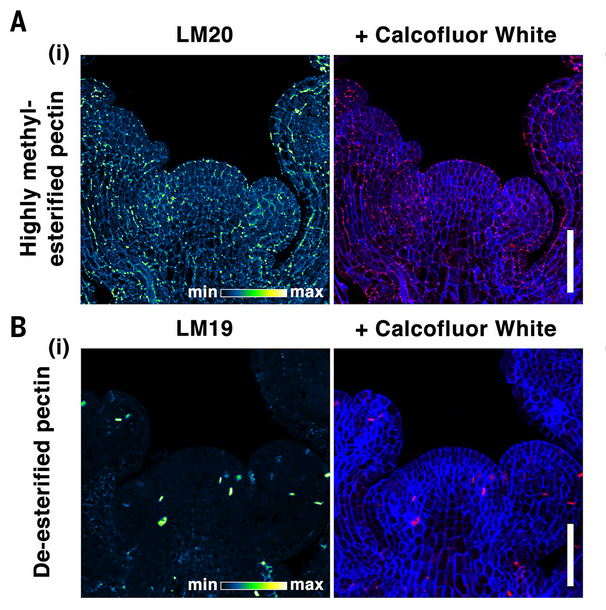 Plant development depends on the precise regulation of cell wall mechanics, largely controlled by the methylesterification status of pectin. Although pectin remodeling is known to influence cell expansion and tissue integrity, how its modification is spatially and temporally regulated during cell division in the shoot apical meristem (SAM) has remained unclear. Zhu et al., reveals that in the SAM of Arabidopsis, pectin methylesterification is highly heterogeneous. Mature cell walls are enriched in highly methylesterified pectins, whereas newly formed cell plates accumulate demethylesterified pectins. This pattern is established by the mitosis-specific pectin methylesterase PME5, whose mRNA is unusually sequestered in the nucleus and released only after nuclear envelope breakdown. Such regulation ensures that PME5 activity is restricted to the forming cell plate. Disrupting pectin demethylesterification or prematurely releasing PME5 mRNA alters division plane orientation, compromises cell wall integrity, and impairs stem cell maintenance. A key contribution of this work is the discovery that mRNA nuclear sequestration functions as a regulatory layer controlling cell wall remodeling. The RNA-binding proteins RZ-1B and RZ-1C directly bind PME5 mRNA and mediate its nuclear retention, thereby maintaining high methylesterification in mature walls while allowing localized demethylesterification during cytokinesis. Similar pectin modification patterns observed in multiple plant species suggest this mechanism is evolutionarily conserved. (Summary by Yuanyuan Liu @YuanyuanLiu12). Science 10.1126/science.ady4102