Viewpoint. Green life beyond Earth: Frontiers of space plant biology
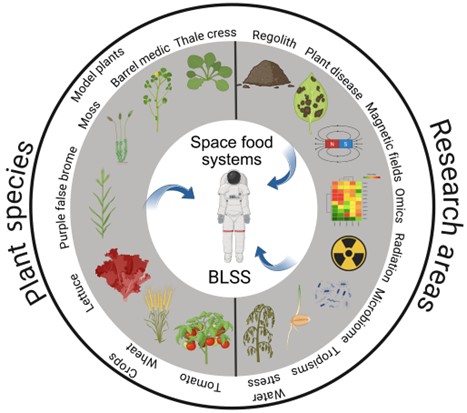 Plants are the quiet architects of life on Earth, sustaining the ecosystem through their ability to capture energy, cycle nutrients, and adapt to extreme environments. Their remarkable plasticity allows plants to thrive on non-arable land such as mountains, deserts, and floodplains, but whether this resilience extends beyond Earth’s orbit remains an open question. Fountain et al. summarize key discussions from the Third International Space Life Sciences Working Group workshop, “Plants for space exploration and Earth applications,” outlining missions and research frontiers shaping the future of plant biology in space. The authors highlight how fundamental discoveries are redefining space plant biology. Studies of plant tropisms under microgravity and partial gravity reveal how altered perception and signal transduction reshape differential growth. Beyond classical tropisms, electrotropism (aka galvanotropism, growth guided by electric fields) emerges as a promising strategy to compensate for the absence of gravity. The workshop also underscored other space stressors, including the lack of Earth geomagnetic field, ionizing radiation, and lunar or Martian regolith as growth substrates, which often result in poor growth and reduced fecundity. Microgravity further disrupts water delivery, leading to hypoxia and increased susceptibility to phytopathogens. Translating these insights into functional space agriculture remains a central challenge. Building on NASA’s Crop Readiness Level, the workshop proposed a new Bioregenerative Life Support System Readiness Level, emphasizing self-replication, regeneration, and plants’ capacity to recycle water, waste, and atmospheric gases. Looking forward, the authors emphasize that successful space farming must also extend beyond biology and engineering. Psychological well-being, ethical, and cultural considerations are indispensable integral to the journey of humanity beyond Earth. (Summary by Ching Chan @ntnuchanlab) New Phytol. 10.1111/nph.70662