The last piece of the nicotine puzzle
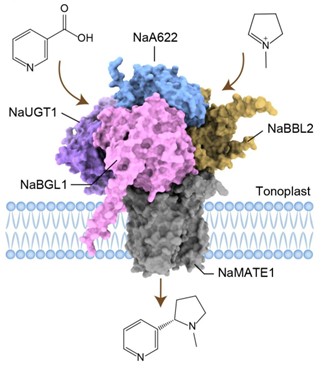 No other alkaloid has received as much scientific attention as nicotine. For better or for worse, tobacco has been used by humans for at least 12,000 years, yet the final steps of nicotine biosynthesis have remained stubbornly unresolved until now. A new paper in Cell by Chang et al. (2026) reveals that the key missing piece is a hidden sugar. Before the two rings of nicotine can be joined together, nicotinic acid must first be tagged with a glucose group. This cryptic glycosylation step, catalysed by a UDP-glycosyltransferase (NaUGT1), had been overlooked for decades because earlier labelling experiments misidentified the intermediate as a metabolic dead end. In fact, this modification acts as a chemical activating group, making the molecule reactive enough to be reduced and stereoselectively coupled to form nicotine’s distinctive bicyclic scaffold. The glucose is then removed at the end. Equally notable is where this chemistry happens. All five enzymes responsible for the final biosynthetic and transport steps, NaUGT1, NaA622, NaBBL1/2, NaBGL1/2, and the MATE transporter NaMATE1, assemble into a dynamic metabolon on the tonoplast membrane. This architecture channels reactive intermediates directly into the vacuole, solving the autotoxicity problem that a compound as potent as nicotine would otherwise pose to the producing cell. The team demonstrated that transplanting this metabolon into tomato, aubergine, and pea confers genuine pest resistance, pointing towards a tractable route for engineering natural insect defences into crops. (Summary by Charlay Wood) Cell 10.1016/j.cell.2026.03.034