

How to Select the Right Journal for Your Manuscript
Congratulations! You’ve completed your experiments, analyzed your data, written your manuscript, and finally reached the point every researcher looks forward to: Where should I publish it?
There are plenty of journals, different metrics, acceptance rates, and turnaround times. So, choosing where to publish can feel overwhelming for young researchers who are taking their first steps into the plant science field.
However, it is in your best interest to select target journals carefully. Peer review can take months, reformatting manuscripts and figures after a rejection causes further delays, and the journal’s standing within your field ultimately dictates your paper’s visibility.
Here are a few practical tips to make compiling your journal list much easier.
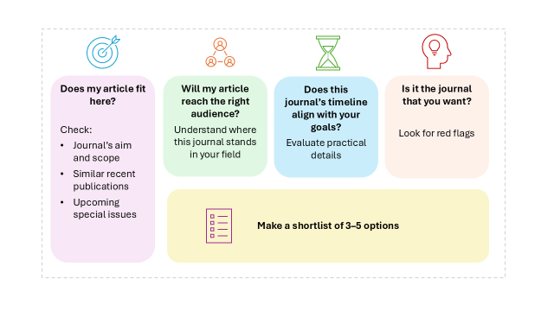 Scope and Fit
It is completely normal to have favorite journals or journals that you regularly read and admire. However, the journals we like most are not necessarily the best fit for every manuscript.
Imagine you investigating a gene that helps wheat survive drought. If your paper focuses on the cell biology and molecular mechanisms behind it, a molecular plant journal is the natural choice. But if your study tests yield performance across multiple seasons and field trials under varying irrigation regimens, an agronomy or crop science journal will be a good fit.
Moreover, some journals are more interested in research articles based on cultivated plants rather than research using plant models such as Arabidopsis thaliana. Therefore, the organism you work with is also an important factor to consider when searching for the right journal fit.
Identifying a journal that is closely aligned with your research field will also make writing the cover letter easier. In the cover letter, you need to clearly explain why your research is important to the field and why it is a good fit for that particular journal. If you can make this connection clearly and convincingly, you can help the editor quickly understand the relevance of your manuscript and potentially increase its chances of passing the initial editorial screening and proceeding to peer review.
Some practical steps that you can follow to help you find the right fit:
- Start by reading the journal’s aims and scope. Look beyond a few keywords and ask yourself: Does the journal publish research on my organism, system, or topic? Does it publish research at the scale and level of specialization of my work? Does the journal publish my article type (Short Communication, Review, or Methods paper)?
- But don’t stop at the scope page. Look at the journal’s recent publications. Search through papers published in the last one or two years and identify 2–5 articles that are genuinely close to yours. If you can regularly find papers addressing comparable questions, organisms, approaches, or biological systems, that is a good indication of journal fit.
- Search for upcoming special issues. Check whether the journal is planning a special issue that your research could contribute to. If your manuscript fits particularly well with the theme of an upcoming special issue, this presents a great opportunity for you.
Audience and Visibility
Finding a journal that your research fits best will also affect the visibility of your article. A journal with a strong readership in your research area can help your paper reach the right audience, who are most likely to be interested in your findings and will cite your work.
To get an idea of the journal’s visibility in your field, you can:
- Look at its recent publications. See whether researchers in your field regularly publish and cite papers in the journal.
- Beyond the impact factor check its Q1 status. A Q1 journal is among the top 25% in a particular subject category and can indicate strong standing within that field. However, consider this together with the journal’s scope and audience.
- Consider open access. Open-access papers are freely available to readers, which can make your research easier to access and increase its visibility.
- Look at how the journal promotes published research. Some journals actively share new papers through social media, newsletters, or other channels, which can help increase the reach of your article.
Practical Considerations
Once you have identified journals that are a good scientific fit, consider the practical requirements of each journal. These details can affect how quickly and easily you can submit and publish your work.
- Review and revision time. Check the journal’s typical time to make the first decision and consider how long the review and revision process may take. If you are working with a deadline, such as a thesis, grant, or job application, this can be particularly important.
- Publication fees. Inform your supervisor whether the journal charges submission fees, publication fees, or other costs.
- Open-access options. Check whether the journal is fully open access or offers an open-access option. If there is an APC, check whether you have funding available to cover it.
- Author guidelines. Check the journal’s word limits, number of figures and tables, and requirements for the manuscript structure. Some journals may have strict limits that require substantial changes to your manuscript.
- Data and supplementary material requirements. Some journals require authors to make datasets, code, or other supporting materials publicly available. Check these requirements early to make sure you can meet them.
These practical details may seem minor, but checking them before submission can save you time and prevent unexpected problems later in the publication process.
Credibility and Red flags: The easy solution is not always the best
Apart from well-established journals, what else should you consider when judging a journal’s credibility? A journal may look attractive because it promises fast publication, but a quick publication process is not necessarily a sign of a good journal. Before submitting, check a few key points:
- Publisher and editorial team: Check who publishes the journal, who the Editor-in-Chief is, and who sits on the editorial board. The editors and board members should be identifiable researchers with relevant expertise.
- Peer review and publication ethics: Make sure the journal clearly describes its peer-review process and has transparent policies on issues such as plagiarism, conflicts of interest, research misconduct, corrections, and retractions.
- Indexing and publication history: Verify the journal’s indexing claims rather than relying only on information provided on the journal website. Also check whether the journal has a transparent and consistent history of publishing research in your field and retraction history.
Be particularly cautious about journals that guarantee acceptance, promise unrealistically fast publication, use questionable metrics, or provide little information about their editorial and peer-review processes.
Have a Backup Plan
After exploring potential journals, make a shortlist of 3–5 realistic options. Put them in order of preference, with your strongest choice first and the rest suitable backup journals.
Having backup options in advance can save time if your first-choice journal rejects the manuscript or if the editor considers it outside the journal’s scope.
Final Thoughts
Choosing a journal is an important part of the publication process, not something to decide at the last minute. A strong journal choice is not necessarily the journal with the highest impact factor or the fastest publication time. The best choice is a journal where your research fits well, reaches the right audience, meets your practical needs, and is published through a credible and transparent process.
Taking a little time to compare your options before submitting can save you time later and increase the chance that your manuscript reaches the right research community. For early-career researchers, developing this habit can make journal selection easier with every manuscript you write.
______________________________________________
About the Authors
Fatai Ayomide Akande
Fatai is a research assistant at the International Institute of Tropical Agriculture Headquarters in Nigeria and a 2026 Plantae Fellow, specializing in advancing crop resilience to biotic and abiotic stresses through molecular breeding, genomics, and bioinformatics. His research focuses on understanding and improving Striga resistance and drought adaptation in maize using gene expression studies, marker discovery, and validation. You can find him on X: @AkandeAyomide20.
Fengoula Avgeri
Fengoula is a recent PhD graduate in Plant Molecular Biology from the Agricultural University of Athens, Greece and a 2026 Plantae Fellow. Her research expertise focuses on plant proteostasis and mitochondrial biology, while she sees science as an adventure without boundaries. Beyond her scientific pursuits, she enjoys the company of a good book, hiking in nature, and creating illustrations. Find her on Bluesky: @fengoulaavgeri.bsky.social and X: @AvgeriF.