

Four Things Wrong with How We Teach Plant Science
In 2011, with funding from the NSF, ASPB and the Botanical Society of America convened a workshop to work out how the Vision and Change recommendations might be put into practice in plant biology. The concern that emerged most was not a gap in research or in funding. It was that undergraduate curricula underrepresented and misrepresented plants, and that students consequently left biology degrees believing that plants do not do very much and that their chief importance is as sites of photosynthesis. The working group that followed produced Core Concepts and Learning Objectives in Plant Biology for Undergraduates, which set out what a biology major ought to understand about plants and how they might demonstrate it.
The diagnosis was made by our own field, in our own words, more than a decade ago. What is striking now is how little of it has changed.
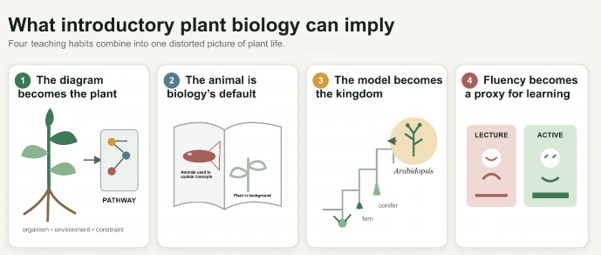
Figure 1: Four teaching habits combine into a curriculum in which plants appear passive, peripheral, and uniform.
The diagram is not the plant
Pathway diagrams are extraordinary feats of compression. Years of enzymology, several regulatory layers, and a good deal of contested interpretation resolve into something that fits on a single slide and can be assessed in a single question.
The consequence is that instruction can leave prior conceptions entirely intact. When researchers surveyed the published literature on plant misconceptions and mapped each documented error onto the ASPB and BSA core concepts, they found that these misunderstandings often persisted despite further education (Wynn et al., 2017; Pedrera et al., 2024). For example, the belief that plants take their food from the soil was reported across 28 separate articles, ranging from elementary pupils through to postgraduates and teachers in training (Wynn et al., 2017). Beliefs that plants lack genes or DNA or that they do not reproduce sexually have been recorded in students well into undergraduate study.
Part of the explanation is developmental rather than pedagogical. Children’s early conceptions of living things appear to form a foundation which later instruction does not erase, and which continues to shape adult reasoning (Goldberg and Thompson-Schill, 2009). Teleological thinking also persists into adulthood as a cognitive construal rather than a simple error of fact (Coley and Tanner, 2012). Roots are often said to grow downward “to find water”. This mistakes an outcome for a mechanism and makes a physiological response sound purposeful. Instructors sometimes reinforce this rather than interrupting it (Wynn et al., 2017).
In middle-school physical sciences classrooms, learning gains were considerably larger when instructors understood both the scientific content and the specific misconceptions their students held, than when instructors knew the content alone (Sadler et al., 2013). Knowing what students are likely to believe is not a soft skill appended to subject expertise. It is part of it, and it is the part we are often least trained in.
Biology’s default animal
Across four introductory biology textbooks written for biology majors, animals were used more often than plants to illustrate biological concepts in every text examined, and plant images accounted for well under a fifth of the total (Brownlee et al., 2023).
Natural selection, gene regulation, inheritance, and cellular energetics are taxon-independent, and an animal illustrates them perfectly well. What students take from the pattern is not misinformation but a hierarchy: the principle is general, the animal is the case in which it is demonstrated, and the plant is the specialised example added afterwards. A student who has only ever seen plants appear as the applied case at the end of a lecture has good reason to conclude that plants are where general biology goes to become a special interest.
Elementary science textbooks give roughly twice as much space to animals as to plants (Schussler et al., 2010), and in two nationally syndicated series, animal photographs were around three times more likely than plant photographs to be identified by their species names (Link-Pérez et al., 2010). Plants are quite literally the unlabelled background of the page. There may be a perceptual dimension too, since animals are detected more reliably than plants in rapid image sequencing (Balas and Momsen, 2014). More encouragingly, the composition and positioning of plants within an image influences how students perceive flora and fauna (Dietrich et al., 2026), suggesting that more thoughtful representation could help change this pattern. The aim is not to remove animals from biology teaching, but to stop presenting them as its default setting.

Figure 2: Plants are underrepresented and less specifically identified in biology textbooks. Panels A and B show elementary textbook photographs and labels from Link-Pérez et al. (2010). Panel C shows animal- and plant-focused images in four undergraduate introductory biology textbooks, calculated from counts reported by Brownlee et al. (2023).
Arabidopsis is not a constitution
A recurring pattern has been identified in which texts present the common case as a universal rule and omit the exceptions: all plants photosynthesise, despite several hundred species lacking chlorophyll; embryos carry one or two cotyledons, despite many gymnosperms carrying more; and fruit development follows pollination and fertilisation, despite the existence of parthenocarpic fruits such as seedless bananas and pineapple (Hershey, 2004; Wynn et al., 2017). We teach from the systems in which we hold real expertise, because that expertise is what allows us to answer the difficult question after the lecture, rather than advancing briskly to the next slide.
An instructor presents a mechanism as one biological solution to a problem; a student receives it as the solution that plants use. The floral development model derived from Arabidopsis becomes floral development. C4 anatomy taught through maize becomes how photosynthesis is organised. When a second lineage appears later in the degree, it does not read as variation but as contradiction, and the most economical way for students to resolve a contradiction is to conclude that one of the two lessons was wrong. There are many exceptions to the rules in the animal world. The platypus is a mammal that lays eggs, and remembering this feels like delightful trivia. By contrast, the Ghost Pipe (Monotropa uniflora) is a flowering plant without chlorophyll that obtains its carbon through fungal partners, yet this fact is more likely to be treated as an annoying exception one must remember for an exam.
The correction costs a sentence and no preparation at all. Name the species aloud rather than allowing it to vanish behind the mechanism. Distinguish what is thought to be broadly conserved from what is specific to the model. Mention one lineage in which the system works differently. Arabidopsis is a superb model and has earned its place several times over. It is simply not empowered to speak for 400,000 species.
Twelve years of knowing better
Across 225 studies comparing traditional lecturing with active learning in undergraduate STEM, performance on examinations and concept inventories rose by 0.47 standard deviations under active learning; the odds of failing were 1.95 times higher under traditional lecturing (Freeman et al., 2014). The effect held across every discipline examined and across class sizes. None of this requires abandoning the lecture. What the evidence questions is the lecture as the sole mode of contact.
Twelve years on, adoption remains uneven. In randomised comparisons within large introductory physics courses, using identical content and handouts, and with no attempt by staff to advocate for either approach, students taught actively learned more, but reported that they had learned less than students who had received a traditional lecture on the same material (Deslauriers et al., 2019). The effort demanded by active learning can be read as poor teaching, and the ease of following an accomplished lecturer could be mistaken for mastery. That study was conducted in physics and has not been replicated in plant biology. However, it highlights the risk of judging teaching quality through student satisfaction, and an instructor who adopts the more effective method may be penalised for it.
What should we do then?
Set the four alongside one another and consider the version of our subject that a student meets on first contact. An organism reduced to a pathway, a kingdom represented by a single convenient species, a discipline largely absent from the examples used to teach general biology, and a body of knowledge delivered in a form that is not optimal for learning. The beliefs that the working group identified in 2011 are not a failure of student attention. They are a reasonable summary of what the curriculum implies.
This matters beyond the classroom. Plant science is being asked to carry an unreasonable share of the next fifty years: in food security under a destabilising climate, in crop resilience, in the replacement of petrochemical feedstocks and in the restoration of ecosystems we have already damaged. The people who will do this work are recruited in large part through the courses described above.
Three of the four changes can be made by an individual instructor before the next teaching term. Begin with the organism, then use a diagram to explain what a real plant is doing under real constraints. Put plants in the foreground when teaching concepts that are not inherently animal. Name the model, then say where nature does something else. The fourth change requires institutions to stop treating satisfaction as a proxy for learning. None of this involves sacrificing detail, diluting rigour, or converting lectures into outreach events. It involves presenting plant science as what it actually is, which is the study of diverse organisms solving hard biological problems in remarkably different ways. Before we ask again why more students do not choose this field, it is worth looking carefully at the plant we introduce them to.
References
ASPB and BSA (n.d.) Core Concepts and Learning Objectives in Plant Biology for Undergraduates. American Society of Plant Biologists and Botanical Society of America.
Balas, B. and Momsen, J.L. (2014) Attention ‘blinks’ differently for plants and animals. CBE—Life Sciences Education 13: 437–443. doi:10.1187/cbe.14-05-0080
Brownlee, K., Parsley, K.M. and Sabel, J.L. (2023) An analysis of plant awareness disparity within introductory biology textbook images. Journal of Biological Education 57: 422–431. doi:10.1080/00219266.2021.1920301
Coley, J.D. and Tanner, K.D. (2012) Common origins of diverse misconceptions: cognitive principles and the development of biology thinking. CBE—Life Sciences Education 11: 209–215. doi:10.1187/cbe.12-06-0074
Deslauriers, L., McCarty, L.S., Miller, K., Callaghan, K. and Kestin, G. (2019) Measuring actual learning versus feeling of learning in response to being actively engaged in the classroom. Proceedings of the National Academy of Sciences 116: 19251–19257. doi:10.1073/pnas.1821936116
Dietrich, L., Dittert, J., Biestek, L., Konnemann, C. and Asshoff, R. (2026) Investigating plant awareness: image composition affects student perceptions of flora and fauna. Plants, People, Planet. doi:10.1002/ppp3.70104
Freeman, S., Eddy, S.L., McDonough, M., Smith, M.K., Okoroafor, N., Jordt, H. and Wenderoth, M.P. (2014) Active learning increases student performance in science, engineering, and mathematics. Proceedings of the National Academy of Sciences 111: 8410–8415. doi:10.1073/pnas.1319030111
Goldberg, R.F. and Thompson-Schill, S.L. (2009) Developmental ‘roots’ in mature biological knowledge. Psychological Science 20: 480–487. doi:10.1111/j.1467-9280.2009.02320.x
Hershey, D.R. (2004) Avoid misconceptions when teaching about plants. ActionBioscience.
Link-Pérez, M.A., Dollo, V.H., Weber, K.M. and Schussler, E.E. (2010) What’s in a name: differential labelling of plant and animal photographs in two nationally syndicated elementary science textbook series. International Journal of Science Education 32: 1227–1242. doi:10.1080/09500690903002818
Pedrera, O., Barrutia, O. and Díez, J. (2024) Rooting out teaching-learning difficulties of plant nutrition: a systematic literature review. Studies in Science Education. doi:10.1080/03057267.2024.2442243
Sadler, P.M., Sonnert, G., Coyle, H.P., Cook-Smith, N. and Miller, J.L. (2013) The influence of teachers’ knowledge on student learning in middle school physical science classrooms. American Educational Research Journal 50: 1020–1049. doi:10.3102/0002831213477680
Schussler, E.E., Link-Pérez, M.A., Weber, K.M. and Dollo, V.H. (2010) Exploring plant and animal content in elementary science textbooks. Journal of Biological Education 44: 123–128. doi:10.1080/00219266.2010.9656208
Wynn, A.N., Pan, I.L., Rueschhoff, E.E., Herman, M.A.B. and Archer, E.K. (2017) Student misconceptions about plants: a first step in building a teaching resource. Journal of Microbiology and Biology Education 18(1). doi:10.1128/jmbe.v18i1.1253
______________________________________________
About the Author
Charlay Wood
Charlay is a postdoctoral researcher at the University of Wisconsin–Madison and a 2026 Plantae Fellow. working on plant metabolic engineering, redirecting atmospheric CO₂ into high-value natural products including pharmaceuticals, flavour compounds, and sustainable alternatives to synthetic food dyes. Find her on LinkedIn: https://www.linkedin.com/in/charlaywood/