

Finding Funding: Tricks and Tips for Research and Travel
You know that feeling when you have a great idea for an independent project that could actually go somewhere, or you get an email inviting you to speak at a conference in another country, but you don’t have the money to make it happen?
This post is for early-career researchers who want to find funding for research, travel, and fellowships. The main text gives practical advice. The callout bubbles are personal notes from my own Marie Skłodowska-Curie Actions (MSCA) experience and from other researchers who generously shared what they had learned.
From my experience: When I was putting together my MSCA fellowship application, I spent months chasing funding opportunities, rewriting proposals, and learning things nobody teaches you. A standard protocol for the process does not exist. You figure it out as you go, usually at 11 p.m., and are stressed.
- Start earlier than you think you should
If you only take one piece of advice from this post, it would be “start at least six to eight months before you need the money”.
Successful fellowship applications are rarely developed in just a few weeks. You need time to explore funding opportunities, check eligibility criteria, develop project ideas, build a relationship with a future host lab, identify collaborators, and collect feedback. Plan for research travel funding as early as your first year, especially if you are a graduate student. Even if you are not ready to travel yet, start learning what is available before your actual deadline arrives.
From my MSCA experience: I thought I had plenty of time, but I didn’t. The application took far longer than I expected because every part- host lab, career plan, budget, feedback- needed time.
- Know where to look and which type of grant you need
There are more funding sources than most researchers realize. The trick is to know what kind of funding you are looking for.
Internal funds
Before you hunt externally, check what your own institution offers. Your supervisor may have travel funds within their research project. Graduate schools often maintain small discretionary funds. These internal sources are often less competitive and quicker to access.
Travel grants and conference awards
Travel grants support conference presentations, fieldwork, short lab visits, and collaboration trips. For plant scientists, Plantae is an invaluable resource. The global plant science community maintains a regularly updated hub of funding opportunities, jobs, and news. Plantae’s conference funding page alone lists multiple travel awards, including the Recognition Travel Award (RTA) from the American Society of Plant Biologists, the PLANTS program from the Botanical Society of America, and the SEEDS program from the Ecological Society of America.
Other examples include the Tansley Fund of the New Phytologist Trust, which assists postgraduate students and postdoctoral researchers to visit laboratories and meetings at home and abroad, and the International Association for Plant Taxonomy (IAPT), which offers research grants supporting travel to institutions, herbaria, or fieldwork.
For travel grants specifically, remember that most do not cover everything. The Boehringer Ingelheim Fonds travel grants, for example, contribute to travel, lodging, and course fees but do not promise full coverage.
Research grants
Research grants fund project costs, equipment, consumables, and fieldwork. Foundations often fund niche areas that government agencies overlook. The Tansley Fund and IAPT research grants are good examples in plant science.
Fellowships and salary support
Fellowships are usually larger and longer-term. They may cover salary, mobility allowances, family costs, and research expenses. The MSCA is one of the most comprehensive funding packages available for early-career researchers.
From my MSCA experience: As an MSCA fellow, the fellowship covers salary, mobility allowances, family costs, and research expenses. It supports not just your science, but your career development.
International mobility and exchange
If your research has an international dimension, look for mobility programmes. The MSCA, EMBO, Human Frontier Science Program (HFSP), and Gatsby Charitable Foundation offer substantial support for research and mobility. Read the call carefully: some schemes prioritize transnational mobility, interdisciplinary work, or specific career stages.
Recognition and nomination opportunities
Some opportunities are not traditional funding sources but can shape your career. The Lindau Nobel Laureate Meetings are a good example. Every year, Nobel laureates gather in Lindau, Germany, to spend a week with young scientists from around the world. You can talk with them, ask questions, share meals, and learn from some of the greatest minds in science. You cannot simply sign up; you have to be nominated or apply through a partner organization.
The catch? Getting there costs money. This is where your country or institution may come in.
From my Lindau experience: I was lucky enough to be supported by the Bangladesh Academy of Sciences, which covered my travel, and the Lindau foundation arranged accommodation. Other countries have similar arrangements. Check with your host institute or your home country’s academy of sciences. Don’t assume you can’t go and ask around.
- The proposal is where dreams are made
Finding an opportunity is only half the battle. The proposal is where you either convince a committee to bet on you or give them an easy reason to pass.
Know your audience. Your reviewers are often not ultra-specialized in your field. They may be tired from reading several applications before yours. Your job is to explain your ideas to them while keeping them interested. No excessive jargon. No over-detailed techniques. Clear, simple, to-the-point sentences.
Make it skimmable. Use clear section headings. Lead with your strongest points. Organize your proposal so that someone skimming it over breakfast can quickly grasp your objectives, methodology, and significance.
Get feedback as much as possible. Send your proposal to colleagues, friends, mentors, and proofreading services. Use mock reviews. Every round of feedback makes your proposal stronger.
From my MSCA experience: I had at least six people read my MSCA application before I submitted it, and each one caught something I had missed.
- Think like a funder
One of the most useful mindset shifts is to stop thinking about what you need and start thinking about what the funder wants.
Funders have priorities set by boards or regulations. Read the call for proposals carefully for key terms. If the announcement emphasizes “transnational studies” or “interdisciplinary collaboration,” address those explicitly. Connect your project to the funder’s stated interests.
The European Commission has prepared detailed “Dos and Don’ts” for Horizon Europe proposals. They emphasize careful planning, precise budgeting, and seamless collaboration. These are not just boxes to check; they are the criteria reviewers use to separate funded proposals from the rest.
From my MSCA experience: MSCA loves phrases like “career development,” “transfer of knowledge,” and “interdisciplinarity.” Familiarize yourself with the programme’s vocabulary and use it in your proposal. This isn’t about gaming the system; it’s about showing that you understand what the funder values and that your project aligns with their mission.
- Budget realistically and honestly
A budget that is either wildly inflated or implausibly lean undermines your credibility. Calculate costs carefully. Set a lower limit of what you absolutely need and identify what you could cover from other sources.
For travel grants, remember that most do not cover everything. Plan accordingly. And be realistic: most projects only last two years. You need to be able to do everything you promised in that relatively short time frame.
- Rejection is not the end
Grant applications get rejected quite often, honestly, a lot. The researchers who succeed are not the ones who never get rejected. They are the ones who keep applying.
Use reviewer comments to improve your next application. See each rejection as data about what to refine. And remember that asking for money is an essential career skill, not a personal judgment. Every successful application you write makes the next one easier.
- Diversify
Don’t rely on a single funding source. Build a portfolio approach: small internal grants for quick needs, association awards for conference travel, foundation fellowships for larger research projects, and international programs for extended stays abroad.
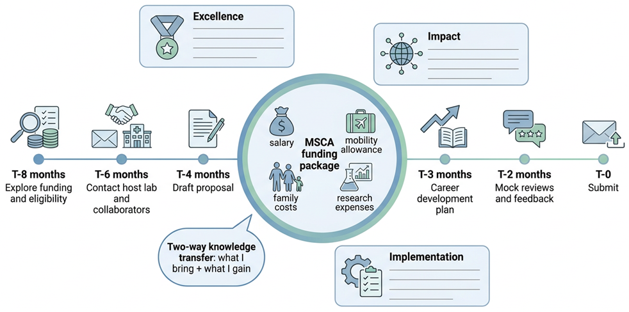
Figure 1. My MSCA application journey: from first idea to submitted proposal. Figure created by Figurelabs and edited by Canva
So, what does all of this really boil down to? Finding funding for research and travel is not about luck but it’s about giving yourself time, knowing where to look, and not taking rejection personally. Start early. Like, really early. Then figure out what kind of support you are looking for and search by category. When you write your proposal, keep it clear, skimmable, and written in the funder’s language. Think like them, budget honestly, and do not let a rejection stop you; let it teach you. Build a diverse funding portfolio. With a bit of preparation and the right mindset, you can find the support you need and keep moving your research and career forward.
References
Marie Skłodowska-Curie Actions (MSCA) — https://marie-sklodowska-curie-actions.ec.europa.eu/
Plantae — https://plantae.org/
ASPB Recognition Travel Award (RTA) — https://aspb.org/awards/recognition-travel-awards/
Botanical Society of America PLANTS program — https://botany.org/home/awards/plants-program.html
Ecological Society of America SEEDS program — https://www.esa.org/seeds/
Tansley Fund of the New Phytologist Trust — https://www.newphytologist.org/tansley-fund
International Association for Plant Taxonomy (IAPT) grants — https://www.iapt-taxon.org/grants/
Lindau Nobel Laureate Meetings — https://www.lindau-nobel.org/
Horizon Europe Dos and Don’ts for proposals — https://ec.europa.eu/info/funding-tenders/opportunities/docs/2021-2027/horizon/guidance/dos-and-donts-for-horizon-europe-proposals_en.pdf
Boehringer Ingelheim Fonds travel grants — https://bifonds.de/travel-grants/
______________________________________________
About the Author
Jahed Ahmed
Jahed is a Marie Curie Postdoctoral Fellow at the Laboratory of Membrane Biogenesis, CNRS/University of Bordeaux and a 2026 Plantae Fellow . His research focuses on deciphering the roles of reactive oxygen species and calcium signaling in plant-virus interactions, exploring how pathogens hijack host membrane nanodomains to facilitate infection.
