
Cellulose synthase complexes and remorins anchor the membrane to the cell wall under water stress
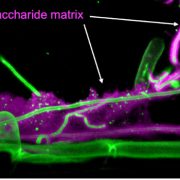
 Plant cells are under constant turgor pressure that pushes the plasma membrane tightly against the cell wall. Under severe water loss, cells shrink and membrane retracts without fully detaching from the wall. Narrow bands known as Hechtian strands remain tethered to the cell wall at membrane/wall contact sites. However, the identity and physiological role of these sites still remain poorly understood. Rui and colleagues used hyperosmotic stress to study them in Arabidopsis root epidermal cells, testing mutants deficient in cellulose or rhamnogalacturonan-I rhamnose. The two types of mutants had opposite phenotypes: cellulose-deficient mutants (cesa3, cesa6, and cob-1) showed severe plasmolysis, whereas rhamnose-deficient rhm1 mutants showed reduced plasmolysis. Proximity-labeling proteomics and live-cell imaging revealed rhm1 had elevated cellulose synthase complex (CSC) density at the plasma membrane and that CSCs accumulate at attachment sites under stress. Stress also triggered rapid nanodomain formation at attachment sites, and mutants lacking remorins (REMs), which are known markers of plasma membrane nanodomains, resisted plasmolysis and grew better. These mutants also carried more CSCs at the plasma membrane, pointing to REMs as negative regulators of attachment. Proximity labeling and FRET-FLIM identified the CSC exocytosis inhibitors SHOU4/4L as REM-associated proteins, and shou4;4l double mutants phenocopied rem mutants. Taken together, the authors showed that baseline CSC density, restrained by REM-SHOU4/4L module, sets wall-membrane attachment and root growth under hyperosmotic stress. (Summary by Aditi Bhat @jumpy_botanist) Cell 10.1016/j.cell.2026.05.009