

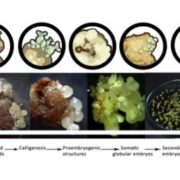
Regeneration of different genotypes of cocoa (Theobroma cacao L.) via somatic embryogenesis (Sci. Hortic.) ($)
Plant Science Research WeeklyThe global demand for cocoa (from Theobroma cacao) has been increasing, but production has not kept up with demand due to global climate change, pest and disease issues, and low productivity due to old cocoa trees. Currently, grafting and seeds (produced by cross-pollination) are used to propagate cocoa,…
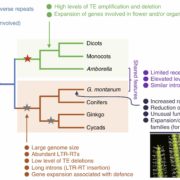
A genome for gnetophytes and early evolution of seed plants (Nature Plants)
Plant Science Research WeeklyFor decades, the Gnetophyte lineage has puzzled plant scientists in its correct phylogenetic placement. When taxonomists largely focused on morphological characteristics before the advent of molecular biology, it made sense to treat these apparently intermediate species as a transitional group between…
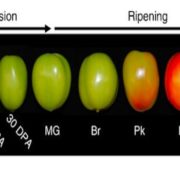
Transcriptome mapping of tomato fruit development and ripening (Nature Comms)
Plant Science Research WeeklyTomato (Solanum lycopersicum) is today the main model to study fleshy fruit development. Until now, most tomato growth and ripening studies are focused on a single tissue, the pericarp, and do not take into consideration the development of internal tissues. Shinozaki et al. provide an extensive spatiotemporal…

NEWS Germany vs Elsevier: universities win temporary journal access after refusing to pay fees (Nature)
Plant Science Research WeeklyDuring 2017, a consortium of 200 German research institutions was in conversations with the publishing group Elsevier to achieve a collective deal for full online access to Elsevier journals. This deal would have granted them access to about 2.500 journals for half the market price. After they could…

A toolkit for studying cellular reorganization during early Arabidopsis thaliana embryogenesis (Plant J.) ($)
Plant Science Research WeeklyEmbryogenesis is the simple process of plant development, but until recently our knowledge has been limited to how individual cells are specified and organized. Reported markers have been mostly constitutive promoter-driven, a fact that creates background and makes them unsuitable for the study of cellular…

ARF2 – ARF4 and ARF5 are essential for female and male gametophyte development in Arabidopsis (Plant Cell Physiol.)
Plant Science Research WeeklyAuxin is considered a master molecule for plant growth and development; in a whimsical way, IAA (Indole – 3 – Acetic Acid) has been defined as "Induce Almost Anything"! Auxin-mediated gene expression is regulated by Auxin Responsive Factor (ARFs). The model plant Arabidopsis thaliana contains 23…

Chloroplast signaling gates thermotolerance in Arabidopsis (Cell Reports)
Plant Science Research WeeklyPlants are able to sense and respond to temperature changes in their environment. However, the mechanism by which high temperature is sensed and then relayed to affect the expression of heat shock transcription factors (HSFs) is unclear. Dickinson et al. demonstrated that Arabidopsis plants show…
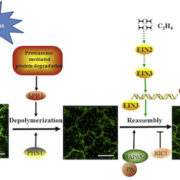
Microtubule reassembly mediated by ethylene in response to salt stress (Plant Physiol.)
Plant Science Research WeeklyIt has been shown previously that cortical microtubule reorganization contributes to adaptation to salt stress; however, the upstream factors that signal this response are not know. Ethylene has been shown to regulate microtubule stability and organization in roots and etiolated hypocotyls. Ethylene…
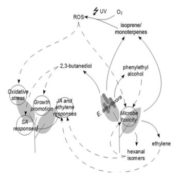
Biological relevance of VOCs emitted during the pathogenic interactions (Mol. Plant Pathol.)
Plant Science Research WeeklyIt is well known that upon pathogenic infections, plants defend themselves by emission of volatile organic compounds (VOCs) as one of the defence strategies. This work by Cellini et al. aims to understand the biological relevance of these organic volatiles in the fire blight disease of apple caused by…