

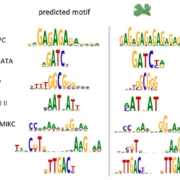
Many plant transcription factor families have evolutionarily conserved binding motifs
Plant Science Research WeeklyThe regulated expression of genes is fundamental to all biological processes, including development, cell growth, and responses to environmental signals. Transcription factors (TFs) are sequence-specific DNA-binding proteins that play a central role in transcriptional regulation by directly interacting…
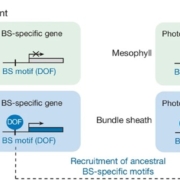
Changes in regulatory regions shape C3 to C4 evolution
Plant Science Research WeeklyIn most land plants, carbon fixation into a three-carbon compound by the enzyme Rubisco takes place in the leaf mesophyll cells; these are called C3 plants. However, a different and more efficient pathway has evolved independently many times, in which a four-carbon metabolite is first produced in the…
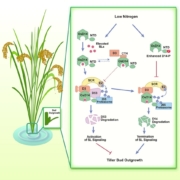
Regulatory mechanisms of strigolactone perception in rice
Plant Science Research WeeklyStrigolactones (SLs), a group of carotenoid-derived small signaling molecules and a class of phytohormones, play key roles in regulating various growth and developmental processes in plants. Additionally, they act as rhizosphere signaling molecules that promote symbiosis with arbuscular mycorrhizal (AM)…
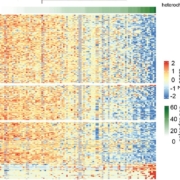
Epigenetic clocks in plants: uncovering DNA methylation decay in aging
Plant Science Research WeeklyWhat if plants could teach us about aging? Understanding how and why living organisms age is a fundamental question in biology and medicine. While most research focuses on humans, the model plant Arabidopsis thaliana offers unique insights into how organisms age. In a recent study, Dai et al. analyzed…
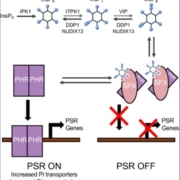
Disrupting plant inositol pyrophosphates to mitigate P pollution
Plant Science Research WeeklyInositol pyrophosphates (PP-InsP) are plant signaling molecules that regulate phosphate homeostasis and related metabolic processes. But a global phosphate crisis, due to resource depletion and environmental pollution from excess phosphate, has raised the need for phosphate management. Freed et al. investigated…
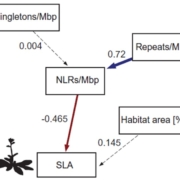
A trade-off between investment in molecular defense repertoires and growth in plants
Plant Science Research WeeklyThe reduction in crop yields caused by pathogens and pests poses a significant challenge to global food security. Genetic engineering, aimed at strengthening plant defense mechanisms, offers a cost-effective solution for disease control. However, this approach often comes with a growth penalty, commonly…
Plant Science Research Weekly: December 6, 2024
WWR Full PostReview: Bringing purple tomatoes to market
This interesting article by Cathie Martin and Eugenio Butelli describes the process through which purple, anthocyanin-accumulating tomatoes were brought to the US market, from idea to business plan to regulatory status review and finally direct-to-consumer…

Plant Physiology Spotlights September 2024 First Authors
Blog, Community, Plant Physiology: Author ProfilesBehind the Plant Physiology manuscripts are researchers, professors, professionals and students dedicated to advancing the field of plant science. You’ve seen our First Authors on Facebook and Twitter — now, read more about why they chose to pursue plant sciences and click on the links below to read…

The Plant Cell Features September First Authors
Blog, Community, The Plant Cell: Author ProfilesBehind the manuscripts are researchers, professors, professionals and students dedicated to advancing the field of plant science. You’ve seen our First Authors on Twitter and Facebook— now, read more about why they chose to pursue plant sciences and click on the links to read their articles.
Jinrui…