

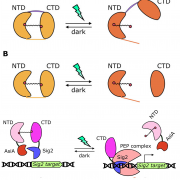
A synthetic switch based on orange carotenoid protein to control blue-green light responses in chloroplasts (Plant Physiol)
Plant Science Research WeeklySynthetic biology aims to engineer and redesign components of natural organisms for useful purposes. One of the most prolific areas of synthetic biology is based on the engineering of photoreactive proteins with signaling potential, such as photoreceptors. Natural photoreceptors consist of a prosthetic…
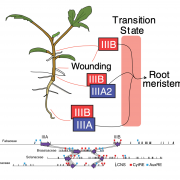
A conserved superlocus regulates above- and belowground root initiation (Science)
Plant Science Research WeeklyThe vascular plant body composed of root and shoot is specified during embryogenesis, but most flowering plants can also develop additional root systems post-embryonically: lateral roots, as a response to wounding, or shoot-borne roots (“adventitious” roots, literally meaning “in the wrong place”).…
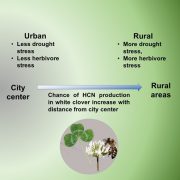
The urban environment led to unintended adaptive evolution in plants (Science)
Plant Science Research WeeklyGenerally, evolution is driven by natural selection, but not always. Human activities lead to the creation of unique niches, and other organisms must adapt accordingly. Cities are unique niches that are significantly different from rural areas and natural conditions. The urban habitat provides plants…
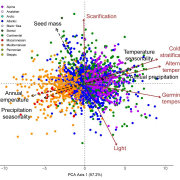
Climate shapes the seed germination niche of temperate flowering plants: a meta-analysis of European seed conservation data (Ann. Bot.)
Plant Science Research WeeklyThe seed germination niche is the set of environmental conditions in which a seed can germinate. This collection of requirements is expected to be tuned to the climate each species encounters in its natural habitat, but this hypothesis remains to be formally tested. Here, Carta and colleagues make use…
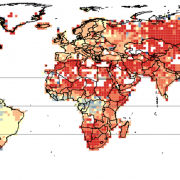
Seed dormancy in space and time: global distribution, paleo- and present climatic drivers and evolutionary adaptations ($) (New Phytol.)
Plant Science Research WeeklySeed dormancy is widely recognized as a key mechanism to ensure that germination takes place under the most suitable conditions. Such is its importance that multiple studies have described the morphological, physiological, and genetic mechanisms behind it, yet its global distribution and the past and…
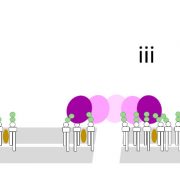
An oomycete peptide cytolysin forms transient small pores in lipid membranes (Sci. Adv.)
Plant Science Research WeeklyNLPs (Necrosis and ethylene-inducing peptide 1–like proteins) are small peptides produced by a variety of plant pathogens. Some NLPs are cytolysins meaning that they trigger lysis of their target cells. Here, Pirc et al. use an assortment of tools including molecular dynamics (MD) simulations, neutron…

Live Plant Cell Tracking: A Fiji plugin to analyze cell proliferation dynamics and understand morphogenesis (Plant Physiol.)
Plant Science Research Weekly
Live Plant Cell Tracking: A Fiji plugin to analyze cell proliferation dynamics and understand morphogenesis
Morphogenesis in plants occurs in 3D space over time, referred to as 4D. Recent advances in high-resolution microscopy imaging and computational pipelines have helped to better understand…
Plant Science Research Weekly: April 1, 2022
WWR Full PostChloroplast protein import determines plant proteostasis and retrograde signaling
The neurological condition Huntington’s disease is caused by mutated versions of the Huntingtin gene that encode expanded stretches of polyglutamine repeats, resulting in protein aggregation. However, despite the widespread…

Takashi Akagi: The Plant Cell First Author
The Plant Cell: Author Profiles
Takashi Akagi, co-first author of "Genome-wide cis-decoding for expression design in tomato using cistrome data and explainable deep learning"
Current Position: Research Professor, Grad Sch Environ Life Sci, Okayama University, Japan
Education: B.S., M.S. and PhD in agricultural biology, Kyoto…