
Can plants adapt quickly enough to keep up with climate change?
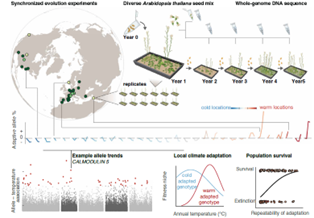 In a new article by Wu et al., a large team of collaborators led by the Moi lab addressed this question by doing a huge outdoor evolution experiment at 30 places with different climates. The authors achieved real-time adaptation under natural conditions by sowing a mixture of 231 Arabidopsis thaliana accessions and tracking genomic changes over five years. Long-term evolution experiments, like those led by Richard Lenski, have given us important information about microbes. However, it has been very hard to do similar studies on multicellular organisms in real-world settings. This study addresses partially that gap, demonstrating rapid and repeatable allele frequency shifts that point to natural selection rather than genetic drift. Evolutionary trajectories were similar under comparable climatic conditions, but differed in very distinct climates, showing how local adaptation works. Accessions from matching climates became more common, with temperature being a major factor in selection. However, an ‘adaptation lag’ suggests that populations may not yet be prepared for current conditions. Although populations adapted rapidly, this was often insufficient to prevent extinction in the warmest environments. This highlights eco-evolutionary tipping points at which natural selection is stronger than the capacity for adaptation. This study demonstrates that although plants can evolve rapidly, their ability to adapt is clearly limited in the context of climate change. (Summary by Adrian Gonzalez Ortega‑Villaizan @adrigov98 @adrigov.bsky.social) Science 10.1126/science.adz0777.