
A new shade of photosynthesis: The missing chlorophyll f found in action
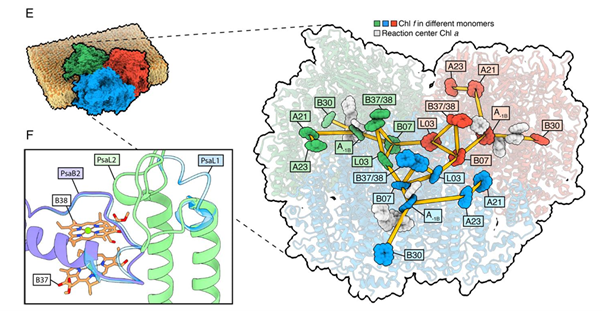 Photosynthetic organisms were long believed to only use visible light for energy capture, until the discovery of far-red photosynthesis challenged this view. Far-red photosynthesis is thought to be enabled by the presence of the pigment chlorophyll f. Although previous studies have identified chlorophyll f within Photosystem I of cyanobacteria, its precise photochemical function has remained unclear. Consoli et al. now provide a structural breakthrough by resolving two high-resolution (1.89 Å and 2.01 Å) cryo-electron microscopy structures of far-red Photosystem I from Chroococcidiopsis thermalis PCC 7203. Using a refined statistical approach to analyze electrostatic potential maps, the authors conclusively locate all eight chlorophyll f molecules and, crucially, identify one as the redox-active pigment at the A–1B site, a key electron donor in Photosystem I. These analyses show that the experimental spectra can only be explained if chlorophyll f participates directly in charge separation. This finding overturns previous assumptions that chlorophyll f acts solely as an antenna pigment in Photosystem I. Functionally, the presence of chlorophyll f at A–1B allows Photosystem I to perform photochemistry with lower-energy far-red photons, effectively redefining the lower energy limit of oxygenic photosynthesis. This work fills a long-standing structural gap in our understanding of far-red photosynthesis and opens potentially new avenues for engineering crops effective in harvesting light of lower energy. (Summary by Katarina Kurtović, @katarinakurtovic.bsky.social) Science 10.1126/science.ado6830