

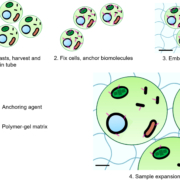
Cells are larger than life when ExPOSEd
Plant Science Research WeeklyCells are as small as life gets, but can be much larger than they appear if given room for expansion. This is possible with expansion microscopy, a technique that enables three dimensional cell imaging by physically expanding cellular components for visualization. Although expansion microscopy has been…

Expanding the resolution limits of conventional microscopy in whole plant tissues
Plant Science Research WeeklyHow can we precisely image plant tissues in super-resolution when approaching the optical limits of conventional microscopes? One solution lies in expansion microscopy, a technique that embeds tissue samples in an expandable hydrogel that proportionally increases the distances between structures, allowing…
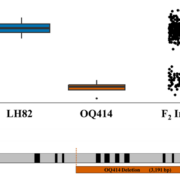
CA-nundrum: How a spontaneous mutation in carbonic anhydrase uncouples leaf δ13C, WUE and C4 photosynthesis
Plant Science Research WeeklyWith climate change, drought is expected to happen more frequently, making supplemental irrigation increasingly necessary to sustain crop productivity. One target trait to improve climate resilience is water use efficiency (WUE), defined by the ratio of carbon assimilation to water used by the plant.…
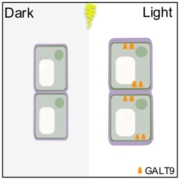
Lights, camera, pectin: Bringing hypocotyl elongation out of the dark
Plant Science Research WeeklyLight is a powerful signal, shaping plant development and growth. However, the cellular mechanisms that translate light signals into precise developmental responses are still being unravelled. The Arabidopsis hypocotyl (the embryonic stem, situated underneath the cotyledons in seedlings) rapidly restricts…
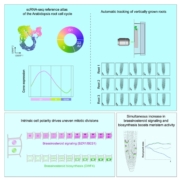
Brassinosteroids positively regulate growth through asymmetrical division
Plant Science Research WeeklyBrassinosteroids are plant hormones that play important roles in cell proliferation and expansion, but it is still unclear exactly what those roles are. Vukasinovic and colleagues show, in Arabidopsis thaliana root cells, that instrinsic brassinosteroid gradients signal anticlinal division. Single-cell…
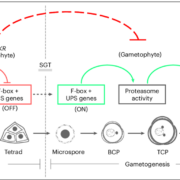
SHUKR in the sporophytic tissue directs male gametophyte development in Arabidopsis
Plant Science Research WeeklyIn flowering plants, reproduction involves the alternation of two generations: the diploid sporophyte and the haploid gametophyte. Traditionally, the male gametophyte was thought to develop autonomously with minimal regulation by the sporophyte. However, recent research by Sivakumar, Pandey, and Ramesha…

Classic regulators, new functions: FT and TFL1 shape Arabidopsis seed traits
Plant Science Research WeeklyFLOWERING LOCUS T (FT) and TERMINAL FLOWER1 (TFL1), two members of the phosphatidylethanolamine-binding protein (PEBP) family, are well-known regulators of flowering time and inflorescence architecture in Arabidopsis thaliana. However, recent work by Bigas et al. uncovers their additional roles in regulating…
Plant Science Research Weekly: April 11, 2025
WWR Full PostReview: Celebrating 150 years of Arabidopsis genetics
The first known report of an Arabidopsis thaliana mutant appeared approximately 150 years ago (1873). In the intervening years, Arabidopsis has become an essential model for plant genetic research, driving groundbreaking discoveries across multiple…

Integrating Multidisciplinary Approaches in Plant Science Research
Blog, CommunityAs global challenges such as climate change, population growth, and food security intensify, it is increasingly evident that traditional, isolated approaches to plant science research are insufficient to address these complex, interconnected issues. The intricate nature of plant systems and the scale…